
Lace bug
Gargaphia iridescens
Description
How to identify
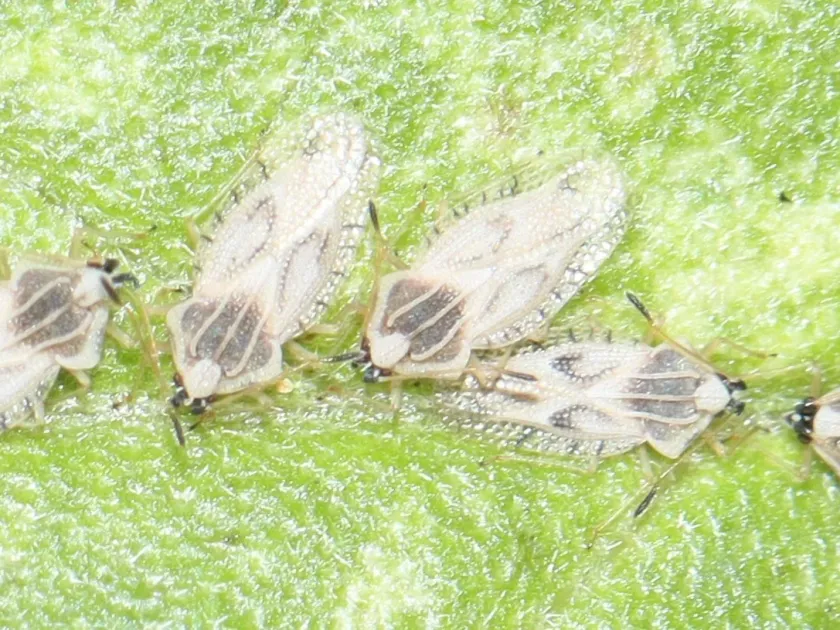
The lace bug (scientific name: Gargaphia iridescens) is a small insect belonging to the order Hemiptera and the family Tingidae. These insects are easily recognized by their unique, lace-like appearance of the wings and pronotum, which feature a fine, reticulated network of veins.
Adults are typically flat and measure between 3 to 5 millimeters in length. Their coloration often ranges from brownish to gray, frequently with a subtle iridescent or metallic sheen. This specialized coloration provides them with excellent camouflage against the foliage they inhabit.
Nymphs of the lace bug go through several developmental stages (instars) and look significantly different from adults. They are wingless and often covered with small spines or hair-like structures, which serve as a defense mechanism against predators.
Lace bugs are characterized by a hemimetabolous life cycle, meaning they have no pupal stage. This allows them to reproduce relatively quickly, with several generations often occurring during a single growing season, leading to rapid population growth in favorable climates.
Due to their small size and stationary nature while feeding, these insects are often overlooked until significant damage occurs. Their ability to remain hidden on the undersides of leaves makes them a persistent challenge for both commercial farmers and home gardeners.
What it damages
Lace bugs are primarily known as pests of various leguminous crops, with soybeans being a major host. They feed by inserting their needle-like mouthparts into the plant tissue to suck out cell sap, which is essential for the plant's metabolic processes.
Beyond legumes, these bugs can infest a wide range of herbaceous plants and certain ornamental shrubs. Their feeding activity effectively disrupts the photosynthetic capacity of the host plant, as the targeted cells lose their vital chlorophyll content.
High populations of lace bugs can lead to severe stress for the plant. The loss of sap results in stunting, reduced growth rates, and a significant decrease in the final yield of the crop, making them an economically damaging pest in soybean production.
The feeding sites serve as entry points for various pathogens, including fungi and viruses. Consequently, the damage is not just direct nutrient loss but also an increased susceptibility to secondary plant diseases that can further cripple the health of the host.
In cases of severe infestation, the cumulative effect of thousands of individual feeding points causes the foliage to wither and drop prematurely. This premature senescence hinders the plant's ability to produce healthy seeds or fruits, leading to further quality losses.
When it appears
The activity of the lace bug is heavily dependent on weather conditions. Adults typically emerge from hibernation sites in the spring as temperatures rise, moving to young, succulent plant tissues to begin feeding and laying eggs.
The peak activity and damage usually coincide with the warmest months of the year, particularly mid-summer. During hot and dry spells, the developmental cycle accelerates, leading to overlapping generations and a sharp increase in the bug population.
As autumn arrives and temperatures drop, adults seek protected microhabitats for overwintering. These sites commonly include leaf litter, dense mulch, crevices in bark, or debris at the base of plants, where they can survive the cold winter months.
The number of generations per year varies depending on the regional climate. In warmer climates, it is not uncommon for the lace bug to complete three or more generations within a single season, sustaining the pest pressure for several months.
Farmers should monitor their fields starting from the early vegetative stage. Early detection is crucial, as the population grows exponentially if left unchecked, making later control measures less effective and more difficult to implement.
Signs of infestation
The most visible sign of a lace bug infestation is the appearance of light-colored, mottled spots on the upper side of the leaves. These spots, often referred to as stippling, represent the individual points where the insect has pierced the leaf surface.
As feeding continues, these spots merge, causing the leaf to turn pale yellow or greyish-white. In severe cases, the entire leaf may take on a bleached appearance and eventually turn necrotic, brittle, and brown before falling off the plant.
Upon inspecting the underside of the leaf, one can usually find colonies of nymphs and adults. In addition to the insects themselves, the presence of dark, sticky fecal spots is a diagnostic characteristic that confirms the presence of lace bugs.
The presence of sooty mold is another common secondary sign. Because lace bugs cause plants to lose sap and may be associated with other sap-sucking insects, the surface of the leaves can become sticky, promoting the growth of black, powdery fungal mold.
A general lack of vigor in the crop, slow development, and premature wilting are clear indicators that the plant is struggling. When these symptoms are present in patches across a field, it is highly likely that a lace bug colony is active.
Control measures
Managing lace bugs effectively requires an integrated approach. Cultural controls, such as the removal and destruction of crop residues after harvest, are vital because they eliminate the overwintering sites for the adult bugs.
Crop rotation and maintaining good field hygiene can disrupt the life cycle of the pest. By moving host crops to different locations and keeping surrounding areas free of wild leguminous weeds, the potential for local outbreaks is significantly reduced.
For chemical management, systemic insecticides are often the most effective, as they are absorbed into the plant tissue, providing protection against these sap-sucking pests. It is essential to ensure thorough coverage, especially targeting the undersides of the leaves.
- Apply insecticides during the cool parts of the day to avoid leaf phytotoxicity.
- Rotate chemical classes to prevent the development of insecticide resistance.
- Use biological controls, such as promoting natural predators like lacewings or spiders, whenever possible.
Regular field scouting is the best tool for control. By identifying early infestations before they spread across the entire plot, farmers can limit the need for widespread chemical applications and minimize the overall impact on the environment.
Taxonomy
- Latin name
- Gargaphia iridescens
- Order
- Hemiptera (bugs, aphids, leafhoppers)
- Family
- Tingidae
- EPPO code
- GARGIR
Discussion
No discussions yet — be the first.