
Grey junglefowl
Gallus sonneratii
Description
How to identify
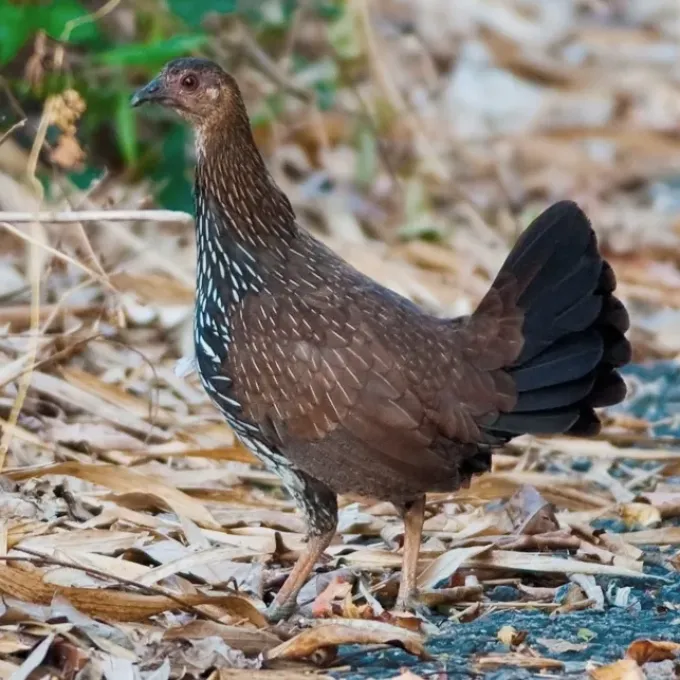
The Grey junglefowl (Gallus sonneratii) is a member of the Phasianidae family within the Galliformes order. These birds are medium-sized and possess a greyish plumage that serves as excellent camouflage within dense undergrowth and forest fringes.
A distinctive feature of this species is the unique yellow-grey wax-like spots found at the tips of the neck feathers. This biological characteristic helps distinguish them from other junglefowl species found in similar habitats.
They are notoriously secretive and cautious, often hiding in thick vegetation during the day and emerging to feed at the edges of agricultural fields, making them difficult to monitor.
The vocalizations of the males are loud and diagnostic, serving as a primary indicator for agronomists and farmers of their presence in the vicinity of crop lands.
They are highly territorial and adapted to foraging in diverse environments, which allows them to thrive in human-modified landscapes near rural agricultural plots.
What it damages
Grey junglefowl primarily damage crops by consuming seeds and seedlings of various cereals, such as wheat, millet, and rice, which can lead to sparse crop stands if not managed.
They cause mechanical damage to vegetable crops by vigorously scratching the soil surface in search of food, which exposes roots and leaves young plants vulnerable to desiccation.
The birds also consume fruits and berries, often damaging orchards and berry farms by picking at ripening produce, which directly reduces the marketability and yield of the harvest.
Trampling is another significant issue; as the birds forage in groups, they often trample rows of crops, creating paths that eventually allow weeds to encroach on the field.
Their habit of feeding during the grain-filling stage can cause noticeable yield losses on smallholder farms located near the jungle borders, significantly impacting local food security.
Signs of infestation
The most reliable sign of their presence is the appearance of distinct three-toed footprints in the soil, which are deeper than those of standard poultry, alongside localized patches of disturbed, scratched earth.
Scattered feathers around field edges during molting periods confirm that the birds frequent the area, serving as a clear warning sign for farmers to implement protection measures.
Damaged crops often exhibit jagged edges, as the birds tear at the plant tissue with their beaks to access the seeds or soft fruits, leaving recognizable debris behind.
Observation during dawn and dusk hours often reveals small groups of these birds foraging along the border between forests and cultivation zones.
Droppings left in characteristic areas near crop rows are further evidence of consistent activity, highlighting which sections of the field are most at risk of damage.
Control measures
Acoustic deterrents that broadcast distress calls or predator sounds are highly effective in scaring these cautious birds away from large-scale crop areas without harming them.
Visual deterrents, including reflective tape, predator decoys (e.g., owl or hawk figures), and spinning wind-activated devices, help to keep the birds wary and away from the crops.
For high-value plots, installing protective netting is the most reliable method to ensure that Grey junglefowl cannot gain physical access to the developing plants or fruits.
Agronomic practices, such as ensuring seeds are buried deep enough and maintaining clear field edges by mowing nearby tall grass, reduce the natural cover and attractiveness of the site.
- Utilizing seed coatings with avian-repellent properties to prevent digging.
- Scheduling field inspections during early morning hours to detect activity early.
- Encouraging the presence of natural raptor predators in the surrounding area.
Taxonomy
- Latin name
- Gallus sonneratii
- Family
- Phasianidae
- EPPO code
- GALUSO
Discussion
No discussions yet — be the first.