
Sri Lanka junglefowl
Gallus lafayettii
Description
How to identify
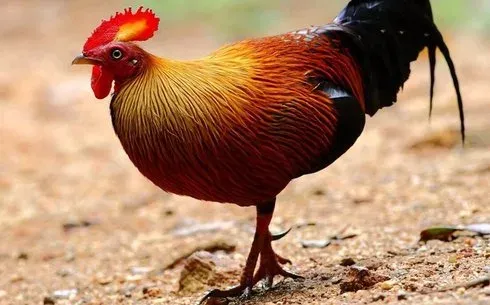
The Sri Lanka junglefowl is an endemic bird species found on the island of Sri Lanka. Physically, it resembles domestic poultry but possesses more vibrant, distinctive plumage and behaviors characteristic of wild species.
Males of this species are significantly larger than females and are distinguished by a bright red comb with a prominent yellow center. This specific color combination serves as a primary visual indicator for identifying individuals in their natural habitat.
The species is classified within the order Galliformes, family Phasianidae. These birds lead a predominantly terrestrial life, preferring dense thickets and forest margins that border agricultural landscapes.
In the wild, populations are distributed unevenly, yet during grain ripening periods, they tend to concentrate in open fields. This makes them a critical subject of observation for farmers engaged in large-scale crop production.
Studies of their biology indicate that while the birds are generally cautious, high population density can lead them to become less skittish, occasionally approaching residential areas and gardens in search of easily accessible food sources.
What it damages
The primary damage caused by the Sri Lanka junglefowl occurs when they encroach upon agricultural fields during the ripening phase of grain crops. The birds feed on cereal grains, causing direct harvest losses and significant crop damage.
A particular threat is the consumption of germinating seeds, which significantly reduces seedling density during the initial stages of vegetation. Farmers frequently encounter patches of bare ground caused by the birds' active foraging.
Beyond cereal crops, these junglefowl can damage vegetable plantations by pecking at fruits and destroying young shoots of various agricultural plants. Their flexible diet allows them to adapt easily to cultivated crop varieties.
Trampling of crops in foraging areas is an additional negative factor. Gatherings of birds can lead to broken stalks and soil compaction, which negatively impacts the development of plants within their range.
Economic damage escalates during dry seasons, when the birds' natural forest food supply diminishes, forcing them to seek alternative nutrition in farm fields, thus positioning them as serious competitors in agricultural production.
When it appears
Bird activity in agricultural areas is directly correlated with crop development phases. The most critical periods coincide with sowing time, when seeds are shallow, and during the full grain maturation stage.
During drought periods, when natural food sources become scarce, birds migrate more frequently toward human settlements. This results in an increased frequency of field incursions in search of moisture-rich food.
The breeding season also influences bird behavior; during the chick-rearing period, the demand for accessible, high-calorie food increases, intensifying the pressure on nearby agroecosystems.
Farmers should anticipate heightened activity during the early morning hours and before sunset, when the birds are most eager to leave their cover. This is when the most intense damage to crops typically occurs.
Monitoring bird population numbers during the harvest maturation period allows for the implementation of timely deterrence measures, which significantly minimizes the risk of losing a substantial portion of production.
Signs of infestation
The primary sign of bird presence in a field is the existence of specific tracks in loose soil, clearly identifiable as pheasant-family footprints. As crops grow, these are complemented by characteristic plant damage.
One clear indicator of infestation (visitation) is pecked grains in ears or completely uprooted seedlings. Patches of thinning or bare spots on fields that are not linked to pests or diseases are common observations.
The presence of feathers in foraging areas and the characteristic noise birds make when flushing from thickets serve as indirect evidence of their active presence within agricultural land.
Damage to vegetable crops typically presents as deep dents or clean, punctured holes from the bird's beak, which often leads to rapid decay of the damaged plant material.
Bird presence is frequently accompanied by droppings along the field edges and near plantings, which is a clear indicator that the birds regularly use the site as a foraging base over an extended period.
Control measures
To protect crops from the Sri Lanka junglefowl, visual deterrent methods such as reflective elements or scarecrows mimicking predators are used, proving effective during the early stages of crop growth.
The use of acoustic systems that play alarm calls or predator sounds creates a zone of discomfort for the junglefowl, forcing them to vacate the vicinity of agricultural fields.
Mechanical protection, such as covering vulnerable plantings with special protective netting, remains the most reliable, albeit labor-intensive, method to prevent bird access to high-value areas.
Timely harvesting as soon as the crop reaches maturity shortens the time birds can spend in fields, removing their primary incentive and minimizing losses associated with leaving grain to dry on the stalk.
- Installation of ultrasonic deterrents in the planting zone.
- Regular site monitoring and patrolling by farm workers.
- Implementation of crop rotation to reduce field attractiveness.
- Creation of buffer strips using non-palatable crop varieties.
Taxonomy
- Latin name
- Gallus lafayettii
- Family
- Phasianidae
- EPPO code
- GALULA
Discussion
No discussions yet — be the first.