
Red junglefowl
Gallus gallus
Description
How to identify
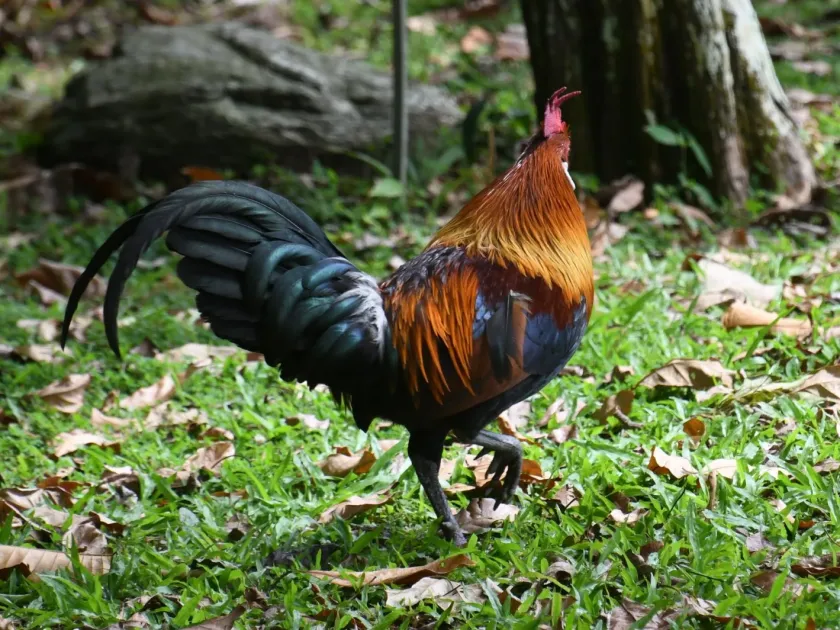
The red junglefowl (Gallus gallus) is a tropical member of the family Phasianidae and is the primary wild ancestor of the domestic chicken.
Males are characterized by vibrant plumage, a long tail, and a prominent red comb, whereas females are more cryptic, with earthy brown tones to blend in with foliage.
Classified under the order Galliformes, these birds are naturally adapted to forest edges and thickets, which brings them into direct contact with farmland.
The average body length ranges from 40 to 70 centimeters, and they possess strong, sturdy legs designed for scratching the earth to uncover hidden food sources.
Despite their wary nature, they can quickly adapt to anthropogenic environments if the agricultural area provides an easy and reliable food source.
What it damages
These birds cause damage primarily by scratching the soil surface, which exposes and destroys the root systems of newly emerged plant seedlings.
They consume seeds and grains directly from the soil, causing significant losses during the initial planting stages of various cereal and vegetable crops.
Young plants are frequently trampled by foraging groups, leading to patchy crop stands and the necessity for costly replanting operations.
During the maturation phase, the red junglefowl can inflict damage on fruits, berries, and maize, often destroying the quality of the produce.
Their feeding habits also contribute to the spread of unwanted weeds, as they inadvertently transport seeds on their feet and through their droppings across the field.
When it appears
The peak period of damage occurs during the spring sowing season when seeds and sprouts provide high-energy nutrients for the birds.
As summer progresses, the focus shifts to ripening crops, as the birds seek out moisture-rich plant parts during periods of natural drought.
Feeding activity is most concentrated in the early morning and late evening, marking the times when management interventions are most critical.
Seasonal patterns are influenced by the abundance of natural forest food, meaning that in years of food scarcity, bird pressure on farms increases significantly.
Autumn brings renewed interest in fields as the birds scavenge for post-harvest leftovers, potentially damaging soil structure if the ground is left bare.
Signs of infestation
Frequent small depressions and "dug-out" soil patches scattered across the field are the most obvious indicators of their foraging presence.
Shredded plant leaves and stems, accompanied by visible pecking marks, are characteristic signs of damage inflicted by adult birds.
Droppings left in the field are easily identifiable and often contain partially digested seeds or insect remains from their varied diet.
The presence of shed feathers near the field perimeter often indicates a nearby roosting site where the birds gather when not foraging.
Reduced plant density in specific patches, contrasting with untouched sections, reveals the path and intensity of the flock's movement through the crop area.
Control measures
Acoustic deterrents that broadcast distress calls or predator sounds can effectively discourage the birds from settling in the immediate area.
Physical barriers like netting or wire fencing around small, high-value vegetable plots remain the most reliable method for total protection.
The use of moving visual deterrents, such as shiny strips or reflective mirrors, creates an environment that the wary birds find threatening.
Seed treatments with repellent chemical or organic coatings can discourage birds from consuming seeds immediately after they are placed in the furrow.
Managing the vegetation along field borders by clearing unnecessary brush reduces safe nesting spots and makes the agricultural area less attractive to the flock.
Taxonomy
- Latin name
- Gallus gallus
- Family
- Phasianidae
- EPPO code
- GALUBA
Discussion
No discussions yet — be the first.