
Striped killifish
Fundulus majalis
Description
How to identify
The striped killifish (Fundulus majalis) is a small fish species belonging to the family Fundulidae, order Cyprinodontiformes. It is widely known for its ability to thrive in coastal and brackish water environments.
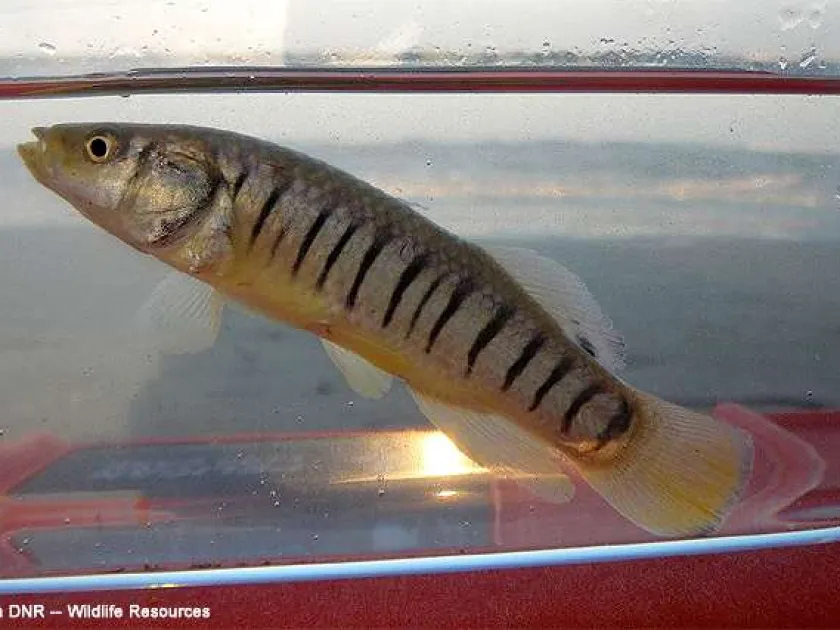
The species exhibits sexual dimorphism, with males often displaying vertical stripes, while females might show horizontal stripes or spots. This makes identification possible during the breeding season when colors are brightest.
They possess an elongated, robust body shape, typically measuring between 10 and 15 centimeters. Their anatomy is highly adapted for maneuvering through shallow waters and marshy habitats.
The striped killifish is known for its extreme environmental plasticity. It can tolerate a wide range of salinities and temperature fluctuations, allowing it to easily colonize artificial irrigation canals.
Due to their high adaptability, they can become a dominant species in stagnant or slow-moving water bodies associated with agricultural landscapes.
What it damages
The striped killifish can become a nuisance in agricultural settings, particularly in rice paddies and connected irrigation networks. Their foraging behavior can cause physical damage to young roots and shoots.
As opportunistic feeders, they consume small aquatic organisms and larvae, which disrupts the natural food web. This can negatively impact aquaculture operations integrated with farming systems.
By rooting through the substrate in search of food, they destabilize the soil around the base of crops. This displacement of sediment can lead to root exposure and stunted development of young plants.
High population densities lead to increased turbidity in water, which can interfere with the light penetration needed by aquatic plants or algae, indirectly affecting the water quality for irrigation purposes.
Their presence can lead to localized depletion of essential nutrients in the water, which affects the health and growth rates of sensitive agricultural crops irrigated by such water sources.
When it appears
The activity of the striped killifish peaks during the warmer months, generally from late spring through summer. This period correlates with their spawning cycle and rapid growth of juvenile fish.
During the growing season of crops, the fish are most active in the shallow irrigation ditches. This creates a direct overlap between the peak activity of the fish and the vulnerability period of the plants.
As water temperatures drop in the autumn, the striped killifish reduces its metabolic rate and retreats to deeper, more stable water areas, significantly lowering its impact on agricultural fields.
In winter, they enter a period of reduced activity and often burrow into the substrate to survive cold spells. Agricultural maintenance in irrigation systems is most effective during this dormant period.
Water management strategies, such as periodic drawdown of irrigation systems, must account for the fish's life cycle to effectively control their numbers throughout the year.
Control measures
Preventative measures primarily involve the installation of physical barriers like mesh screens at water intake points to prevent the entry of killifish into irrigation networks.
Vegetation management in canals is crucial, as dense aquatic plants provide shelter and spawning grounds. Regular mechanical cleaning of these channels helps to discourage colonization by the fish.
Biological control involves supporting local populations of predators such as herons, egrets, and predatory fish, which naturally keep the killifish population in check.
If the infestation is severe, managed drying or draining of specific irrigation canals during the off-season can effectively eliminate the local population by removing their habitat.
- Installation of exclusion screens.
- Mechanical vegetation control.
- Encouraging natural predators.
- Periodic system draining.
Taxonomy
- Latin name
- Fundulus majalis
- Family
- Cyprinodontidae
- EPPO code
- FUNUMA
Discussion
No discussions yet — be the first.