
Aphanius fasciatus
Aphanius fasciatus
Description
How to identify
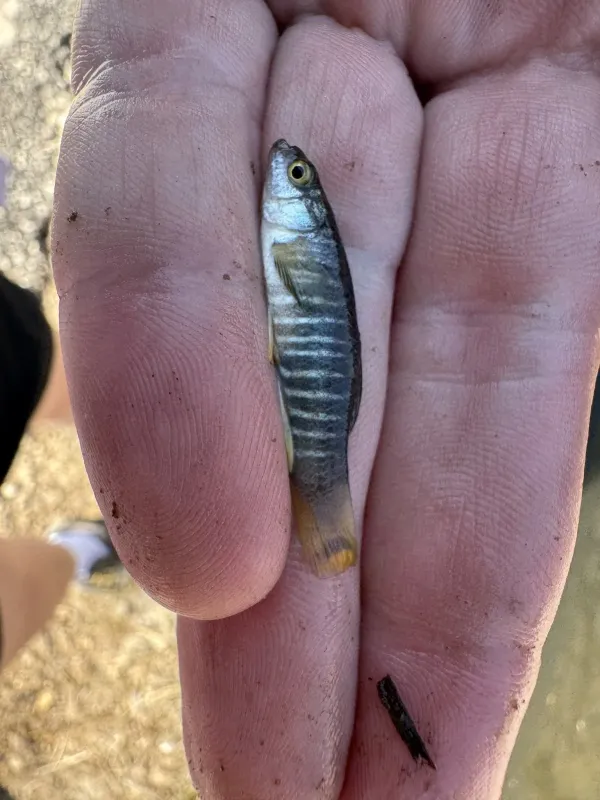
The South European toothcarp (Aphanius fasciatus) is a small fish belonging to the Cyprinodontidae family, typically reaching only 5-6 cm in length.
The species exhibits sexual dimorphism, where males are easily identifiable by the dark vertical bands along their bodies, while females are paler with spotted patterns.
These fish possess an extremely high tolerance to salinity and temperature variations, which allows them to thrive in harsh environments, including irrigation ditches.
They are classified within the Cyprinodontiformes order, well-adapted to Mediterranean shallow waters and brackish environments.
Their compact size and hardy nature make them a significant species in pond ecology, where they often interact with other aquatic organisms.
What it damages
While not a traditional crop pest, Aphanius fasciatus can pose challenges in aquaculture by competing for vital resources.
They are known to consume significant amounts of zooplankton, which is essential for the healthy development of young commercially valuable fish.
In closed irrigation systems, a surge in the population density of these fish can disrupt the natural biological balance of the pond ecosystem.
This competition for food often leads to reduced growth rates in fish stock, affecting the overall economic efficiency of the farm.
Furthermore, their presence in high densities can facilitate the transmission of parasites that might compromise the health of other fish stocks.
When it appears
As a thermophilic species, the activity of the South European toothcarp is heavily influenced by the seasonal water temperature cycle.
Spring marks the beginning of their reproductive period, during which they actively colonize shallow areas and irrigation channels.
Summer provides the peak conditions for their growth and reproduction, leading to the highest density of fish observed in the water systems.
During autumn and winter, the fish reduce their metabolism and retreat to deeper parts of the water bodies to survive the colder temperatures.
Monitoring these seasonal movements is crucial for farmers to time their maintenance and control operations effectively.
Signs of infestation
The most reliable way to identify their presence is by observing shallow areas during the warmer months when the fish aggregate.
Visual identification of the characteristic dark bands on males is a definitive sign that the species has established itself in the location.
Sampling via fine-mesh nets in irrigation zones typically yields individuals, confirming the presence of the population.
A decrease in natural food availability, such as plankton, in stocked ponds may indicate an overgrowth of this competitive species.
Changes in the behavior or development of commercial fry are often observed once the toothcarp population reaches critical thresholds.
Control measures
Management of this species in aquaculture primarily involves physical exclusion and environmental control strategies.
Installing fine-mesh barriers at water inlets is the most effective way to prevent the intrusion of these fish into managed ponds.
- Regular draining and cleaning of pond beds to remove eggs and larvae.
- Introduction of natural predators that target small fish species for control.
- Maintenance of water quality parameters that favor targeted commercial species.
- Mechanical removal of excess aquatic vegetation to limit suitable breeding grounds.
Avoidance of chemical ichthyocides is recommended to preserve the safety of the water and the health of the primary aquatic crop.
Taxonomy
- Latin name
- Aphanius fasciatus
- Family
- Cyprinodontidae
- EPPO code
- APHZFA
Discussion
No discussions yet — be the first.