
Olive lace bug
Froggattia olivinia
Description
How to identify
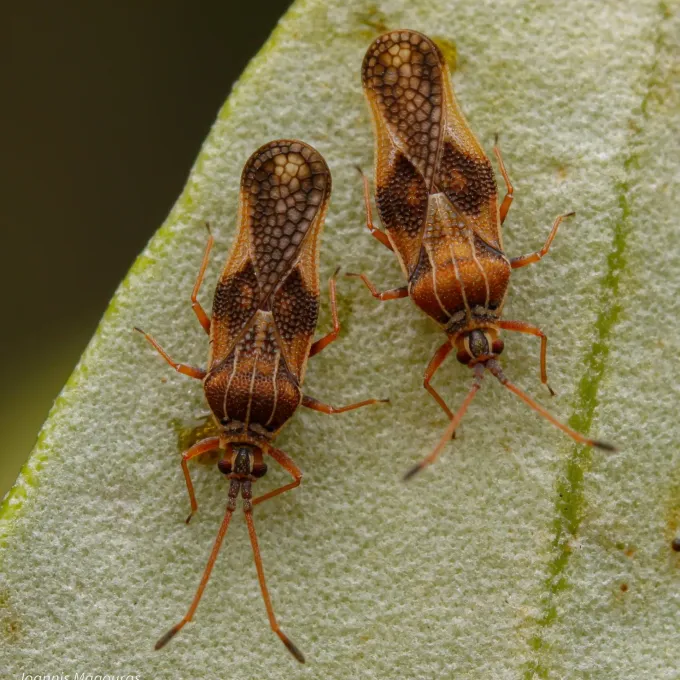
The olive lace bug (Froggattia olivinia) is a member of the order Hemiptera and the family Tingidae. These insects are very small, typically measuring between 3 to 4 millimeters in length.
The name "lace bug" derives from the highly detailed, reticulated, lace-like appearance of their wings and pronotum, which serves as excellent camouflage against bark and foliage.
Nymphs of this species resemble the adults but lack functional wings and are often covered in small spines, making them appear somewhat different during their developmental stages.
These insects are gregarious, meaning they live in colonies, which makes finding them easier if you inspect the undersides of the leaves closely during the growing season.
Due to their tiny size and intricate patterns, using a hand lens is highly recommended for accurate field identification and distinguishing them from other similar pests.
What it damages
The primary host for Froggattia olivinia is the olive tree (Olea europaea). High infestations can lead to significant physiological stress for the host plant.
The insects feed by piercing the leaf tissue with their mouthparts and extracting sap, which directly disrupts the plant's photosynthetic capacity.
Symptoms of feeding appear as chlorotic spots on the upper leaf surface, which correspond to the areas where the bugs have been feeding on the underside.
Over time, the affected leaves turn yellow, then brown, and eventually drop from the tree, leading to premature defoliation and a reduction in the tree's vigor.
A heavy infestation eventually impacts fruit set and overall yield, as the tree lacks the resources to support healthy growth and high-quality olive production.
Signs of infestation
The most common sign of an olive lace bug infestation is the stippled, light-colored or bleached spots on the upper leaf surface, commonly referred to as "chlorosis."
By turning the leaves over, you will often find dark spots of excrement, empty exuviae (cast skins left behind after molting), and the insects themselves clustered together.
In severe cases, the foliage becomes distorted, curled, or misshapen, and the tree may appear stunted compared to healthy, non-infested individuals.
The presence of sooty mold, a black, velvety fungus growing on the insect's sugary secretions, is another hallmark of a lace bug colony on olive trees.
Early leaf drop, especially during the peak summer months, is a strong indicator that the population density of the pest has reached an alarming level.
Control measures
Monitoring is the first line of defense; regular visual inspections of the undersides of leaves should be conducted starting from early spring to detect colonies early.
Good orchard sanitation and pruning practices help by opening up the tree canopy, which increases airflow and exposure to sunlight, both of which are detrimental to lace bug survival.
Biological control agents, such as lacewings and various predatory bugs, play a vital role in suppressing Froggattia olivinia populations in a sustainable way.
When chemical control is necessary, applying systemic or contact insecticides during the nymphal stages is usually the most effective approach for managing outbreaks.
- Timely pruning to maintain canopy health and light penetration.
- Application of horticultural oils to disrupt insect populations.
- Targeted insecticide treatments based on monitoring thresholds.
Taxonomy
- Latin name
- Froggattia olivinia
- Order
- Hemiptera (bugs, aphids, leafhoppers)
- Family
- Tingidae
- EPPO code
- FROTOL
Discussion
No discussions yet — be the first.