
Manna cicada
Fidicina mannifera
Description
How to identify
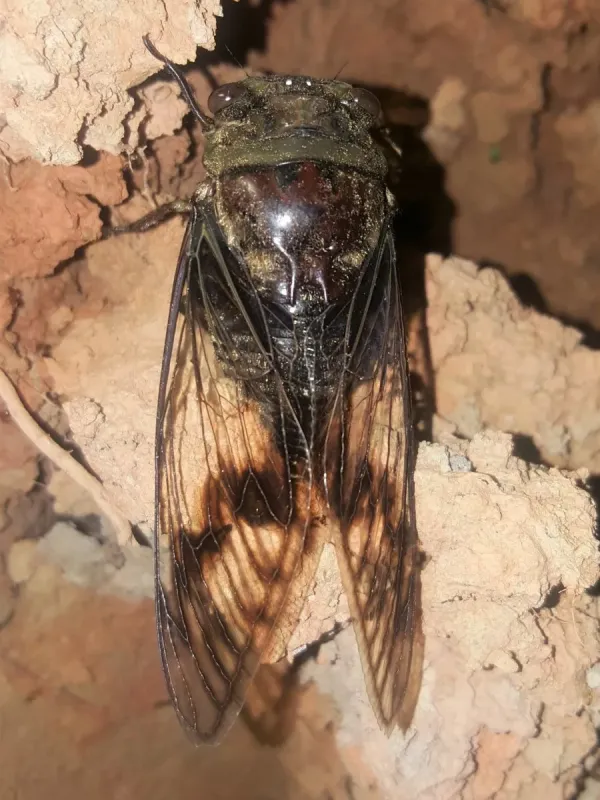
The Manna cicada (Fidicina mannifera) belongs to the Cicadidae family, order Hemiptera. Adults are large, robust insects characterized by transparent wings with distinct, strong veining and a heavy, broad body.
Their coloration typically ranges from dark brown to olive-black, providing effective camouflage against tree bark. A key identifier is the specific, high-intensity sound produced by males using specialized organs called tymbals.
The nymphs of this species are subterranean, spending the majority of their long life cycle underground. They possess powerful, specialized forelegs designed for digging in the soil and feeding on the sap of woody root systems.
Development involves incomplete metamorphosis, with several nymphal stages occurring within the soil. The total life cycle can span several years, which makes monitoring and predicting population surges challenging for growers.
Adults are primarily active during the warmer summer months when they emerge from the ground for mating. After fertilization, females deposit eggs directly into plant tissues, such as stems and twigs.
What it damages
Both nymphs and adults cause damage, though through different mechanisms. Nymphs feeding on roots underground weaken the tree's health, reducing its vigor and overall resilience against environmental stress.
Adult cicadas use their piercing-sucking mouthparts to feed on the sap of young shoots and branches. This extraction process interrupts nutrient flow, leading to stunted growth and visible physiological distress in the affected parts of the canopy.
Various tropical and subtropical fruit crops, as well as several species of ornamental trees, are highly susceptible to these infestations. Damaged plant tissues often become entry points for secondary pathogens and infections.
Large-scale infestations can lead to premature leaf drop and dieback of thin branches. In intensive orchard environments, this damage significantly reduces yield and the long-term productivity of the plantation.
Egg-laying sites often show necrosis and bark splitting, which can cause severe shoot deformation. Such mechanical injuries further weaken the tree's structure and susceptibility to winter injury.
When it appears
The emergence of adult Fidicina mannifera is strictly linked to regional climatic conditions. In tropical and subtropical belts, peak activity usually coincides with the rainy season or the onset of the dry period.
Mass emergence of nymphs from the soil occurs synchronously, a strategy driven by the species' biological rhythm to overwhelm predators. This behavior leads to sudden, localized population spikes.
During the summer, cicadas are most active throughout the daylight hours. This is the period when males engage in the most intense vocalization to attract mates, signaling the height of the adult life phase.
Nymphal stages are active year-round within the rhizosphere. They do not exhibit a distinct seasonal diapause, continuing their slow feeding on roots even during periods when the tree canopy is relatively dormant.
Because development cycles can last several years, population surges of this pest are often cyclical and tied to the conclusion of specific generational development phases.
Signs of infestation
The most immediate sign of an infestation is the characteristic, loud chirping sound produced by males, which can be heard at great distances. This vocalization is the primary indicator of adult presence.
On the soil surface around the base of the tree, one can often find characteristic exit holes, approximately 1–1.5 cm in diameter. These are created when nymphs emerge from the ground to undergo their final molt.
Empty exoskeletons, or exuviae, are often found clinging to trunks and branches after the cicadas have emerged as adults. These papery husks are a definitive sign that the insects have completed their cycle in that area.
Shoot damage appears as punctures or scars on the bark surface where females have inserted their eggs. Heavy infestation can cause shoots to yellow, lose turgor, and eventually wither.
Secondary signs include an overall decline in tree health, characterized by canopy thinning and premature fruit drop, which are often consequences of long-term root feeding by the nymphal population.
Control measures
Controlling Fidicina mannifera requires a multi-tiered approach, as the subterranean nymphal stage is protected by the soil. Regular cultivation of the soil around the base of the tree can help destroy nymph tunnels.
Applying systemic insecticides targeting adult cicadas can reduce population levels before egg-laying occurs. These treatments are most effective when timed precisely with the mass emergence period.
Proper orchard management is essential, including maintaining high agricultural standards, pruning infested shoots, and clearing plant debris that may harbor egg-laying sites.
Biological control options include the use of entomopathogenic fungi and nematodes capable of suppressing larval populations within the soil, offering an environmentally friendly alternative to chemical pesticides.
- Preventative irrigation and soil aeration.
- Timely removal of damaged twigs and branches.
- Use of light traps to monitor and reduce adult populations at night.
- Application of targeted insecticides during peak emergence.
Taxonomy
- Latin name
- Fidicina mannifera
- Order
- Hemiptera (bugs, aphids, leafhoppers)
- Family
- Cicadidae
- EPPO code
- FIDCMA
Discussion
No discussions yet — be the first.