
Euploea
Euploea
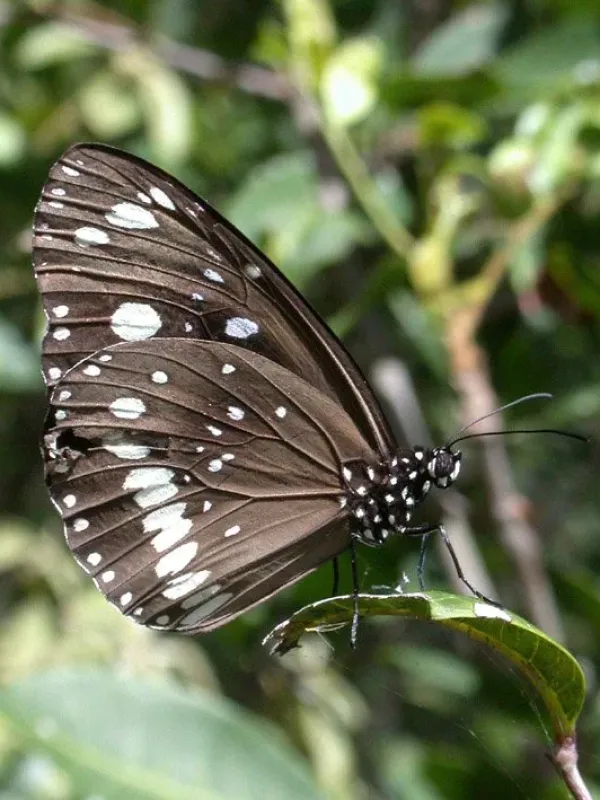
Description
How to identify
Euploea is a genus of butterflies within the Nymphalidae family, known for their distinctively dark, often iridescent wings marked with white or blue spots.
The larvae, or caterpillars, are typically characterized by fleshy tentacles or tubercles, which serve as a warning mechanism regarding their chemical defenses.
Taxonomically, they belong to the subfamily Danainae. These butterflies are famous for sequestering alkaloids from their host plants, which makes them unpalatable to birds and other predators.
Understanding their morphology at the larval stage is crucial for agricultural identification, as the caterpillars are the life cycle stage responsible for crop damage.
The pupae of the Euploea genus are often gold or silver in color, suspended from plant surfaces, representing a unique developmental stage in their life cycle.
What it damages
The primary agricultural concern stems from the larvae, which feed voraciously on the foliage of various host plants, including specific ornamental and medicinal crops.
Feeding damage involves the consumption of leaf tissue, which reduces the plant's photosynthetic capacity and can severely stunt the development of young plants.
When populations reach high densities, they can cause defoliation, significantly reducing the marketability and yield of affected plant species.
Because these insects are often specialized, they tend to target specific host plants, meaning the risk is usually localized but potentially severe.
Secondary damage can occur if the loss of foliage weakens the plant, making it more susceptible to opportunistic pathogens or secondary pest infestations.
When it appears
The seasonal appearance of Euploea is primarily dictated by temperature and host plant availability, with highest activity during warm, moist periods.
In tropical and subtropical regions, these butterflies can reproduce continuously, with overlapping generations occurring throughout the year.
In temperate zones or areas with distinct seasons, activity peaks during the peak growing season when succulent foliage is most abundant.
Monitoring efforts should correlate with the developmental stages of the host crops to intercept infestations before they become established.
Diapause is rare in tropical species, but migration or population shifts may occur in response to seasonal changes in rainfall and resource availability.
Signs of infestation
Early warning signs include the presence of frass (caterpillar droppings) on the leaf surfaces or at the base of the plant.
Notched or ragged leaf edges are classic indications that larvae are feeding, often progressing to skeletal remains of leaves in severe infestations.
Visual detection of the larvae themselves, especially on the underside of leaves or along stems, is the most accurate way to confirm an infestation.
Visible silk trails or webbing associated with larval movement may also indicate their presence in the canopy of the plants.
Distorted or yellowing foliage resulting from the loss of structural leaf tissue is a late-stage sign that requires immediate intervention.
Control measures
Effective management strategies prioritize biological and cultural methods to minimize environmental impact while maintaining crop health.
Application of biological control agents, specifically those targeting lepidopteran larvae, is highly effective and selective.
Cultural practices such as removing host-plant weeds and maintaining proper spacing can significantly decrease the carrying capacity of the habitat for the pest.
Regular monitoring of plant health and manual removal of larvae in small-scale plantings remain viable options for integrated pest management.
- Integrated Pest Management (IPM).
- Use of Bacillus thuringiensis (Bt).
- Regular canopy inspection.
- Habitat sanitation to reduce host availability.
Taxonomy
- Latin name
- Euploea
- Order
- Lepidoptera (butterflies)
- Family
- Nymphalidae
- EPPO code
- EPLOSP
Discussion
No discussions yet — be the first.