
Toadflax Pug
Eupithecia linariata
Description
How to identify
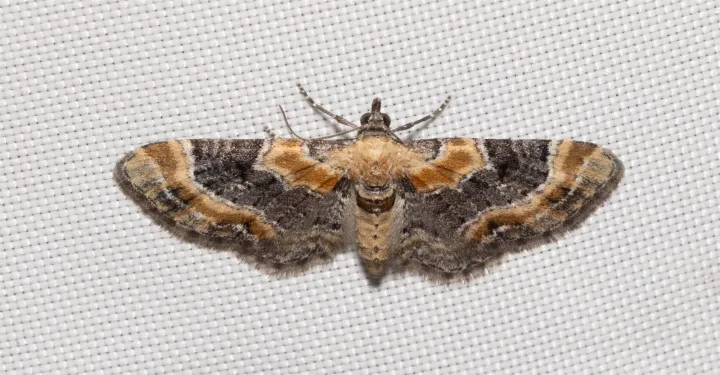
The Toadflax Pug (Eupithecia linariata) belongs to the Geometridae family, order Lepidoptera. The adult moth has a wingspan ranging from 20 to 25 mm, with a grey to brownish wing coloration characterized by distinct wavy cross-bands.
The larva of this species grows up to 18 mm in length. Its coloration is highly variable, often appearing in green or yellowish shades with reddish markings, which provides excellent camouflage while resting among the flowers of its host plants.
The pupa usually overwinters in the soil or within a dense silken cocoon hidden among plant debris, which serves as a protective measure against low winter temperatures in temperate regions.
The life cycle undergoes complete metamorphosis: egg, larva, pupa, and adult. The moths are primarily nocturnal or crepuscular, making them difficult to detect during the day without specialized monitoring equipment.
This species is a specialized phytophage, with its biological development closely synchronized with the flowering and seed-pod formation periods of plants within the Scrophulariaceae family.
What it damages
The larvae feed primarily on plants of the Scrophulariaceae family, most notably the common toadflax (Linaria vulgaris), from which the pest derives its common name.
Although naturally associated with wild plants, under conditions of high population density, the larvae may infest ornamental or agricultural varieties of this family, leading to aesthetic damage and reduced reproductive success.
The primary damage is inflicted upon the generative organs of the plant. Larvae consume buds, flowers, and developing ovaries, which disrupts fertilization and significantly lowers the quantity and quality of seed production.
Infested floral structures often drop prematurely or become deformed. These weakened tissues provide entry points for secondary infections, including fungal pathogens and bacterial rots, which exacerbate the overall harm.
Due to the destruction of flowers and seed pods, the plant diverts energy into compensatory growth, which stunts its overall development and reduces its vigor throughout the growing season.
When it appears
The emergence of the first generation of moths typically occurs in late spring or early summer, coinciding with the start of the growing season and the onset of flowering in host plants.
The peak of larval damage occurs during the bud-burst and flowering stages. Depending on the climatic zone, the species may complete one or two generations per season, increasing the risk of prolonged infestation.
During the summer months, with favorable weather and moderate humidity, larval development proceeds rapidly, which can lead to a sudden increase in the local pest population.
As autumn approaches, the insects enter the pupal stage for hibernation. Environmental conditions during August and September are critical for successful pupation and the survival of the population until the next season.
Monitoring the adult flight period using light traps or pheromone lures allows growers to time protective measures accurately and minimize potential crop loss.
Signs of infestation
The initial sign of infestation is the presence of eaten petals and hollowed-out buds, which eventually shrivel or become deformed before they have a chance to bloom fully.
Close inspection of the flower spikes may reveal frass (larval excrement), which accumulates in leaf axils or around the base of damaged seed pods, signaling the presence of active feeders.
Fine silken threads, used by the larvae to bind floral parts together, are a telltale sign that a larva is currently nesting and feeding within the inflorescence.
Withered top-heavy spikes and a noticeable lack of viable seed pods during the peak flowering season are strong indicators of an infestation by the Toadflax Pug.
Finding the larvae is easiest using a beating tray or by shaking the flower heads over a light-colored surface, which makes them visible due to their distinct body structure and coloring.
Control measures
The primary cultural control method is deep autumn plowing, which helps destroy the pupae overwintering in the soil and disrupts the pest's development cycle on the field.
Regular weeding and removal of wild Scrophulariaceae species from the perimeter of cultivation areas significantly reduce the reservoir of the pest, preventing migration onto crops.
Biological control involves the application of products based on Bacillus thuringiensis, which are effective against early-instar larvae while remaining safe for non-target beneficial insects.
In cases of high infestation, systemic or contact-stomach insecticides may be used, provided they are authorized for the specific crop and applied in strict accordance with the label to avoid resistance.
- Crop rotation and spatial isolation.
- Regular field scouting during the flowering period.
- Eradication of host weeds.
- Application of bio-insecticides at the egg-hatch stage.
Taxonomy
- Latin name
- Eupithecia linariata
- Order
- Lepidoptera (butterflies)
- Family
- Geometridae
- EPPO code
- EUPILI
Discussion
No discussions yet — be the first.