
Spruce cone moth
Eupithecia abietaria
Description
How to identify
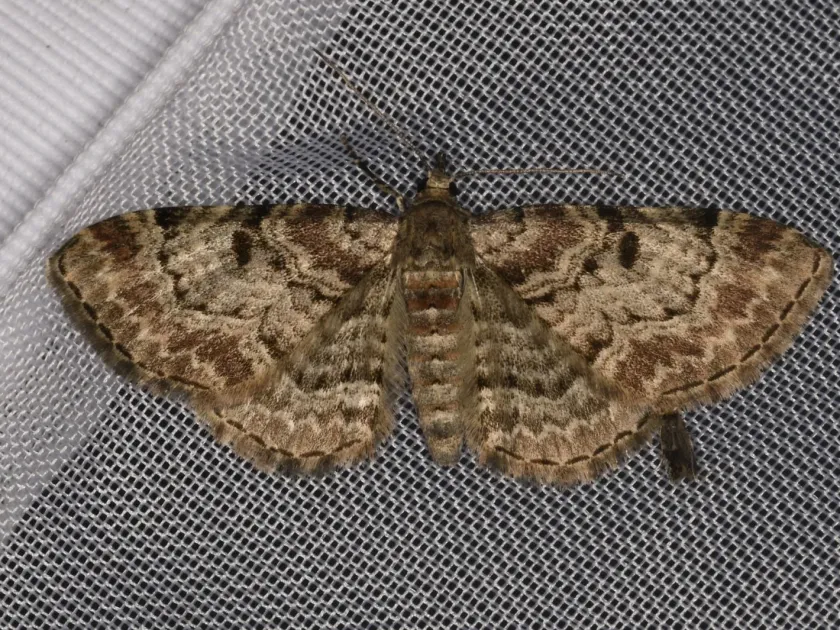
The spruce cone moth Eupithecia abietaria belongs to the Geometridae family, order Lepidoptera. The adult moth has a wingspan of approximately 20–25 mm, with brownish-grey forewings adorned with subtle dark transverse lines.
This species is characterized by a slender body structure common to the Eupithecia genus. The larvae reach a length of 15–18 mm and exhibit cryptic coloration ranging from green to brown, which helps them blend seamlessly with their host plant.
The pupal stage is spent in a compact, brown cocoon found in leaf litter or within the bark crevices of the host tree. This life stage is vital for the moth's survival during winter, ensuring the population persists until spring.
The lifecycle is tightly synchronized with the development of the spruce trees. Adult emergence usually coincides with the blooming of spruce, providing the necessary conditions for mating and oviposition.
Females lay their eggs directly on young spruce cones or near the base of the scales. Shortly after hatching, the larvae burrow into the cone tissue to begin their feeding cycle on the internal seeds.
What it damages
The primary damage caused by the spruce cone moth is to the reproductive organs of the Norway spruce. Larvae feed extensively inside the developing cones, consuming seeds and destroying the internal structure.
By eating the seeds, these larvae significantly reduce the seed yield, which is a major concern for commercial seed orchards and nurseries. Destroyed seeds often lose their viability, rendering the harvest useless.
Furthermore, larvae often feed on the central axis of the cone, causing the cones to dry out prematurely or deform. This often leads to premature cone drop, which limits the dispersal of mature seeds.
In forest ecosystems, while the pest rarely kills mature trees, it can cause severe economic losses by hampering natural regeneration and reducing the quality of forest seed stocks significantly.
The severity of the damage is often density-dependent. In outbreak years, a single cone may contain multiple larvae, leading to the complete destruction of all seeds within that specific cone.
When it appears
Adult moths are typically active in late spring and early summer, corresponding with the initial growth phase of new spruce cones. They are nocturnal and are most active during dusk and early night hours.
Larvae are present from June through the end of the summer, which is the period when they are actively feeding within the cones. This is the most critical window for forest health managers to implement control measures.
By late summer, the larvae migrate to the ground or bark crevices to pupate. They remain in this stage throughout the autumn and winter, emerging as adults the following spring.
Climate variables, particularly spring temperatures, significantly affect the timing of emergence. Warmer weather typically accelerates the life cycle, leading to earlier infestations of the developing cone crop.
Regular monitoring starting from the cone formation phase is essential for predicting potential infestation levels and determining the appropriate timing for any necessary protective actions.
Control measures
Effective management of the spruce cone moth requires an integrated pest management (IPM) approach. Monitoring adult populations using pheromone traps or light traps is a standard practice to gauge infestation risk.
Chemical control involving systemic insecticides is most effective when applied during the larval hatching period before they burrow deep into the cones. Strict adherence to application protocols is necessary to minimize non-target impacts.
Cultural practices, such as the removal and destruction of fallen cones in seed orchards, can significantly reduce the local population of pupating larvae, thereby lowering the risk of infestation in subsequent seasons.
Biological control, including the use of entomopathogenic bacteria or fungi, serves as an environmentally friendly alternative to chemical pesticides, particularly for controlling larval stages in seed-producing areas.
- Consistent forest health monitoring programs.
- Pheromone trap deployment to time control applications.
- Sanitation removal of infested or fallen cone material.
- Targeted systemic insecticide treatments during early larval development.
Taxonomy
- Latin name
- Eupithecia abietaria
- Order
- Lepidoptera (butterflies)
- Family
- Geometridae
- EPPO code
- EUPIPI
Discussion
No discussions yet — be the first.