
Northern spinach
Eulithis populata
Description
How to identify
The Northern spinach moth (Eulithis populata) is a member of the Geometridae family within the Lepidoptera order.
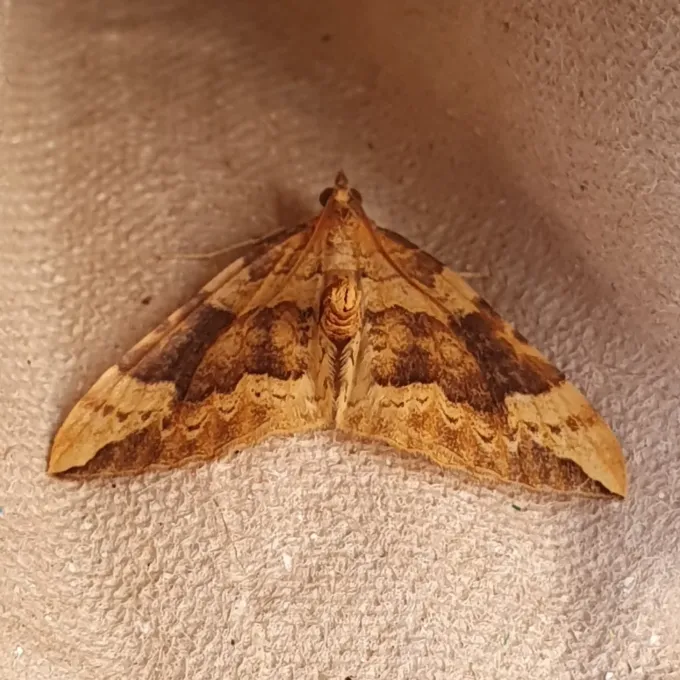
Adult moths typically have a wingspan ranging from 25 to 35 mm, displaying yellow to ochre wing coloration with brown bands.
The larvae, known as loopers, possess the characteristic "inchworm" movement, which helps them camouflage effectively against host plants.
The species undergoes a complete metamorphosis involving egg, larval, pupal, and adult stages.
It is widely distributed across temperate regions where its host plants, such as bilberry and willow, are abundant.
What it damages
Larvae primarily feed on foliage of the Ericaceae family, with bilberry (Vaccinium myrtillus) being a preferred food source.
In addition to berry bushes, the larvae are known to consume foliage from willow species (Salix) in diverse habitats.
The main damage caused by this pest is heavy defoliation, which severely hampers the plant's photosynthetic capacity.
Severe infestations can lead to significant yield losses in commercial and wild berry crops due to biomass reduction.
Young shoots may also be damaged, causing stunted growth and increased susceptibility to winter frost.
When it appears
The flight period of the adult moths occurs during the summer months, typically spanning from July through August.
The species overwinters in the egg stage, with eggs firmly attached to the bark or twigs of host plants.
Larval emergence occurs in the spring, synchronized with the budding and leaf expansion of blueberry and willow plants.
Feeding activity takes place from late spring through early summer before the larvae seek pupation sites.
The moth is univoltine, meaning it completes only one generation cycle per year.
Signs of infestation
Characteristic signs include irregular holes in leaves or completely stripped leaf margins on berry bushes.
One can identify the larvae by their distinct resting posture, where they stretch out rigid to mimic small twigs.
Extensive skeletonization of leaves, where only the primary veins remain, indicates high larval density.
The accumulation of larval frass on leaves or the ground beneath the canopy is a clear indicator of active feeding.
Rapid yellowing and premature dropping of foliage are symptomatic of high-pressure infestations.
Control measures
Biological control using Bacillus thuringiensis formulations is considered the most environmentally friendly approach.
When necessary, broad-spectrum or selective insecticides may be applied during the early larval development stage.
Maintaining clean orchard hygiene, including the removal of leaf litter, helps disrupt the life cycle of the moth.
Encouraging predatory birds and insectivorous insects can significantly lower the pest population naturally.
- Regular inspection of buds and leaves in early spring.
- Selective use of environmentally safe insecticides.
- Monitoring population levels through light trapping of adults.
- Protecting natural habitats of local parasitoids.
Taxonomy
- Latin name
- Eulithis populata
- Order
- Lepidoptera (butterflies)
- Family
- Geometridae
- EPPO code
- EULTPO
Discussion
No discussions yet — be the first.