
Thomson's gazelle
Eudorcas thomsoni
Description
How to identify
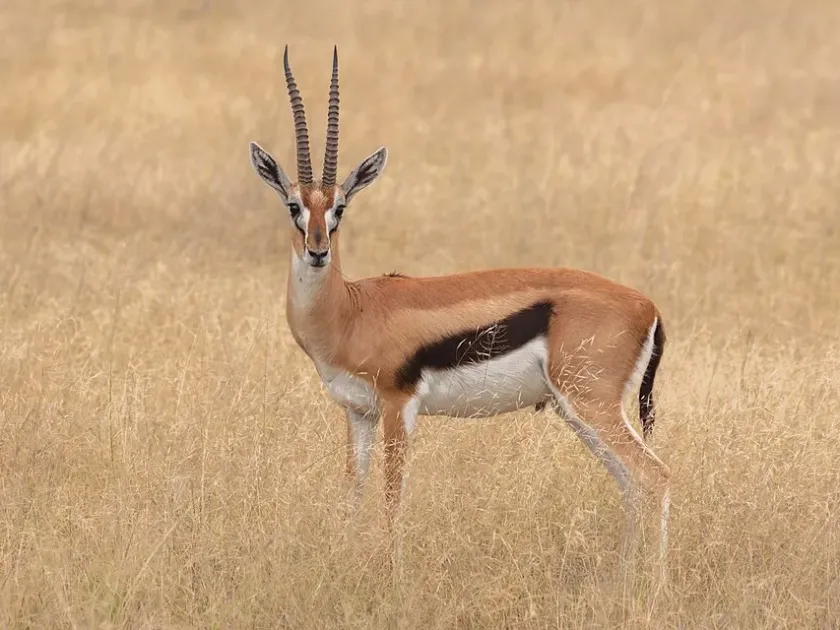
Thomson's gazelle (Eudorcas thomsoni) is a medium-sized antelope belonging to the family Bovidae. These animals are recognizable by their slim build, light brown upper parts, white underparts, and a distinct black stripe running along their flanks.
Both males and females possess lyre-shaped horns, which are essential for social interactions within the herd. They stand approximately 60–80 cm at the shoulder and typically weigh between 20 and 35 kg.
They are gregarious animals, commonly found in the savannahs and grasslands of East Africa. Their keen eyesight and hearing allow them to detect predators or disturbances from a great distance.
In an agricultural context, they are viewed as opportunistic herbivores. While not agricultural pests in the traditional sense, their foraging habits in areas overlapping with farmland lead to significant conflicts with crop production.
Their reliance on high-quality forage makes them highly mobile, often following the rains and naturally moving across agricultural landscapes in search of sustenance.
What it damages
These gazelles can cause substantial damage to a wide range of agricultural crops, including cereals, legumes, and various vegetable species. They often target young, tender seedlings during early growth stages.
Large herds can devastate entire sections of fields, particularly corn, sorghum, and wheat. Grazing behavior involves not just the consumption of biomass but also the destruction of plant structures.
Trampling is a significant secondary damage factor, where the animals' hooves compact the soil and crush plants, hindering root development and reducing overall soil porosity.
The economic impact for farmers is substantial, involving loss of yield, waste of expensive seeds, and the costs associated with replanting devastated areas.
Additionally, the destruction of fencing and other farm infrastructure while attempting to access or traverse fields adds to the financial burden on the agricultural sector.
When it appears
The presence of Thomson's gazelle in agricultural zones is closely linked to rainfall patterns. They migrate into fertile areas immediately following the start of the wet season.
During prolonged dry seasons, they are more likely to encroach upon irrigated farmland, as these are often the only green patches available in the region.
Understanding their seasonal migration is critical for farmers. By predicting when and where the herds are likely to pass, agricultural managers can implement protective measures before damage occurs.
The timing of the cropping cycle must be balanced with the migratory patterns of these animals to avoid exposing young crops during peak migration periods.
Seasonal environmental factors, such as water availability in national parks, dictate their movement, which in turn influences the probability of herd incursion onto private lands.
Signs of infestation
The most immediate signs of incursion include the presence of hoof prints along the edges of fields, especially after rain or irrigation, when the soil is soft enough to retain tracks.
Grazing evidence manifests as plants bitten off at an angle, characteristic of their dental anatomy, leaving ragged edges on the stems of affected crops.
The presence of small, pellet-like droppings in and around the fields is a clear indicator that a herd has spent time foraging in the vicinity.
Trampled paths through the crop rows, where plants are flattened and soil is compacted, clearly mark the travel corridors used by the gazelles to navigate across the farm.
Behavioral signals, such as the increased restlessness of local bird populations or audible herd movements, can alert farmers to their nocturnal presence.
Control measures
Physical exclusion remains the most effective management strategy. Installing robust, well-maintained fencing is the primary method to prevent herd entry into vulnerable crop fields.
The use of deterrents, including motion-activated lighting, sirens, or acoustic devices, can be highly effective in discouraging nocturnal grazing on crops.
Strategic planting, such as creating buffer zones with non-palatable crops or thorny hedges around the perimeter, can help divert gazelle paths away from the main production areas.
Cooperation with local wildlife management authorities is essential to develop landscape-level solutions that balance biodiversity conservation with the protection of agricultural interests.
- Check and repair perimeter fencing periodically.
- Employ night patrols during critical crop growth stages.
- Integrate deterrent systems to disrupt grazing patterns.
Taxonomy
- Latin name
- Eudorcas thomsoni
- Family
- Bovidae
- EPPO code
- EDORTH
Discussion
No discussions yet — be the first.