
Eudorcas Gazelle
Eudorcas
Description
How to identify
The Eudorcas gazelle refers to a genus of antelopes belonging to the Bovidae family and the order Artiodactyla. These animals are characterized by their slender build, long legs, and a specialized digestive system suited for grazing on open savannahs and semi-arid plains.
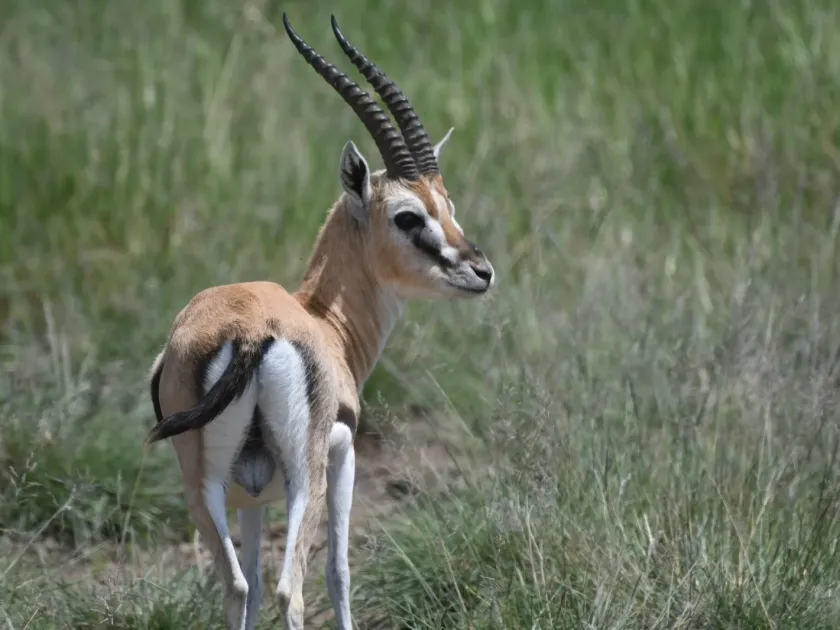
The physical appearance of these gazelles includes a sandy-colored coat with a distinct dark band on the flanks, separating the back from the white underbelly. Both males and females possess lyre-shaped horns with prominent rings, which serve as a primary identification feature.
Eudorcas species are highly adapted to arid environments, possessing the ability to survive on minimal water by extracting moisture from vegetation. They typically live in small social groups, often led by a dominant male, and move across large distances.
Their daily behavior includes periodic grazing and resting phases, usually avoiding the hottest hours of the day. This adaptability allows them to thrive in harsh climates but also brings them into contact with human agricultural developments.
An adult Eudorcas gazelle weighs between 20 and 50 kg. Their constant need for nutrition in arid regions is a major factor driving their tendency to exploit agricultural crops when natural sources become scarce.
What it damages
The primary damage caused by Eudorcas gazelles is the intensive grazing on agricultural crops, especially wheat, sorghum, and barley. When they enter farm lands, they can consume a significant portion of the young biomass, severely stunting plant growth.
In addition to consuming the green parts of the plants, gazelles cause mechanical damage by trampling fields. Their hooves break the soil surface and can destroy the delicate root systems of young seedlings, leading to high plant mortality.
For smallholder farmers, the loss caused by these animals can be significant, potentially reducing yield by 30-40% in affected areas. This makes them a serious concern for food security in regions bordering their natural habitats.
Furthermore, their presence can lead to the spread of seeds from wild plants into cultivated fields through their waste, increasing weed competition and further reducing crop health.
The cumulative effect of grazing and trampling creates patches of bare, compacted soil, which can lead to erosion and degraded soil quality over multiple growing seasons if left unmanaged.
When it appears
The seasonal damage caused by gazelles is directly correlated with the availability of natural vegetation in their native habitat. During the rainy season, when wild grasses are abundant, they rarely pose a threat to farmland.
However, during the dry season, as wild forage dries up, these animals are forced to seek alternative food sources. This is when they migrate toward irrigated farms and crop fields, causing significant agricultural damage.
The period of most intensive damage usually occurs during the early growth stages of crops. Young, succulent plants are highly attractive to gazelles, making the start of the growing season a high-risk time for farmers.
Temperature fluctuations also influence their activity. During extreme heat, they may transition to feeding during the cooler evening or night hours, which makes monitoring and deterring them more challenging for farmers.
Effective management requires tracking rainfall patterns to anticipate when gazelles are most likely to move toward agricultural areas, allowing for preemptive protection measures to be deployed.
Signs of infestation
The most visible sign of gazelle presence is the pattern of their tracks in the soil. These are distinct, narrow hoof prints that are easily identifiable, especially in soft or irrigated soil around fields.
Plant damage caused by gazelles appears as clean, angled bites on stems and leaves. Unlike insect damage, which is often patchy or involves skeletonizing, gazelles strip the foliage neatly from the top down.
Small, firm, pellet-like droppings are another clear indicator of their presence. The discovery of these droppings in or around a crop field confirms that the animals have been feeding in that specific location.
Flattened areas of soil, where plants have been crushed or eaten away completely, are evidence of the animals resting or congregating. These spots are often devoid of vegetation and are key areas to inspect for damage.
Farmers may also observe sudden behavioral changes in nearby livestock, which may become restless or vocal if wild gazelles are moving through the vicinity during the night.
Control measures
The most effective long-term solution for protecting crops is the installation of robust physical barriers, such as high-tensile wire mesh fencing at least 1.8 to 2 meters high.
Acoustic and visual deterrents, such as motion-activated light systems, noise makers, or ultrasonic repellers, can be used to protect fields during peak risk periods in the growing season.
Agronomic strategies include planting buffer zones of non-attractive crops around the perimeter of the field to discourage gazelles from entering the core cultivated area.
In many regions, the use of trained guard dogs has proven highly successful in patrolling field boundaries and deterring wild antelopes from approaching the crops.
Collaboration with local conservation authorities is essential to develop sustainable wildlife management plans that protect both the crops and the natural ecosystem from excessive conflict.
Taxonomy
- Latin name
- Eudorcas
- Family
- Bovidae
- EPPO code
- EDORSP
Discussion
No discussions yet — be the first.