
Hawksbill sea turtle
Eretmochelys imbricata
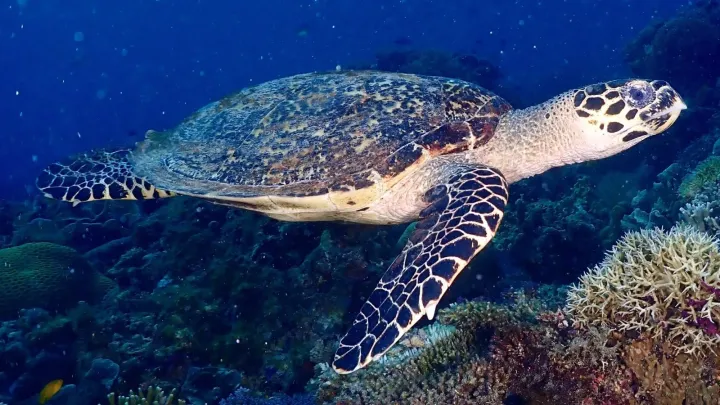
Description
How to identify
The Hawksbill sea turtle is a marine reptile belonging to the order Testudines and the family Cheloniidae.
This species is strictly aquatic, living primarily in tropical and subtropical ocean waters throughout its entire life cycle.
Its morphology is characterized by a distinctive, sharp, bird-like beak that allows it to feed on sponges and organisms found in coral crevices.
From an agronomic and entomological perspective, this organism is not a pest of agricultural or ornamental plants, as its diet is specialized.
Any inclusion of this animal in pest control databases is a clear biological error, as the species lacks the physiology required to cause damage to vegetation.
What it damages
The Hawksbill sea turtle causes no damage to any cultivated crops, as its habitat is confined to marine ecosystems, specifically coral reefs.
The species has no herbivorous affinity for terrestrial or aquatic flora utilized in modern agriculture.
The presence of this animal near coastlines does not pose a threat to crop health, as they only venture onto land for nesting purposes.
Classifying the Hawksbill as a pest is a common data error resulting from an incorrect interpretation of global biological classification systems.
There is absolutely no interaction between this species and agricultural production practices that would warrant consideration as a biological threat.
Control measures
As the Hawksbill sea turtle is not an agricultural pest, no protective measures or control strategies are required for agricultural fields.
The species is strictly protected under international law, specifically by the CITES convention, and any harm or disturbance is strictly prohibited.
If these turtles are sighted near coastal fields, it is essential to ensure they remain undisturbed to protect their reproductive success.
Agronomists must respect the conservation status of this species and avoid the use of harmful pesticides in sensitive coastal habitats.
All agricultural databases containing this species as a pest should be corrected to prevent confusion and protect this endangered animal.
Taxonomy
- Latin name
- Eretmochelys imbricata
- Family
- Cheloniidae
- EPPO code
- ERMCIM
Discussion
No discussions yet — be the first.