
Sunn pest
Caretta
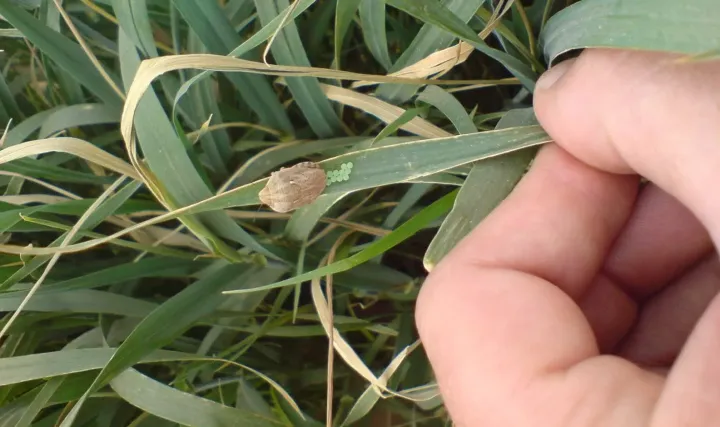
Description
How to identify
The Sunn pest (Latin: Eurygaster integriceps) is a significant insect pest belonging to the Scutelleridae family. Adults are shield-shaped bugs typically measuring 10–13 mm in length, often resembling a small turtle shell.
Their coloration ranges from light brown to dark grey or black, allowing them to blend seamlessly with leaf litter and dry plant remains in the field during the off-season.
The life cycle involves an egg stage, five larval instars, and the adult phase. Eggs are laid in clusters of 14–40 on the undersides of cereal leaves, usually appearing pale green initially before darkening.
Sunn pests overwinter as adults, primarily in forest belts or protected areas with dense plant cover. As soon as temperatures rise above 12-15°C in the spring, they migrate to wheat and barley fields to feed.
They produce one generation per year. After spring feeding and mating, the population density often spikes, leading to localized infestations that require careful monitoring by agronomists.
What it damages
Sunn pests primarily attack cereal crops such as wheat, barley, and rye. They feed by piercing the plant tissue with their specialized mouthparts and injecting digestive enzymes.
During the spring, adults feed on the stems, often causing the central leaf to die and preventing the ear from forming correctly, which results in significant yield reductions.
The most severe damage occurs when larvae and adults feed on developing grain. The enzymes injected into the grain destroy the gluten protein structure, making the grain unsuitable for flour production.
Even a small number of punctures can render an entire batch of wheat unusable for bread-making because the dough loses its elasticity and structural integrity during the baking process.
Economic losses are cumulative, involving both a reduction in grain weight and a drastic drop in commercial grain grade, making it a critical threat to food security in wheat-growing regions.
Control measures
Integrated pest management (IPM) for Sunn pest involves cultural practices such as early harvesting, which limits the time pests have to feed on the grain and prepare for winter dormancy.
Selecting early-maturing varieties of wheat can help the crop reach maturity before the larval population reaches its peak, effectively "outrunning" the pest damage.
Chemical control is necessary when populations exceed the economic threshold (ET). Agronomists typically apply broad-spectrum or selective insecticides during the sensitive larval development stages.
Rotation of insecticide chemical classes is essential to manage resistance, as these pests have shown a history of adapting to frequently used active ingredients.
Biological control plays a key role through the preservation of egg parasitoids like Trissolcus species, which naturally keep pest populations in check if chemical use is minimized.
Taxonomy
- Latin name
- Caretta
- Family
- Cheloniidae
- EPPO code
- KARTSP
Discussion
No discussions yet — be the first.