
Green sea turtle
Chelonia mydas
Description
How to identify
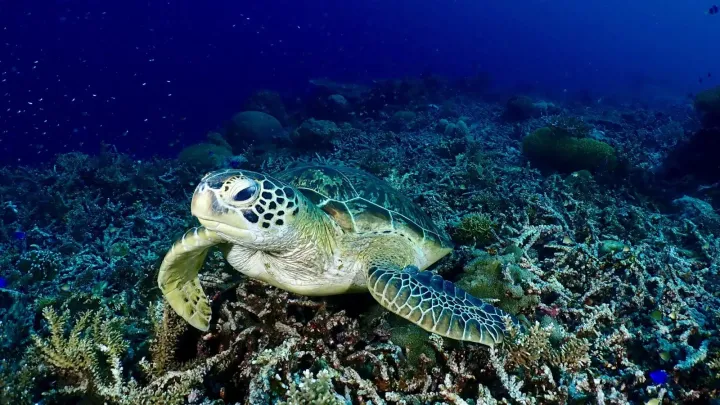
The green sea turtle (Chelonia mydas) is a large marine reptile belonging to the family Cheloniidae. These animals are characterized by their massive size, reaching weights of up to 200 kilograms and featuring a distinctive carapace.
Adult green sea turtles are primarily herbivorous, which sets them apart from most other marine turtle species. They use their serrated beaks to feed on seagrasses, algae, and other aquatic vegetation found in shallow coastal waters.
They are easily identified by their broad, smooth carapace and the unique arrangement of head scales. Their color ranges from shades of olive to brown, allowing them to blend into the marine environment.
The life cycle involves long-distance migrations between feeding grounds and nesting beaches. Their population distribution is global, primarily concentrated in tropical and subtropical regions.
Within agricultural and aquaculture settings, these turtles are recognized as a biological factor that can interfere with the production of coastal plant-based crops.
What it damages
The main damage caused by green sea turtles is the overgrazing of cultivated seagrasses and seaweed beds. By consuming large amounts of foliage, they can significantly deplete the crop biomass.
Beyond direct consumption, the turtles cause physical damage through their movement. As they navigate across a farm, they break stalks and disrupt the soil or substrate stability, leading to stunted growth.
This disruption can cause economic losses by reducing the overall harvest yield and degrading the quality of the harvested produce, making it less suitable for commercial purposes.
In some regions, they have been observed tearing through protective netting designed for aquaculture, which necessitates frequent maintenance and infrastructure repairs.
The severity of the damage is often dependent on the turtle population density in the area and the availability of their natural food sources compared to the farmed crop.
When it appears
Turtle activity levels are largely dictated by water temperature and the specific biological rhythms of the species. Periods of higher water temperature generally lead to higher metabolic rates and increased grazing activity.
Migration periods toward nesting sites often lead to localized surges in turtle density, creating high-risk windows for coastal farms located near these migratory routes.
Farmers must monitor local environmental conditions and biological calendars to anticipate potential arrival times of turtle groups.
Seasonal shifts influence the foraging behavior, with some periods showing more intense browsing as the turtles prepare for migration or post-nesting recovery.
Proactive management of these seasonal threats requires constant observation and the implementation of protective measures before the turtles enter the farming zones.
Control measures
The most effective strategy is the installation of robust fencing or mesh barriers that prevent access to the crops. These must be made of durable materials capable of withstanding the turtles' strength.
Non-lethal deterrents, such as acoustic devices that emit sounds frequencies annoying to sea turtles, are utilized to keep them away from sensitive agricultural areas.
Since the species is protected under various international laws, all defense measures must strictly avoid physical harm to the animals while ensuring the protection of the farm's assets.
Maintaining clear buffer zones and using visual deterrents can also help in guiding the turtles away from high-value crop areas without disrupting the local ecosystem.
- Heavy-duty mesh netting with secure anchoring.
- Acoustic deterrent systems based on marine bio-acoustics.
- Collaborative monitoring with local conservation agencies.
Taxonomy
- Latin name
- Chelonia mydas
- Family
- Cheloniidae
- EPPO code
- KHLNMY
Discussion
No discussions yet — be the first.