
Tortoise beetle
Chelonia
Description
How to identify
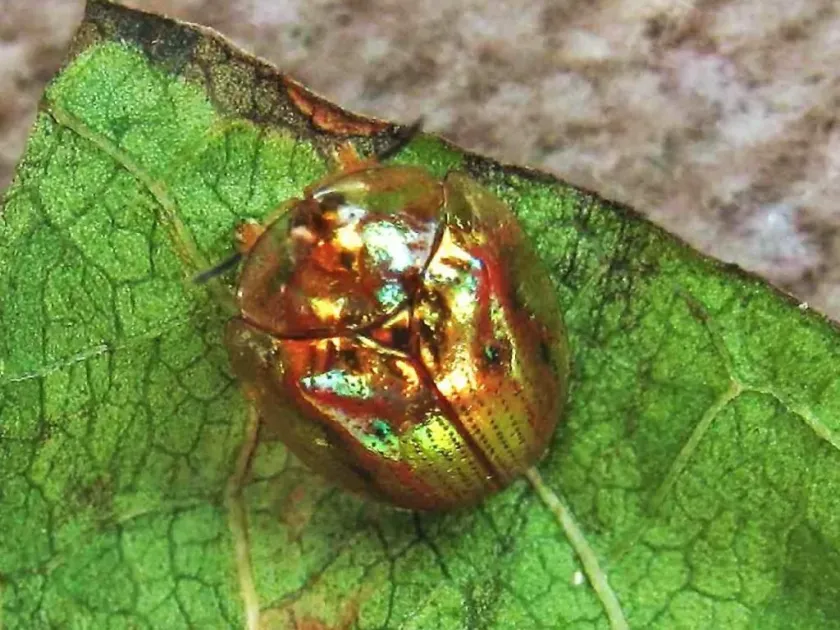
Tortoise beetles (subfamily Cassidinae, family Chrysomelidae) are easily recognizable by their flattened, shield-like appearance, which often hides their head and legs completely.
Their shells are frequently translucent or brightly colored, allowing them to blend into the foliage, acting as a sophisticated form of natural camouflage.
The larvae are distinct in their defensive behavior, as they often carry a "shield" made of their own frass and shed skins on their backs to deter predators.
Adult beetles typically overwinter in the soil or under leaf litter, emerging in the spring when temperatures rise to begin their life cycle on host plants.
They are generally found on the undersides of leaves, making them easy to miss during a casual inspection of the crop or garden plants.
What it damages
These insects primarily target plants in the Chenopodiaceae family, with sugar beets and Swiss chard being among their most common agricultural victims.
Beyond commercial crops, tortoise beetles frequently feed on various common weeds, including lambsquarters and bindweed, which serve as early-season host sites.
Both the larvae and the adults cause damage by eating small, round holes in the foliage, which can eventually lead to significant defoliation of the plants.
In high populations, the feeding damage can lead to stunted growth, particularly in young plants that are sensitive to the loss of photosynthetic leaf area.
While the aesthetic damage is often the first thing gardeners notice, the primary concern for farmers is the reduction in yield caused by weakened crop vitality.
Signs of infestation
The most telltale sign of a tortoise beetle infestation is the presence of "shot-hole" damage, where leaves appear to have been perforated by numerous small, irregular holes.
Looking closely at the foliage, one can often spot the flattened adults or the spiky, frass-covered larvae resting on the undersides of the leaves.
Affected leaves may show signs of premature yellowing or necrosis around the feeding holes, as the damaged tissue becomes susceptible to drying out.
In severe cases, the foliage may look ragged, with large portions of the leaf blade missing or reduced to a skeleton of veins due to persistent feeding.
The presence of dark, crusty deposits of frass on the leaves is another strong indicator that these pests are actively colonizing the plant.
Control measures
Cultural control is the first line of defense; removing host weeds such as lambsquarters around the field edges significantly reduces the local beetle population.
Tilling the soil after harvest disrupts the overwintering sites for adults, effectively lowering the carryover population for the following growing season.
If an infestation reaches economic threshold levels, chemical control using targeted insecticides is effective, though timing is crucial to reach the larvae.
Biological control, including the encouragement of parasitic wasps and other natural predators, can help keep beetle populations in check without chemical intervention.
- Sanitation of crop fields post-harvest
- Regular monitoring for early-stage larvae
- Application of insecticides only when necessary
- Maintaining plant health to improve recovery
Taxonomy
- Latin name
- Chelonia
- Family
- Cheloniidae
- EPPO code
- KHLNSP
Discussion
No discussions yet — be the first.