
Hawksbill sea turtle
Eretmochelys
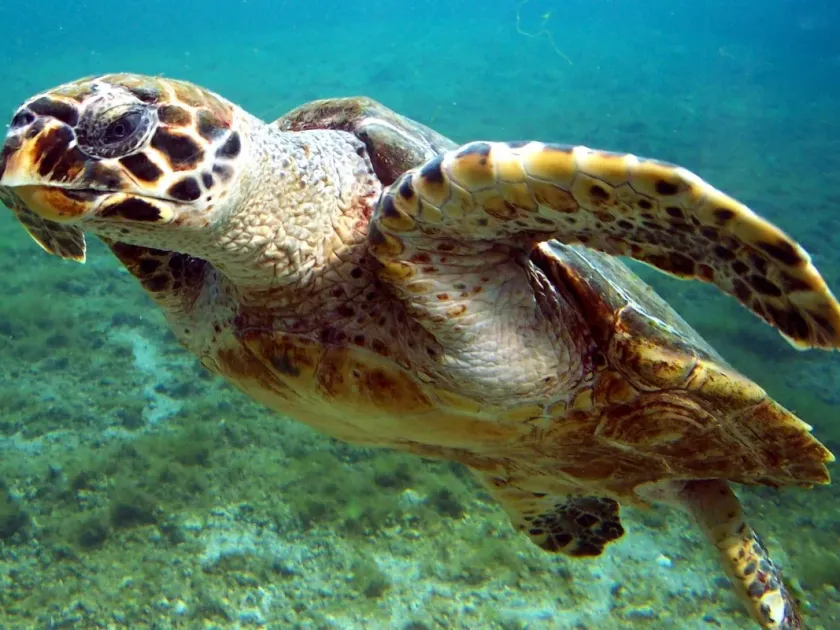
Description
How to identify
The Hawksbill sea turtle (Eretmochelys imbricata) is a member of the Cheloniidae family. It is a marine reptile and is entirely unrelated to agricultural pests, plant pathogens, or insects that affect crops.
It is easily recognized by its sharp, bird-like beak and the overlapping scutes on its shell, which give it a unique, serrated appearance. They inhabit tropical and subtropical oceans.
Biologically, these turtles are specialized marine feeders. They spend their entire lives in the ocean, except for when females come ashore briefly to lay eggs on sandy beaches.
They are classified as a Critically Endangered species by the IUCN. They play a vital role in maintaining the health of coral reef ecosystems, which are far removed from terrestrial farming activities.
The species has a complex lifecycle, and individuals often travel thousands of miles through the open ocean, having zero interaction with any terrestrial agricultural system.
What it damages
The Hawksbill turtle causes absolutely no damage to crops, orchards, or ornamental plants. It does not feed on vegetation, nor does it impact soil quality or plant health in any way.
Its diet consists almost exclusively of sea sponges, which helps keep coral reefs healthy by preventing sponges from overgrowing and suffocating the corals.
There are no recorded instances of this animal interacting with agricultural produce. It is fundamentally impossible for this marine turtle to cause any damage to farm land.
Labeling this animal as a pest in any agricultural guide is a profound error. It is a vital part of marine ecosystems and has no place in a list of threats to agriculture.
Any agricultural loss is caused by insects, fungi, or vertebrates such as rodents or birds, but certainly not by the Hawksbill sea turtle, which remains within marine boundaries.
Control measures
There are no control measures against the Hawksbill turtle because it is not a pest. In fact, all international trade and harm towards this species are prohibited by law.
Conservation efforts are the only appropriate way to manage our interaction with this animal. Protecting its nesting beaches and preventing ocean pollution are the standard priorities.
As an agronomist, it is essential to focus control efforts on genuine threats like aphids, beetles, or weeds, while supporting the conservation of protected wildlife species.
Do not apply any chemicals, traps, or mechanical barriers to deter this animal, as it will never pose a risk to your crops or your professional operations.
Promoting awareness about biodiversity is part of sustainable agriculture. Protecting species like the Hawksbill turtle ensures that our global environment remains healthy for future generations.
Taxonomy
- Latin name
- Eretmochelys
- Family
- Cheloniidae
- EPPO code
- ERMCSP
Discussion
No discussions yet — be the first.