
Erebia medusa
Erebia medusa
Description
How to identify
Erebia medusa is a butterfly species belonging to the Nymphalidae family and the order Lepidoptera.
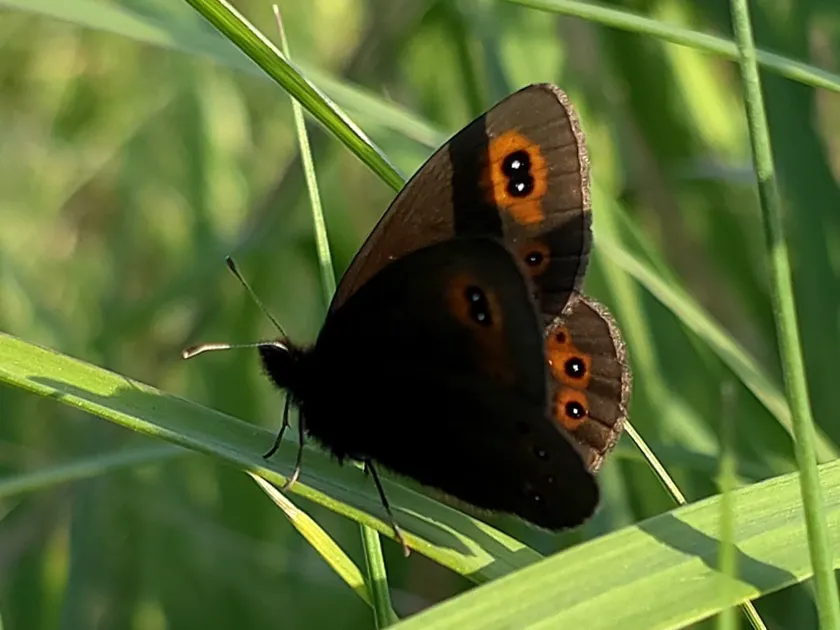
The adult butterfly has a wingspan of approximately 45–50 mm, characterized by dark brown or blackish wings.
Its wings feature distinct eye-spots with white centers surrounded by orange-red rings, which is a key identification mark.
The larvae, or caterpillars, are typically green with longitudinal light-colored stripes, blending well into their environment.
This species is commonly found in meadows, forest clearings, and grassy edges, where it completes its life cycle.
What it damages
The larvae cause damage by consuming the leaves of various grass species, including wild and sometimes cultivated cereals.
While not a primary economic pest, heavy infestations can cause significant leaf area loss on pastures and hay fields.
Larvae may move from forest margins into agricultural plots, especially when their native food sources are depleted.
Defoliation reduces the photosynthetic capacity of the plants, ultimately affecting biomass production and growth vigor.
The damage is usually localized but can be severe in fields adjacent to natural breeding habitats.
When it appears
The species has a univoltine life cycle, meaning it completes one generation per year.
Adult flight usually occurs from May to July, depending on the climatic zone and temperature conditions.
Females lay their eggs on or near the host plants, ensuring food availability for the emerging larvae.
The species overwinters as a caterpillar, exhibiting high cold tolerance to survive the winter months.
Pupation occurs in the spring, typically near the soil surface or at the base of host plants.
Signs of infestation
The presence of Erebia medusa is indicated by notched or ragged leaf edges on host grasses.
Active caterpillars can often be found on the undersides of leaves during early morning or evening hours.
Frass (larval excrement) observed on the ground or leaf surfaces is a clear sign of active feeding.
Stunted growth of the host plants in specific patches suggests an infestation site.
Visual observation of the adult butterflies fluttering over fields confirms their presence and potential egg-laying activity.
Control measures
Preventative cultural practices are the most effective way to manage Erebia medusa populations in agricultural settings.
Keeping field borders and surrounding areas free from invasive grasses and weeds minimizes breeding grounds.
Regular mowing of buffer strips near forest edges helps disrupt the larval development cycle.
Biological control agents, such as entomopathogenic bacteria, can be used if population levels become significantly high.
Chemical intervention is rarely required and should only be considered if economic thresholds are exceeded in valuable crop areas.
Taxonomy
- Latin name
- Erebia medusa
- Order
- Lepidoptera (butterflies)
- Family
- Nymphalidae
- EPPO code
- EREBME
Discussion
No discussions yet — be the first.