
Mottled umber
Erannis defoliaria
Description
How to identify
The Mottled umber (Erannis defoliaria) is a moth of the Geometridae family, known for its significant sexual dimorphism.
The male has a wingspan of about 40–45 mm, with yellowish-brown forewings crossed by dark wavy lines and a prominent central spot.
The female is entirely wingless, possessing a stout, spider-like body measuring 12–15 mm in length, greyish-brown with dark dorsal spots.
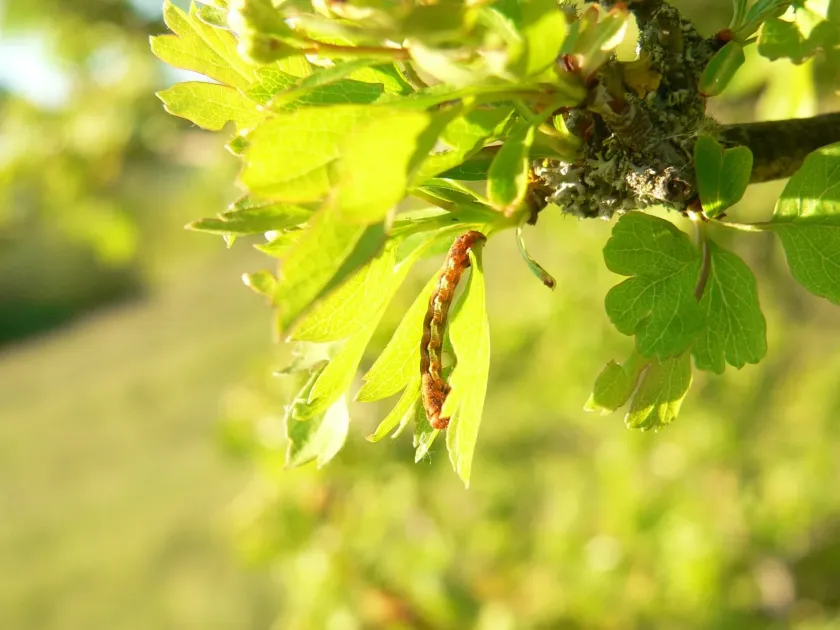
The caterpillars are typical loopers, reaching 30–35 mm in length, with a light yellow base color and a striking broad red-brown stripe along the back.
The species completes one generation per year, with eggs serving as the overwintering stage, usually tucked into bark crevices.
What it damages
This species is a generalist defoliator that feeds on a wide range of broad-leaved trees, including significant damage to fruit orchards.
In orchards, it targets apple, pear, plum, and cherry trees, causing extensive loss of foliage and buds during the spring growth phase.
In forestry, it frequently attacks oaks, birches, and limes, where large outbreaks can lead to complete defoliation of the canopy.
Severe infestations weaken trees significantly, making them more susceptible to drought, secondary pests, and various fungal infections.
Direct damage to reproductive buds leads to reduced fruit set, causing economic losses for commercial fruit growers.
When it appears
Development resumes in spring as larvae hatch from eggs shortly after the buds begin to burst, aligning their life cycle with leaf availability.
The larval stage is active throughout April and May, during which they feed voraciously, increasing in size and causing widespread leaf damage.
Once mature, the caterpillars descend to the soil, where they pupate in subterranean chambers, remaining dormant throughout the warm summer months.
The adult moths emerge very late in the season, with the flight period occurring in October and November, often continuing into December.
Females, lacking flight capability, rely on crawling up tree trunks to reach the canopy and locate suitable spots for egg-laying.
Signs of infestation
Early spring signs include buds that fail to open or appear hollowed out, as caterpillars often attack the developing tissue immediately upon hatching.
Later, the foliage displays irregular holes and ragged edges, eventually leading to leaves reduced to skeletal veins if the population density is high.
Finding wingless females crawling on the bark during late autumn is a critical diagnostic sign that action is required to prevent spring damage.
- Visible silk strands used by caterpillars for movement and protection.
- Dark, pellet-like frass accumulating on the leaves or beneath the tree canopy.
- Sparse tree crowns resulting from heavy foliage consumption by the larvae.
Close inspection of bark cracks and bud scales in winter can reveal small egg clusters, indicating a high risk for the following spring.
Control measures
Installing sticky traps (grease bands) around tree trunks in early autumn is the most effective preventative measure against this pest.
These barriers prevent the flightless females from ascending the trunks, successfully interrupting the egg-laying cycle for the following season.
If caterpillars are present in high numbers during spring, targeted applications of approved insecticides are necessary to protect the tree foliage.
Biological control agents, such as formulations ofBacillus thuringiensis, are highly effective against young larvae while minimizing environmental impact.
Cultivating the soil beneath the trees in late summer can expose the pupae, leading to their destruction by birds and other natural predators.
Taxonomy
- Latin name
- Erannis defoliaria
- Order
- Lepidoptera (butterflies)
- Family
- Geometridae
- EPPO code
- HIBEDE
Discussion
No discussions yet — be the first.