

Pear leaf blister mite
Epitrimerus pyri
Description
How to identify
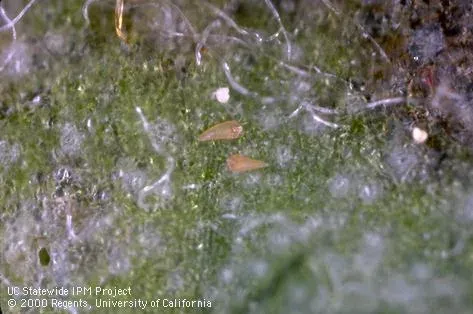
The pear leaf blister mite (Epitrimerus pyri) belongs to the Eriophyidae family, order Trombidiformes. These are microscopic pests, with adults measuring approximately 0.2 mm, making them nearly invisible to the naked eye.
Their bodies are elongated and spindle-shaped, typically pale yellow or white. Unlike spider mites, these pests possess only two pairs of legs situated at the anterior end, which is a diagnostic feature of this family.
Fertilized females overwinter in sheltered locations, primarily under the scales of dormant buds. As soon as temperatures rise in spring and buds begin to swell, the mites emerge and colonize the developing young leaves.
The mite completes several generations per season, depending on the climatic conditions. Warm and humid springs significantly promote population growth, leading to a rapid increase in the number of individuals.
Dispersal within an orchard occurs passively. Mites are spread by wind currents, pruning tools, or birds, facilitating the rapid colonization of healthy trees throughout the growing period.
What it damages
The primary host for Epitrimerus pyri is the pear tree. By feeding on the epidermal cells of the leaves, the mites cause localized physiological disruptions and the formation of characteristic galls.
Galls appear as small, blister-like swellings on the leaf surface. Initially, they are light green or yellowish, but as they age and the tissue dies, they turn dark brown or blackish, often resembling fungal lesions.
Heavy infestations lead to leaf deformation, curling, and premature senescence. This reduction in functional leaf area impairs photosynthesis, which negatively impacts tree vigor and fruit quality.
Significant infestations over consecutive years weaken the host tree, leading to poor bud development and a substantial reduction in yield. In severe cases, tree health declines, making the trees more vulnerable to other stresses.
In nursery conditions or young plantations, a high mite population can severely stunt growth, causing twisted shoots and preventing the proper development of the tree canopy.
Signs of infestation
Symptoms become apparent shortly after bud break, with the appearance of tiny light-colored spots on young leaves. As the season progresses, these spots develop into prominent galls or blisters.
The most visible sign is the discoloration of these galls. When they turn black, it is often mistaken for scab disease or other fungal infections. However, the blister structure is unique to mite feeding.
In cases of heavy infestation, the entire leaf surface may be covered with galls, causing the leaf to wither prematurely and fall off. This often leads to a sparse canopy by mid-summer.
Mite activity is most intense on the terminal leaves of new shoots. Close observation of these young leaves will typically reveal the first signs of the infestation long before the entire tree is affected.
Using a magnifying glass (at least 10x), one can observe the characteristic shape of the mites or their eggs inside the ruptured galls, confirming the diagnosis.
Control measures
Integrated Pest Management (IPM) is essential for effective control. Sanitary practices, such as removing and burning heavily infested branches during the dormant season, are the first line of defense.
Chemical control should be timed to coincide with the period when mites emerge from their winter quarters. Acaricide applications at the green tip stage are critical for success.
Sulphur-based products are highly effective and have a long history of use against eriophyid mites. They act as contact agents and help maintain control when applied according to the phenological stages of the tree.
Avoid broad-spectrum insecticides that may kill beneficial predatory mites (phytoseiids), as these natural enemies are crucial for maintaining the pear leaf blister mite population below the economic threshold.
- Prune and dispose of infested wood during winter.
- Apply acaricides at the green bud stage.
- Encourage biological control with predatory mites.
- Monitor young trees regularly for early signs.
Content graph
Connections · Pear leaf blister mite
Most often together:
Marketplace
Products · 17

Biology
Taxonomy
- Latin name
- Epitrimerus pyri
- Order
- Mites
- Family
- Eriophyidae
- EPPO code
- EPITPI
Community
Discussion
No discussions yet — be the first.