
Oak Beauty
Ennomos quercinaria
Description
How to identify
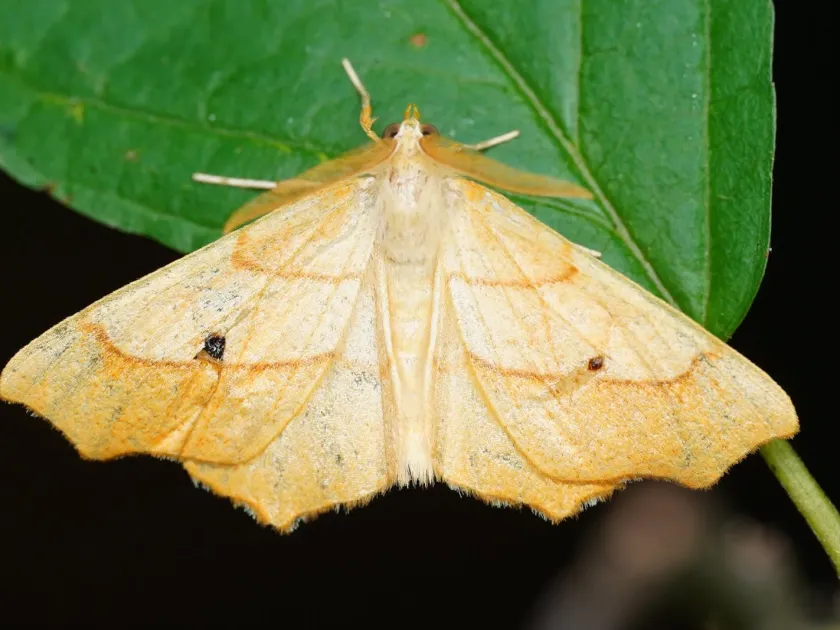
The Oak Beauty (Ennomos quercinaria) is a moth of the family Geometridae. The adult moth has a wingspan of 35–45 mm, with a distinctive angular shape to the edges of its forewings.
The coloration of the wings ranges from pale yellow to ochre-brown, providing excellent camouflage against dead leaves or bark. The body is slender and typical of the Ennomos genus.
The larvae are specialized mimics that resemble twigs of the host tree. They grow to a length of about 50 mm and are often greyish or brown to blend perfectly into the environment.
The pupae are typically formed within loose silken cocoons spun between leaves or in the crevices of bark. They are dark brown and often remain attached to the tree throughout the summer.
The species completes one generation per year. Winter is spent in the egg stage, with eggs laid singly or in small clusters on the branches of host trees.
What it damages
The primary hosts for this species are various oak species (Quercus). However, it is also known to feed on birch, beech, and various fruit trees such as apple and pear.
Larvae cause damage by consuming leaf tissue. Young caterpillars perform skeletonization, while larger larvae consume the entire leaf lamina, leaving only the main veins.
Significant defoliation occurs during outbreak years, which puts trees under severe physiological stress. This stress makes trees more susceptible to wood-boring insects and fungal pathogens.
In ornamental gardens or tree nurseries, the aesthetic damage caused by the larvae can be severe. The loss of foliage reduces the tree's overall vigor and growth rate for the season.
Consecutive years of heavy infestation can lead to dieback in the crown. This eventually weakens the tree and may lead to its decline if conditions remain favorable for the pest.
When it appears
Adult moths emerge in late summer, with the flight period typically occurring from August to September. During this time, they mate and lay eggs for the following season.
The eggs overwinter and hatch in the spring. Larval emergence is synchronized with the budding of the host trees, ensuring that food is available immediately upon hatching.
Active larval development and feeding occur throughout the months of May and June. During this phase, the larvae grow rapidly and cause the most noticeable damage to the canopy.
Pupation takes place in late June or early July. The duration of the pupal stage usually lasts about 3 to 4 weeks, depending on ambient temperatures.
Weather patterns significantly influence the timing of the lifecycle. A warm and dry spring often leads to earlier development and potentially higher survival rates for the larvae.
Signs of infestation
The presence of Oak Beauty is often signaled by irregular holes in the leaves or missing leaf margins in the upper sections of the tree canopy.
Finding larvae that mimic twigs is a definitive sign of infestation. They can often be found by gently tapping branches over a light-colored cloth or beating tray.
Increased activity of insectivorous birds in the canopy can also serve as a biological indicator of a growing larval population on the trees.
- Ragged leaf edges
- Presence of twig-like caterpillars
- Frass deposits under the tree
- Webbed leaves in the canopy
- Reduced crown density
At night, adults may be attracted to artificial light sources. Monitoring light traps can help entomologists assess the density of the moth population in a specific area.
Control measures
Natural predation by birds and parasitic wasps is a significant factor in controlling population outbreaks. Encouraging biodiversity in the landscape helps maintain a natural balance.
For tree care in nurseries, biological controls such as sprays containing Bacillus thuringiensis are highly effective against young caterpillars and have low environmental impact.
Chemical intervention with systemic insecticides is generally reserved for severe outbreaks where tree survival is at risk. Applications should target the foliage early in the larval stage.
Sanitation practices, such as removing heavily infested branches or clearing leaf litter, may help reduce the local population density of the pest.
For individual ornamental trees, physical barriers or manual removal of caterpillars can be an effective and environmentally friendly management strategy.
Taxonomy
- Latin name
- Ennomos quercinaria
- Order
- Lepidoptera (butterflies)
- Family
- Geometridae
- EPPO code
- ENNOQU
Discussion
No discussions yet — be the first.