
Pine looper
Ellopia
Description
How to identify
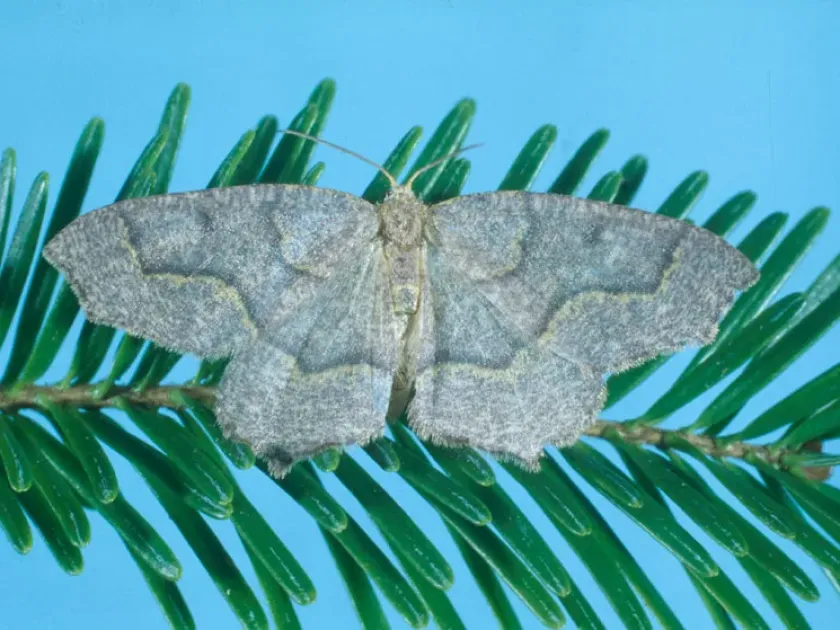
The pine looper (Ellopia prosapiaria) is a moth species from the Geometridae family. The adult moth has a wingspan of approximately 35–40 mm, with variable coloration ranging from reddish-brown to grayish, characterized by two distinct transverse lines on the wings.
The larvae, known as loopers or inchworms, exhibit the characteristic looping movement of the Geometridae family, drawing their posterior prolegs toward their thoracic legs and arching their backs.
Larval coloration varies significantly based on age and host plant, ranging from light green to brown, which provides effective camouflage against pine needles and bark.
The lifecycle includes complete metamorphosis: egg, larva, pupa, and adult. They typically overwinter as pupae hidden within the forest floor litter or crevices of the tree bark.
Adult moths are nocturnal, remaining hidden during the day and becoming active at dusk, which makes them difficult to observe in the field without special equipment.
What it damages
The primary host for this pest is the Scots pine (Pinus sylvestris), although other conifers such as spruce and larch may occasionally be targeted.
Early-stage larvae feed on the inner tissues of the needles, leaving hollowed-out shells, while older larvae consume the entire needle, leaving only short stubs.
Severe infestations can lead to total defoliation of the canopy, severely weakening the tree and making it highly susceptible to secondary pests like bark beetles.
Repeated defoliation over several consecutive seasons is a major cause of growth reduction and can lead to the widespread mortality of pine stands.
The damage is most noticeable in the upper parts of the crown, where larvae prefer to feed, often causing a scorched appearance of the tree foliage.
When it appears
Adult flight typically occurs during the summer months, usually spanning from June to August, depending on the climatic conditions of the region.
After mating, females deposit eggs singly or in small clusters on the pine needles or bark, ensuring that the next generation is well-distributed.
Larval development takes place during the late summer and autumn, which is when the most significant damage to the host trees is inflicted.
The timing of the egg hatch is strictly synchronized with the phenological development of the pine needles, ensuring that food is available immediately upon emergence.
Pupation occurs in autumn, with the larvae descending from the canopy to the ground to overwinter in the duff layer, protected from extreme winter temperatures.
Signs of infestation
Visible signs of infestation include yellowing or browning needles and the presence of small, dark, granular frass pellets accumulating on lower branches or spiderwebs.
Sparse crowns with missing needles in the upper canopy are clear indicators of high larval activity, often visible from the ground.
When disturbed, the larvae may drop from branches on silken threads, a common defensive behavior that also makes them easier to spot during field inspections.
Small silk mats or webs connecting needles can sometimes be observed, as larvae use silk to secure themselves and their food sources while feeding.
- Yellowing and browning of the needle canopy.
- Visible accumulation of larval frass.
- Premature needle drop during the summer.
- Sparse, thin crowns of affected trees.
Control measures
Biological control using Bacillus thuringiensis (Bt) is highly effective against young larvae and minimizes impact on non-target species in forest ecosystems.
Chemical control with systemic insecticides is reserved for outbreak situations where significant economic loss or tree mortality is expected.
Encouraging natural predators such as insectivorous birds and predatory wasps can help maintain population levels below the economic threshold.
Pheromone traps are essential for monitoring adult populations, allowing forest managers to predict outbreaks and time applications for maximum effectiveness.
Silvicultural management, including maintaining tree vigor and promoting mixed-species stands, helps to increase forest resilience against looper damage.
Taxonomy
- Latin name
- Ellopia
- Order
- Lepidoptera (butterflies)
- Family
- Geometridae
- EPPO code
- ELLOSP
Discussion
No discussions yet — be the first.