
Maple aphid
Eichaitophorus
Description
How to identify
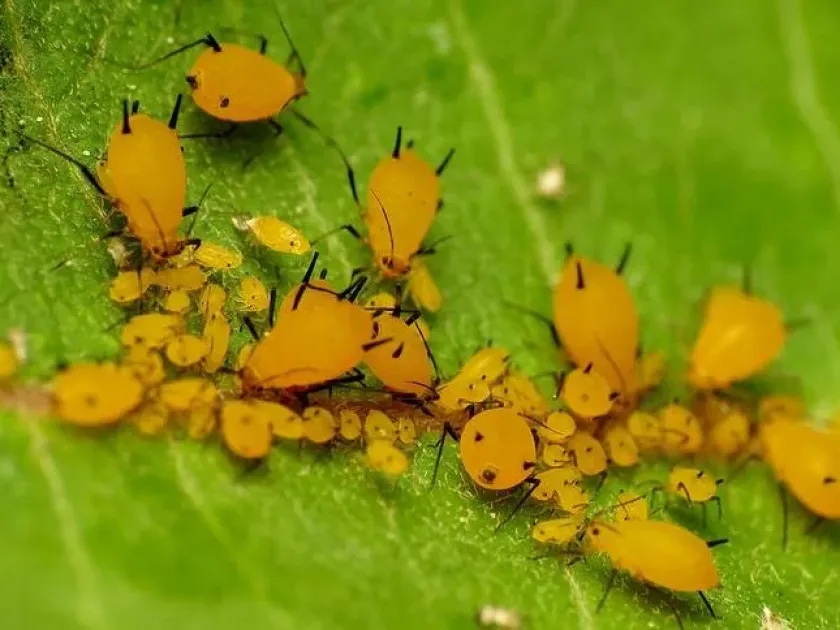
The maple aphid belongs to the order Hemiptera and the family Aphididae. These are small, soft-bodied insects typically measuring 2 to 3 mm in length, known for their specific feeding behavior on sap.
A key morphological feature of the genus Eichaitophorus is the presence of numerous small setae on the body, which helps distinguish them from other common aphid species found in urban landscapes.
These insects range in color from pale green to brownish-yellow, providing them with excellent camouflage against the foliage of their host trees.
The life cycle involves both winged and wingless forms. The winged individuals play a crucial role in dispersal to new host plants, ensuring the survival and expansion of the population during the growing season.
Overwintering occurs in the egg stage, with eggs typically laid by females in the crevices of bark on young shoots, remaining dormant until the spring emergence.
What it damages
Maple aphids primarily attack various species of maple trees. They congregate on the undersides of leaves and on the succulent tissue of young shoots to feed on phloem sap.
Continuous feeding causes the leaves to curl, yellow, and deform, which interferes with the tree's photosynthetic efficiency and stunts its overall growth.
The insects excrete honeydew, a sugary byproduct that coats the foliage and provides a growth medium for sooty mold, a fungus that further degrades the tree's health and appearance.
Severe infestations can lead to premature leaf drop, which puts the tree under significant stress and makes it more vulnerable to other pathogens and environmental pressures.
In nursery settings, maple aphid activity is particularly damaging, as it significantly reduces the aesthetic value and commercial viability of young maple seedlings.
When it appears
Activity usually begins in early spring, synchronized with bud break, when the overwintering eggs hatch into the first generation of nymphs.
The population often peaks during late spring and early summer, when warm and stable weather conditions allow for rapid reproduction and multiple generations to develop in quick succession.
During the summer months, the aphids continue to multiply, often forming dense colonies that are easily visible on the stems and leaf petioles of infested maples.
As autumn approaches, physiological changes triggered by shorter days lead to the production of sexual forms that mate and lay eggs for the winter.
Warm, extended autumns can allow for a late-season population surge, leading to a higher number of eggs being deposited, which increases the pressure for the following spring.
Signs of infestation
Leaf curling and yellowing are among the first visual symptoms that indicate a localized infestation of maple aphids on the tree canopy.
A sticky, shiny residue on the upper surface of lower leaves or on the ground beneath the tree is a classic sign of honeydew secretion resulting from aphid feeding above.
The presence of ant trails moving up and down the trunk is a strong indicator of aphid presence, as ants are known to tend to aphid colonies to harvest the honeydew.
The development of a black, powdery sooty mold on the foliage is a late-stage indicator that the aphid population has reached a high density and has been active for some time.
Dieback of new terminal growth and sparse foliage in the following spring are signs of severe stress sustained from an aphid outbreak in the previous season.
Control measures
Effective management requires a combination of monitoring, biological control support, and targeted chemical applications to prevent outbreaks from spreading.
When infestations are heavy, systemic insecticides are highly effective as they are absorbed by the tree and provide long-lasting protection against sap-sucking pests.
Promoting a healthy environment for natural predators, such as ladybugs, lacewings, and hoverflies, is a sustainable way to keep aphid populations below damaging thresholds.
- Pruning out heavily infested shoots to reduce the initial population.
- Washing the canopy with a strong water jet to physically dislodge the insects.
- Applying horticultural oils during the dormant season to kill overwintering eggs.
- Using insecticidal soaps or neem oil for mild, localized outbreaks.
Routine scouting of maple trees, especially during the peak spring growth window, is essential for identifying the early stages of an infestation and taking timely action.
Taxonomy
- Latin name
- Eichaitophorus
- Order
- Hemiptera (bugs, aphids, leafhoppers)
- Family
- Chaitophoridae
- EPPO code
- EICHSP
Discussion
No discussions yet — be the first.