
Poplar aphid
Chaitophorus populicola
Description
How to identify
The poplar aphid (Chaitophorus populicola) belongs to the order Hemiptera and the family Aphididae. These small insects undergo a life cycle consisting of nymph and adult stages, forming colonies on the undersides of leaves.
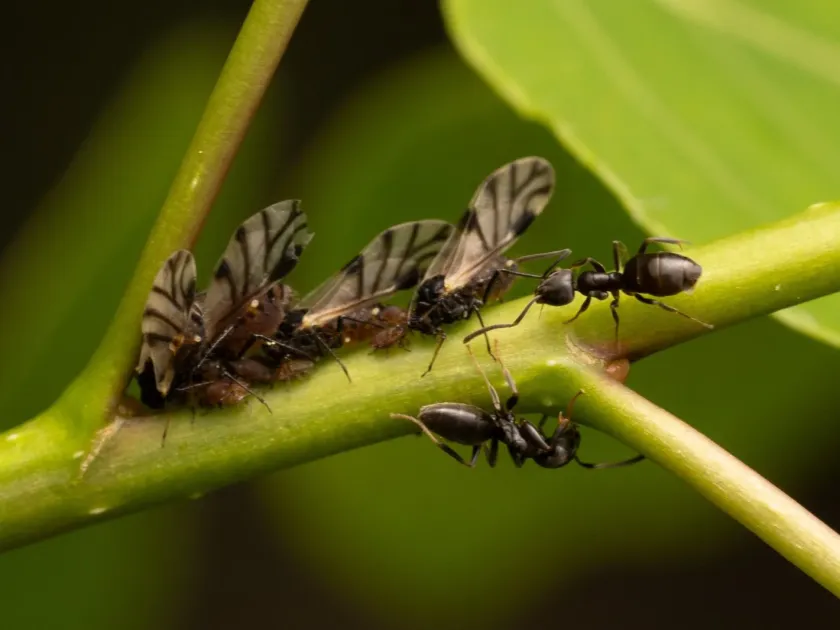
The species exhibits polymorphism, with both wingless and winged forms. The body color typically ranges from yellowish-green to brownish, providing effective camouflage against the leaf veins.
A key diagnostic feature is the presence of short, tube-like structures called cornicles on the posterior end of the abdomen. The body surface may be covered with fine hairs, which is a characteristic trait of the genus Chaitophorus.
Reproduction is asexual (parthenogenetic) during the summer and shifts to sexual reproduction in the late season. The insect overwinters in the egg stage, with eggs laid by females in bark crevices on young poplar shoots.
Aphid colonies are frequently associated with ants, which feed on honeydew—the sugary secretions of the aphids. The presence of ant trails on tree trunks is a reliable indicator of active infestation.
What it damages
The primary hosts for the poplar aphid are various species of the Populus genus. The pest is particularly damaging to young saplings in nurseries and ornamental trees in urban landscapes.
The aphid feeds by sucking sap from young leaves and non-woody shoots. This deprives the tree of essential nutrients, which is especially critical for saplings during their active growth phase.
In cases of mass infestation, the aphid colonizes large areas of the foliage. Intensive feeding weakens the tree, significantly reducing its natural resistance to secondary fungal infections and environmental stress.
Affected leaves often curl, deform, and drop prematurely. This disrupts photosynthetic processes, leading to stunted overall growth and a marked decline in the aesthetic quality of the trees.
Beyond direct damage, aphids serve as vectors for various plant viruses. The punctures caused by their mouthparts create entry points for pathogenic bacteria, which can cause tissue necrosis.
When it appears
The life cycle of the poplar aphid is closely synchronized with the phenology of the poplar host. In spring, as buds begin to burst, nymphs emerge from overwintering eggs and immediately begin feeding.
The most active period for colony growth occurs during May and June. Rapid asexual reproduction allows the population size to reach peak levels within a very short timeframe.
Summer generations often include winged females that act as dispersers. They migrate to neighboring trees, facilitating the spread of the infestation throughout forest patches or park areas.
In the second half of summer, activity may decline slightly if conditions become too dry. However, with sufficient moisture, the population typically remains high until the start of autumn.
As autumn approaches, sexual individuals appear. Females lay eggs that remain in the bark crevices throughout the winter, ensuring the survival of the species until the following spring.
Signs of infestation
The first visual sign of infestation is the curling or deformation of young leaves at the shoot tips. Leaves often look chlorotic and become coated with a sticky substance known as honeydew.
Sooty mold frequently grows on the surface of the honeydew deposits. This results in the blackening of leaves and twigs, which impairs the tree's appearance and interferes with normal gas exchange.
High ant activity on the tree trunk and branches indicates the presence of aphid "herds." Ants protect the colonies from natural predators, promoting their rapid expansion.
When examining the undersides of leaves, one can observe clusters of insects of various ages. The colonies appear as dense groups that slowly move across the leaf surface when disturbed.
Premature leaf drop in mid-summer, in the absence of severe drought, is a clear indicator of heavy infestation and significant depletion of the tree's internal resources.
Control measures
Management of the poplar aphid should begin with cultural practices. Removing root suckers and pruning heavily infested branches can significantly reduce the pest population density.
Biological control methods are highly effective. Encouraging natural predators such as lady beetles, lacewings, and hoverfly larvae helps to keep the population in check without chemical intervention.
In cases of severe infestation, systemic insecticides are recommended. Products containing imidacloprid or acetamiprid are absorbed into plant tissues, effectively eliminating the hidden pests.
Spraying with contact insecticides is most effective in early spring, before bud burst, to target the nymphs as they hatch. Summer treatments should be repeated at the first sign of new colonies.
Rotating insecticide modes of action is essential to prevent the development of resistant populations. All protection measures must comply with local environmental regulations and pesticide safety guidelines.
Taxonomy
- Latin name
- Chaitophorus populicola
- Order
- Hemiptera (bugs, aphids, leafhoppers)
- Family
- Chaitophoridae
- EPPO code
- CHAIPC
Discussion
No discussions yet — be the first.