
Willow black aphid
Chaitophorus nigrae
Description
How to identify
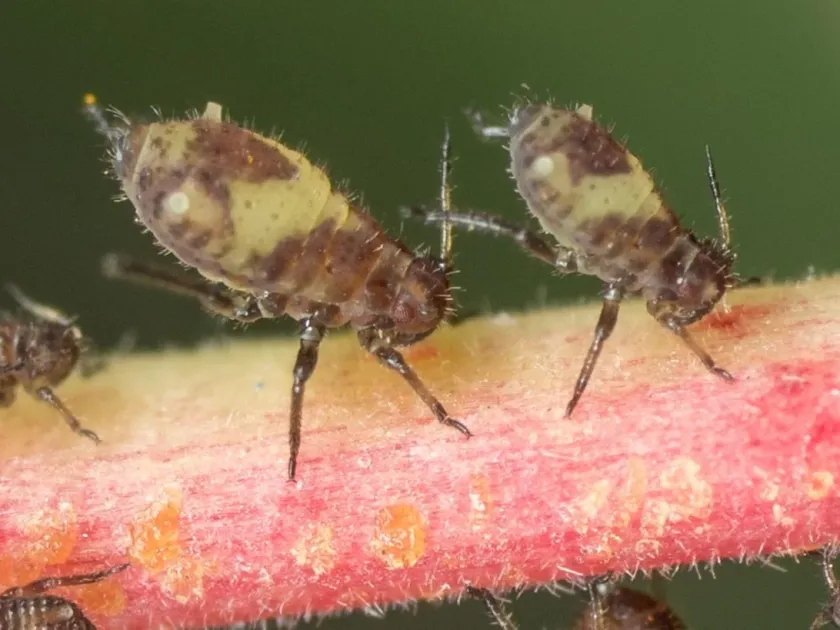
The Willow black aphid (Chaitophorus nigrae) is a member of the order Hemiptera and the family Aphididae. It is characterized by its dark brown or black coloration, which makes it blend in with the bark and foliage of host trees.
Adults occur in both apterous (wingless) and alate (winged) forms. The wingless females typically have an oval-shaped body, approximately 2 mm in length, while winged individuals are specialized for migration.
Nymphs are similar in appearance to adults but are smaller and lack developed reproductive organs. They grow through several molting stages before reaching adulthood.
These aphids live in dense colonies, typically found on the undersides of leaves or along young shoots of willow trees, often accompanied by active ant populations that tend to them.
Accurate identification requires careful inspection of the aphid's morphology under magnification, as they share many physical characteristics with other species within the Chaitophorus genus.
What it damages
The Willow black aphid primarily feeds on various species of willow (Salix). It poses a threat to both ornamental willow varieties in landscaping and native trees in natural habitats.
By using their piercing-sucking mouthparts, these insects drain essential plant fluids. This process saps the tree's energy, hindering its physiological development and overall health.
Heavy infestations lead to stunted growth, twisting of young shoots, and premature yellowing of leaves. If left unchecked, the damage can lead to the decline of entire branches.
The feeding process also compromises the plant's structural integrity, creating lesions that facilitate the entry of secondary pathogens, such as fungal or bacterial infections.
In nurseries, this pest causes significant economic losses by reducing the aesthetic value and vitality of willow saplings, making them unsellable or unsuitable for landscape projects.
When it appears
The life cycle begins in spring when overwintering eggs on the bark hatch into stem mothers. This emergence is closely linked to the budding of the willow trees.
Throughout the spring and summer, the population grows rapidly through successive generations of parthenogenetic females, which allows for exponential increases in colony size.
Peak activity and population density typically occur during June and July, when environmental temperatures are optimal for the insect's development and reproduction.
In autumn, as conditions deteriorate, sexual forms appear. Mating occurs, and the resulting eggs are laid in crevices of the bark, where they remain dormant throughout the winter months.
Dispersal is managed by the winged generations, which move to colonize new plant hosts, ensuring the continuity of the species despite fluctuations in weather conditions.
Signs of infestation
The most visible symptom of an infestation is the curling and distortion of young leaves at the branch tips. These leaves often turn chlorotic before eventually withering.
Sticky, sweet honeydew secreted by the aphids coats the leaves, providing a food source for ants and acting as a substrate for sooty mold, which appears as a black, powdery coating.
Sooty mold significantly reduces the plant's ability to perform photosynthesis and is an immediate visual indicator of a severe aphid infestation requiring attention.
Increased ant activity on the tree trunk and branches serves as a warning sign. Ants protect the aphids from predators, confirming the presence of a thriving colony.
Reduced shoot growth and premature leaf drop are critical signs that the colony has reached a level of damage that necessitates control measures to save the tree's health.
Control measures
Cultural control is the first line of defense, involving the pruning of heavily infested branches and maintaining tree vigor through proper irrigation and nutrition to aid recovery.
Biological control can be highly effective when natural predators such as lady beetles, lacewings, and hoverfly larvae are present. Protecting these beneficial insects is essential.
Chemical control with systemic insecticides is recommended for severe infestations. These products are absorbed by the plant and provide long-lasting protection against sucking pests.
Contact insecticides should be applied thoroughly, ensuring coverage of the leaf undersides, and timed to coincide with the early stages of aphid colonization for maximum success.
- Use sticky barriers on tree trunks to prevent ants from tending aphids.
- Apply insecticidal soaps for safe and targeted control on smaller trees.
- Monitor trees regularly starting from the first signs of bud break in spring.
Taxonomy
- Latin name
- Chaitophorus nigrae
- Order
- Hemiptera (bugs, aphids, leafhoppers)
- Family
- Chaitophoridae
- EPPO code
- PSEMSL
Discussion
No discussions yet — be the first.