
Dufouriellus ater
Dufouriellus ater
Description
How to identify
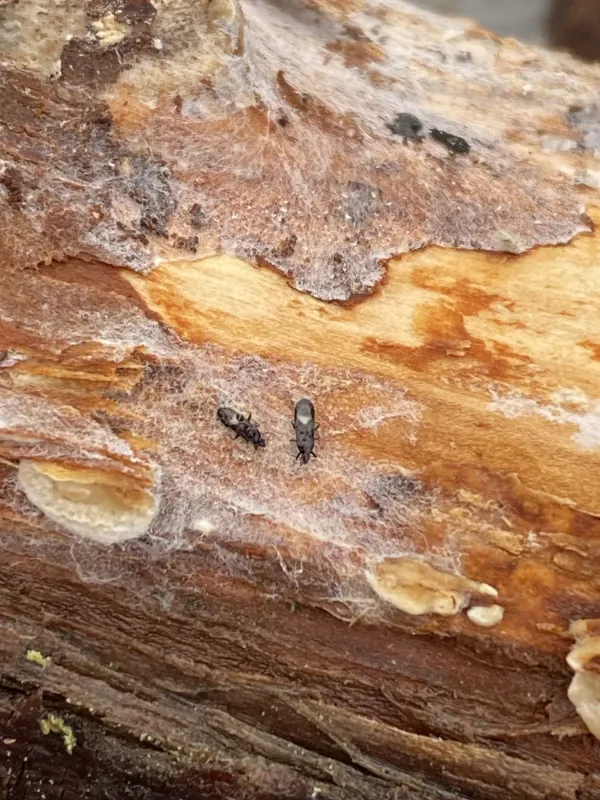
Dufouriellus ater is a small hemipteran bug belonging to the Anthocoridae family (flower bugs). The adults are approximately 2–3 mm long and have a flattened body, which allows them to move easily within narrow fissures of tree bark.
The coloration of adults varies from dark brown to almost black, providing excellent camouflage on tree trunks. The pronotum is wide, and the wings are well-developed, allowing the bugs to fly in search of food or suitable habitats.
Nymphs resemble smaller versions of the adults but lack wings and exhibit a lighter, yellowish-brown coloration. Their development occurs secretively, mainly within the bark cracks of deciduous and coniferous trees.
Systematically, this species belongs to the order Hemiptera, family Anthocoridae. Although many species in this family are beneficial entomophages, Dufouriellus often inhabits areas where other insects cluster, utilizing the bark micro-environment for protection and feeding.
The life cycle is closely linked to the condition of tree stands, as the bark serves as the primary substrate for egg-laying and overwintering. In temperate climates, the species is sedentary, moving along the trunk following food sources.
What it damages
Dufouriellus ater is mainly associated with damaged areas of tree bark. It often colonizes galleries created by other xylophagous insects, which makes it difficult to classify the extent of its direct impact on the plant.
Although this species is often considered a predator feeding on small insects under the bark, its presence can indicate a general weakening of the tree, which has become a favorable environment for a complex of various pests.
Under certain conditions, Dufouriellus may feed on plant sap, damaging young tissues at bark splits or sites injured by other pests, which can lead to localized necrosis of the cambium.
Mass accumulations of bugs in cracks can impede the healing of mechanical bark damage, facilitating the development of secondary infections, including fungal wood diseases.
The economic importance of this pest is considered moderate; however, in nurseries and young orchards, excessive activity requires monitoring of the trunk state to prevent secondary infestation by pathogens.
When it appears
The activity of Dufouriellus begins in early spring when temperatures rise, as the insects emerge from their overwintering sites located in deep bark cracks.
The highest population density is observed in mid-summer, when reproduction and the development of multiple bug generations take place within the tree bark layers.
In autumn, as daily temperatures decrease, the insects gradually enter diapause, hiding in the deepest and most protected bark crevices to survive winter frosts.
The number of generations per season directly depends on the region and the length of the warm period, often reaching two or more broods in southern areas.
The presence of moisture under the bark is a crucial factor, stimulating bug activity during dry summer months as they navigate the trunk in search of micro-climatically stable zones.
Signs of infestation
The main signs of Dufouriellus presence are characteristic excrement appearing as tiny black dots left by the bugs around their galleries and bark cracks.
When dead layers of bark are removed, clusters of the insects themselves can be found; they are highly sensitive to vibration and light and disperse rapidly.
The presence of empty egg shells or nymphal skins (exuviae) inside bark cracks is direct evidence of a persistent population on the tree.
- Darkening of tissues at bark damage sites.
- Presence of small black bug clusters in crevices.
- Microscopic punctures on young shoots if the pest is forced to switch to sap feeding.
Visual inspection of trunks with a magnifying glass helps detect the pest, although due to their small size and secretive nature, detection often occurs accidentally during sanitary pruning.
Control measures
The primary control method involves conducting agrotechnical measures aimed at maintaining tree health, including cleaning trunks of loose, dead bark.
Timely whitewashing of trunks with lime supplemented by insecticides helps reduce the number of overwintering pests by destroying them in their shelters.
In cases of high density in commercial orchards, the use of systemic insecticides capable of penetrating deep into the bark to reach hidden insects is recommended.
Sanitary pruning and timely sealing of wounds on trunks with special garden wax deprive Dufouriellus of sites for safe reproduction and feeding.
Regular monitoring of bark conditions allows for the detection of early infestations, enabling the application of soft biological control methods to suppress the population before significant damage occurs.
Taxonomy
- Latin name
- Dufouriellus ater
- Order
- Hemiptera (bugs, aphids, leafhoppers)
- Family
- Anthocoridae
- EPPO code
- PIETAT
Discussion
No discussions yet — be the first.