

Description
How to identify
The pine sawfly (genus Diprion) belongs to the order Hymenoptera, family Diprionidae. Despite the name, they are not true flies, but closer relatives to bees and wasps.
Adult sawflies have four membranous wings. Females possess a specialized saw-like ovipositor, which they use to cut slits into pine needles to deposit their eggs safely.
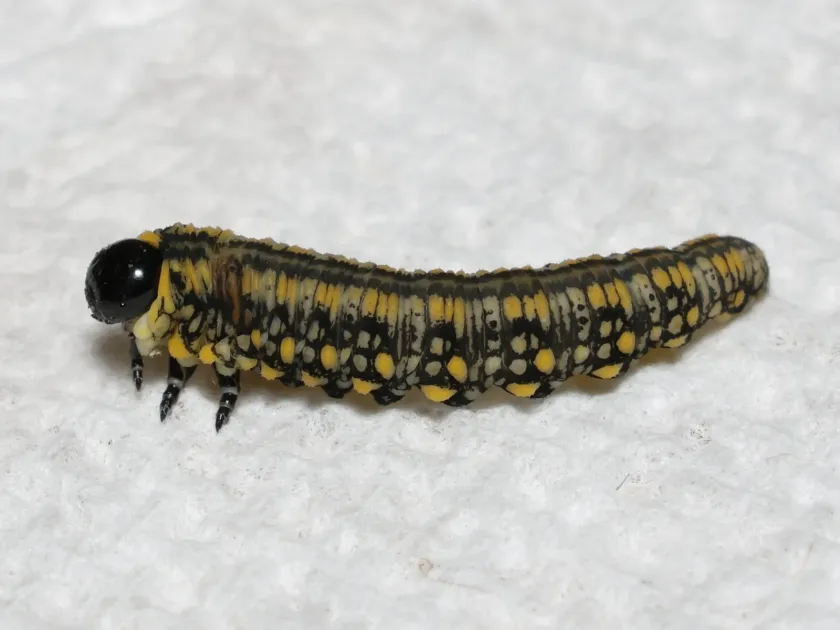
The larval stage, often referred to as false caterpillars, is the most destructive phase. They typically feature a dark-colored head and a multi-legged, greenish or yellowish body.
Unlike butterfly larvae, pine sawfly larvae have more than five pairs of prolegs. This morphological feature is essential for distinguishing them from other forest pests.
Pupation occurs in tough, dark, cylindrical cocoons. Depending on the species, these can be found within the leaf litter beneath the trees or attached directly to the needles and twigs.
What it damages
Sawflies primarily target conifers, with a strong preference for various pine species. In certain cases, they also infest spruces and other coniferous evergreen trees.
Larvae feed gregariously, meaning they gather in groups to consume foliage. They start by eating the edges of needles and later consume entire needles, leaving only the central vascular strand.
Severe infestations can lead to total defoliation of a tree. This stress severely weakens the tree, making it highly susceptible to opportunistic secondary pests like bark beetles.
Consecutive years of heavy feeding significantly stunt tree growth and reduce timber quality. In nursery settings, infestation can cause massive mortality among young seedlings.
Damage results in reduced photosynthetic capacity, weakening the tree's overall vigor. The loss of foliage also affects the tree’s ability to survive subsequent environmental stresses like drought.
When it appears
Adult emergence typically begins in the early spring as temperatures rise. This is the period when mating occurs and eggs are inserted into the needles of host trees.
Larvae emerge from eggs after a few weeks of embryonic development. The peak feeding activity for the first generation usually happens during late spring, around May and June.
After completing their development, the larvae drop to the ground or remain on the branches to spin cocoons and pupate. The pupal stage is relatively short during the summer.
A second generation may appear mid-to-late summer, especially in warmer climates. This generation continues the damage cycle into the early autumn months.
The species overwinters as a prepupa inside its cocoon. The protective nature of the cocoon allows it to survive extreme winter conditions in the soil or forest litter.
Signs of infestation
The first sign of an infestation is the presence of brown, dried-out slits on the needles, which indicate where the female sawfly has laid her eggs.
As the larvae hatch and start feeding, they are easily visible due to their habit of congregating in groups. The foliage starts showing thinning or jagged edges from their feeding patterns.
Significant amounts of frass, which are small dark droppings, will be visible on the branches or accumulating on the ground beneath the tree canopy.
Severe defoliation is evident when needles appear clipped or missing, giving the tree a sparse, thin look. This contrasts sharply with the healthy, dense foliage of adjacent trees.
A diagnostic test is to gently shake a suspected branch. If larvae are present, they often exhibit a collective defensive display by rearing their heads and tails simultaneously.
Control measures
Mechanical control includes physically removing or crushing egg clusters on small trees. Shaking infested branches over a sheet can help collect and dispose of larvae.
Biological control methods are very effective, particularly the application of specific nucleopolyhedroviruses (NPV) that target only sawfly species, leaving beneficial insects unharmed.
Chemical control involving systemic or contact insecticides is recommended only when the pest population exceeds established economic thresholds to prevent widespread tree loss.
Encouraging natural predators such as parasitic wasps (ichneumonids) and predatory bugs is an excellent long-term strategy for maintaining low sawfly population levels.
Cultural practices, such as maintaining healthy tree stands and avoiding overly dense plantings, help ensure that trees remain resilient enough to recover from minor pest activity.
Content graph
Connections · Pine sawfly
Most often together:
Marketplace
Products · 1
Biology
Taxonomy
- Latin name
- Diprion
- Order
- Hymenoptera
- Family
- Diprionidae
- EPPO code
- DIPRSP
Community
Discussion
No discussions yet — be the first.