
Fever fly
Dilophus febrilis
Description
How to identify
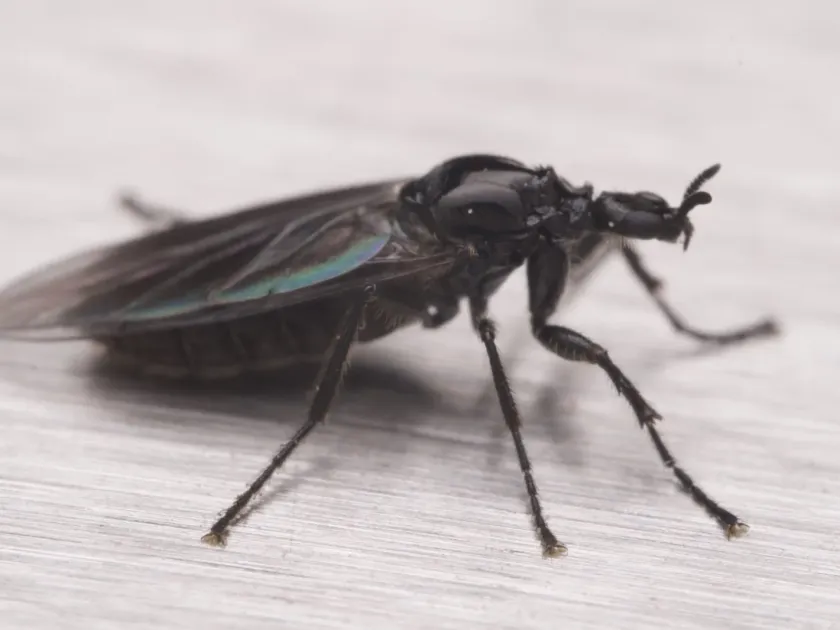
The fever fly (Dilophus febrilis) belongs to the family Bibionidae, order Diptera. Adult flies are typically black with a distinctive thoracic shield characterized by visible tooth-like projections, which helps in their identification.
The larvae are cylindrical, growing up to 6–10 mm in length. Their appearance is generally a dull white or brownish-yellow, featuring a hardened cuticle and a well-developed head capsule with strong mandibles.
The life cycle consists of egg, three larval instars, pupal, and adult stages. Depending on the local climate and temperature, this species typically completes one or two generations per year.
Overwintering occurs primarily in the larval stage deep within the soil profile, providing protection against frost. As temperatures rise in spring, the larvae move upward, pupate, and emerge as adult flies.
While adult flies feed on nectar and are essentially harmless to plants, they are responsible for egg-laying. Female flies seek out organic-rich soil to deposit their eggs, which later hatch into voracious larvae.
What it damages
Fever fly larvae are polyphagous and can cause significant damage to a wide range of plants, including cereals, vegetable crops, and ornamental turf. They are particularly troublesome in managed landscapes.
In cereal crops, larvae often attack the root systems and the base of the stems of seedlings. This damage causes plants to wilt, yellow, and eventually die if the infestation is severe enough.
Turfgrass damage is a major economic concern. Larvae consume the roots of grass, causing dead patches in lawns that can be easily pulled away. This destroys the integrity of the turf and allows weeds to invade.
Vegetable crops, especially root vegetables like carrots and potatoes, are prone to tunneling by these larvae. This damage often ruins the produce and introduces secondary bacterial and fungal pathogens.
The severity of the damage is directly linked to larval density. Large aggregations in the soil can decimate entire patches of crops, leading to significant yield loss in intensive farming and gardening.
Signs of infestation
One of the earliest signs is the sudden wilting of healthy-looking plants that cannot be explained by drought. This indicates that the root structure has been compromised by underground feeding.
Inspecting the soil surface around affected plants often reveals small holes or loosened dirt. If you pull at a wilted plant, it may lack roots or show clear signs of chewing along the stem base.
On lawns, look for circular or irregular patches of dying grass that turn brown. These patches usually feel loose when touched, confirming that the root system underneath has been eaten away.
During the spring, the emergence of numerous black flies suggests a high population density. This is a crucial window for scouting to estimate the potential larval pressure for the coming weeks.
- Yellowing and wilting of young seedlings.
- Plants easily removed from the soil due to root destruction.
- Presence of larvae in the top 5 cm of the soil.
- Dead patches in turf that lift away like a carpet.
Control measures
The most effective management strategy is sound cultural practice. Deep tillage and regular soil cultivation help disrupt larval habitats, exposing them to predators and unfavorable environmental conditions.
Weed control is essential, as some weeds serve as alternative hosts for the larvae. Farmers should also minimize the use of fresh manure, as it is a strong attractant for egg-laying female flies.
Chemical control involving soil-applied insecticides may be necessary in high-pressure scenarios. It is vital to time these applications correctly, often targeting early larval stages for maximum effectiveness.
Biological control using entomopathogenic nematodes is highly recommended for lawns and ornamental gardens. These microscopic organisms target the larvae specifically and pose no threat to the surrounding environment.
Monitoring using yellow sticky traps is a useful method for tracking adult flight. By identifying the peak flight period, gardeners can take preemptive action to reduce the next generation of larvae.
Taxonomy
- Latin name
- Dilophus febrilis
- Order
- Diptera (flies)
- Family
- Bibionidae
- EPPO code
- DILPFB
Discussion
No discussions yet — be the first.