
March fly
Bibio imitator
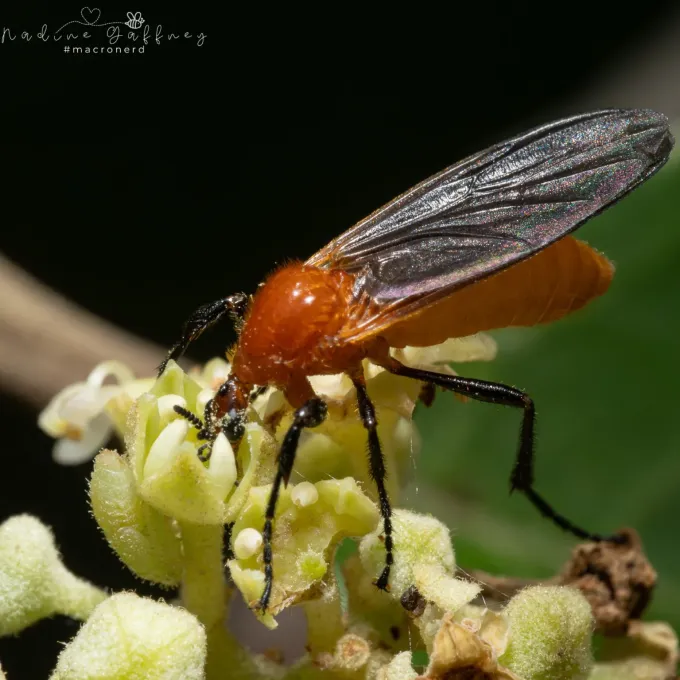
Description
How to identify
The March fly (Bibio imitator) belongs to the order Diptera, family Bibionidae. Adult specimens have a robust body approximately 8–10 mm long, typically featuring a velvety-black coloration.
The larvae of this pest reach 15–20 mm in length. They possess a brownish-gray color, a cylindrical body with a well-defined dark head, and numerous small projections on their segments.
Adult insects are frequently encountered in early spring, flying in groups over fields and orchards during sunny days. They are not very agile and are often seen feeding on plant blossoms.
The insect develops through complete metamorphosis: egg, larva, pupa, and imago. The larvae, residing in the upper soil layers, represent the primary threat to agricultural crops.
A key identification sign is finding clusters of larvae in humus-rich soil, where they initially feed on decaying organic matter before switching to the roots of cultivated plants.
What it damages
Bibio imitator larvae damage the root system of a wide range of crops, including vegetables, cereals, ornamental plants, and young fruit tree saplings.
The larvae feed on underground plant parts: they graze on young roots, bite off the root collars, and burrow into bulbs and tubers, facilitating the entry of secondary fungal and bacterial infections.
Significant damage is typically recorded in nurseries, where the destruction of the root system causes stunted growth or total plant mortality during the spring season.
In conditions of high soil moisture and the presence of uncomposted organic fertilizers, the pest pressure increases dramatically due to the higher density of larvae in the soil.
Damaged plants lose turgor, turn yellow, and exhibit severely reduced development, making them highly susceptible to soil-borne pathogens.
When it appears
Mass emergence of adult March flies typically occurs in March and April, which corresponds to the time of nature's awakening and the start of spring field activities.
The life cycle is univoltine (one generation per year). Larvae overwinter in the soil at a depth of 10–15 cm, where they remain active even at low positive temperatures.
After spring emergence and mating, females lay eggs in clusters directly into soil rich in organic matter or under mulch layers, where moisture is maintained.
The incubation period for eggs lasts two to four weeks, depending on soil temperature. First-generation larvae begin active feeding on roots in late spring and early summer.
By mid-summer, the larvae complete their development and pupate in the soil within specialized cells, where they remain in a dormant state until the following spring.
Signs of infestation
The first sign of infestation is the sudden wilting of seedlings or young plants during the spring period, despite adequate soil moisture levels.
Upon inspecting the root system of affected plants, one can observe characteristic "nibbled" root tissue and the presence of larvae in the surrounding soil profile.
Small mounds of loose soil on the surface can indicate the presence of high populations of soil-dwelling larvae.
Infestation is often correlated with the application of fresh manure or immature compost, as these attract female March flies for egg-laying.
The observation of mass emergence of adult flies in early spring serves as a warning signal to implement preventive soil management practices.
Control measures
Effective agrotechnical control involves deep soil cultivation (plowing or tilling) in late summer, which destroys the pupation sites and eliminates the larvae.
Avoiding the use of uncomposted organic matter is crucial, as it creates an attractive breeding ground for the March fly during the current season.
Maintaining crop rotation and timely removal of crop residues, which serve as a substrate for larval development, significantly reduces the risk of infestation.
If larval populations are high, soil-applied insecticides containing approved active ingredients can be used to control soil-dwelling insects.
- Regular cultivation between rows during spring.
- Use of cover crops to improve soil structure and health.
- Monitoring adult population levels using light traps or colored sticky cards.
Taxonomy
- Latin name
- Bibio imitator
- Order
- Diptera (flies)
- Family
- Bibionidae
- EPPO code
- BIBIIM
Discussion
No discussions yet — be the first.