
St Mark's fly
Bibio clavipes
Description
How to identify
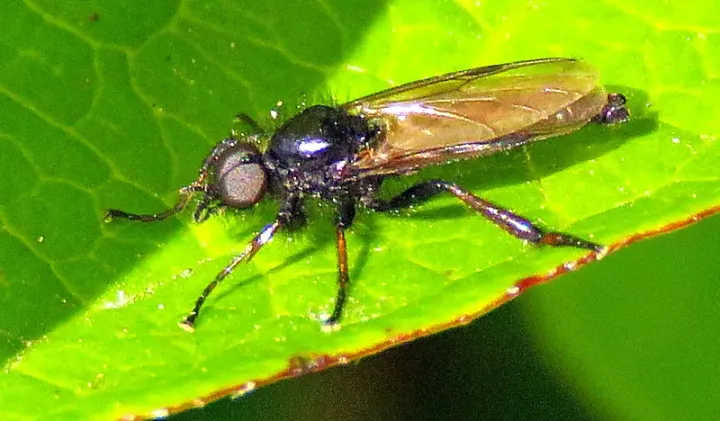
The St Mark's fly (lat. Bibio clavipes) belongs to the order Diptera and the family Bibionidae. The adult has a stout body about 10–12 mm long with characteristic thickened front femurs.
The coloration ranges from black to dark brown, and the body is covered in dense hairs. Males have large compound eyes that occupy a significant part of the head, which assists them in finding mates.
The larvae reach 15–20 mm in length, have a cylindrical shape, and possess a dark brown, almost black head. The larva's body is covered in numerous outgrowths, giving it a distinct spiny appearance.
The life cycle includes one generation per year. Larvae overwinter in the soil, where they continue to develop, feeding on organic matter, or on living plant tissues if organic food is scarce.
Adults appear in early spring, often observed in March and April, which is the origin of their common name. The mass flight lasts only for a few weeks.
What it damages
St Mark's fly larvae are polyphagous. They inhabit the topsoil layer, where they damage the root systems of many agricultural and ornamental crops.
The greatest damage is caused to young cereal seedlings, vegetable crops such as carrots, beets, and potatoes, as well as garden strawberries.
In orchards, larvae can damage the roots of fruit trees and berry bushes, especially in nurseries where high planting density facilitates the rapid spread of the pest.
Damage manifests as gnawing on the root collar and fine roots, leading to plant weakening, yellowing of the leaves, and often the complete death of seedlings or young plants.
Adult flies feed on flower nectar, so their indirect damage may be associated with disease transmission or damaging delicate petals during massive swarming on plants.
Signs of infestation
The main sign of infestation is the sudden wilting of plants without visible reasons in the aerial part, especially in areas with high humus content.
Upon inspecting the root system of damaged plants, one can find grey or dark brown larvae grouped in the soil near the roots.
In fields and garden beds, signs of the pest's presence manifest as bare patches where seedlings have died due to damage to the underground part of the stem.
The mass flight of the flies themselves in the spring serves as a signal that a significant number of larvae have accumulated in the soil, ready for pupation and adult emergence.
Damaged roots often show signs of feeding, and secondary fungal infections can develop at the damage sites, accelerating plant rot.
Control measures
Agronomic methods include regular soil cultivation, which disrupts larval habitats and exposes them to birds and predatory insects.
Crop rotation is essential: avoiding the planting of host vegetable crops in the same location for at least 3–4 years significantly reduces the pest population.
Deep autumn plowing helps reduce the number of larvae by bringing them to the surface, where they perish due to low winter temperatures or predation.
Chemical control is applied when the pest population is high, using soil insecticides incorporated into the soil during the preparation of beds for sowing.
Biological control using entomopathogenic fungi or nematodes serves as an effective and safe supplement to destroy larvae within the soil environment.
Taxonomy
- Latin name
- Bibio clavipes
- Order
- Diptera (flies)
- Family
- Bibionidae
- EPPO code
- BIBICL
Discussion
No discussions yet — be the first.