
March fly
Bibio femoralis
Description
How to identify
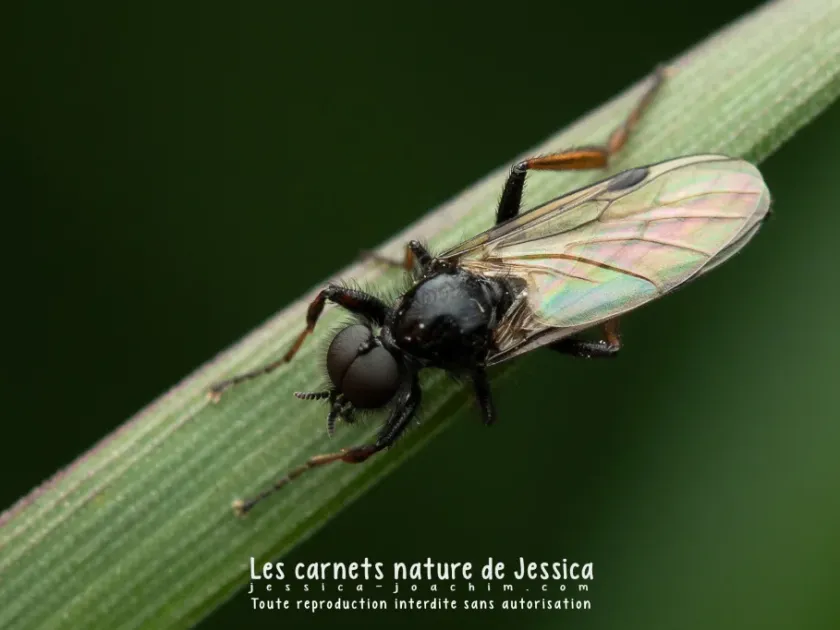
The March fly, belonging to the Bibionidae family, is a small insect measuring approximately 6–10 mm. Adults are typically dark, often black or brown, with a noticeably fuzzy or hairy appearance.
There are distinct morphological differences between males and females of this species, particularly in eye structure. Females have significantly smaller eyes, which helps in field identification.
The larvae are cylindrical with a greyish-brown color. Their bodies are covered in numerous tiny projections and bristles, providing a distinct look that separates them from other soil-dwelling larvae.
The larva has a well-defined and highly sclerotized head, allowing it to feed efficiently on organic matter and plant roots in the soil. Development occurs primarily within the upper layer of the soil humus.
Adults typically emerge in early spring, which is the origin of their common name. They often congregate in large groups on flowering plants, feeding on nectar during their short lifespan.
What it damages
The primary agricultural threat comes from the larvae living in the soil. While they are essentially polyphagous and feed on decomposing organic matter, they will attack living plant tissues when food is scarce.
The pest affects a wide range of crops, including cereals, root vegetables, and seedlings. Young crops are especially vulnerable during germination and the emergence phase.
Larvae damage the root system by chewing on underground stems and roots. This weakens the plant, reduces its vigor, and often leads to the death of the young sprout.
In addition to direct mechanical damage, root lesions provide entry points for secondary fungal and bacterial infections. As a result, affected fields often show patchy crop loss.
During years of high population density, March flies can cause significant economic losses to farms by reducing plant stand density and overall crop yield.
When it appears
The life cycle of this insect consists of a single generation per year. Adult activity occurs mainly in March and April, during which mating and egg-laying take place.
Females deposit eggs in soil rich in organic matter or directly under plant debris. After a few weeks, larvae emerge and begin active feeding.
The peak period for larval feeding is the spring and summer season, followed by the pupation stage in the soil. Larvae overwinter in deeper soil layers to survive cold temperatures.
The early spring emergence of adults is linked to their tolerance for lower temperatures. Warmer weather acts as a signal for the massive emergence of adults to the surface.
Weather conditions significantly impact female fecundity and larval survival. A wet and cool spring usually favors higher population numbers of the pest in the current season.
Signs of infestation
One of the first signs of infestation is the wilting and yellowing of seedlings without visible surface causes. Excavating the plant often reveals chewed or damaged roots.
The presence of a large number of adults near fields in early spring is an indicator of a high probability of egg-laying. This should trigger monitoring of the root system.
Inspecting the soil around damaged plants often reveals clusters of larvae, as they tend to stay in groups within the topsoil layer, especially in moist conditions.
Another characteristic sign is the presence of focal crop failures in the field, where root damage has become severe. In these areas, the soil may appear looser due to larval activity.
Diagnostics are improved by using soil traps to assess larval population density prior to sowing or during the seedling emergence stage.
Control measures
Effective control begins with agrotechnical measures, such as deep plowing and thorough incorporation of plant residues, which removes the larvae's primary food source.
Crop rotation is essential for reducing the pest population, as it interrupts the development cycle and prevents the buildup of larvae in specific fields over time.
If larval density is high, soil-applied insecticides should be used. These treatments must have contact or systemic action to effectively target the pest in the root zone.
Managing soil moisture is a crucial element, as waterlogged soil creates an ideal environment for the fly's reproduction. Proper field drainage reduces the risk of infestation.
Biological control methods, including the use of entomopathogenic fungi or nematodes, are promising options for population reduction but require strict adherence to application protocols.
Taxonomy
- Latin name
- Bibio femoralis
- Order
- Diptera (flies)
- Family
- Bibionidae
- EPPO code
- BIBIFM
Discussion
No discussions yet — be the first.