
St Mark's fly
Bibio hortulanus
Description
How to identify
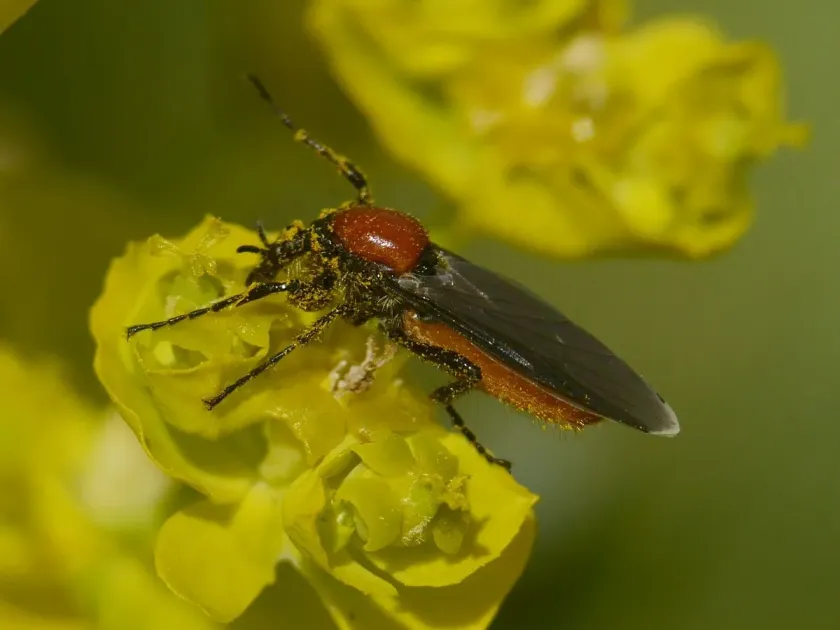
St Mark's fly (Bibio hortulanus) is a member of the Bibionidae family, order Diptera. Adults are 6–9 mm long, black, and covered with dense hairs.
Males possess large eyes covering most of the head, while females have smaller heads and often exhibit a brownish or reddish body coloration.
Larvae can reach 20–25 mm in length. They are cylindrical, slightly flattened, with a dirty-grey or brown color, a dark head, and distinctive body projections.
Adults are easily recognized by their slow, sluggish flight, often clustering in large numbers on flowering plants during the spring season.
Larval development occurs entirely underground, making them difficult to detect without careful soil examination.
What it damages
The damage is caused by the larvae, which are polyphagous. They feed on underground plant parts, including roots and tubers of various crops.
Affected plants include vegetables such as beets, carrots, onions, as well as seedlings of tomatoes and cabbage.
Larvae can severely harm ornamental plants by chewing through roots, which often leads to the wilting and eventual death of young seedlings.
Besides crops, larvae feed on decomposing organic matter, meaning high populations are common in soils heavily treated with raw manure.
In cases of heavy infestation, larvae can destroy the root systems of entire crop rows in a short time, leading to significant yield loss.
When it appears
St Mark's fly has a single-year life cycle. Adults appear in early spring, typically in April or May, which is the origin of their common name.
Adults live for a short period, feeding on nectar before females lay eggs in loose, moist soil rich in organic material.
Larvae hatch by summer and begin feeding intensively on roots, remaining in the soil throughout the summer and autumn months.
They overwinter in the soil at depths of up to 20 cm, surviving low temperatures to pupate and emerge as adults the following spring.
Peak larval activity occurs during the second half of summer and autumn, when larvae reach maturity and become highly voracious.
Signs of infestation
A primary sign of infestation is sudden wilting of young plants, which can be easily pulled from the soil due to root destruction.
Inspection of the root system often reveals chewed areas or the total absence of fine root hairs on the affected plants.
Soil excavation around wilting plants frequently uncovers larvae, which tend to cluster in areas with concentrated organic matter.
The presence of large numbers of adults on flowering shrubs in spring can indicate that the soil is infested with egg clutches.
If bald spots appear in seedling beds, it is recommended to inspect the soil at a depth of 5–10 cm for larval presence.
Control measures
Good agricultural practice is essential; specifically, ensure that all manure used as fertilizer is fully composted before application.
Regular soil cultivation and deep autumn plowing disrupt the larvae's habitat and increase their exposure to predators and dehydration.
Practicing crop rotation helps prevent the buildup of pest populations by limiting their food source in specific areas over time.
In cases of severe infestation, the application of appropriate soil-based insecticides registered for agricultural use may be necessary.
Biological control, such as encouraging birds to visit the garden, is highly effective, as they feed on larvae during soil tilling.
Taxonomy
- Latin name
- Bibio hortulanus
- Order
- Diptera (flies)
- Family
- Bibionidae
- EPPO code
- BIBIHO
Discussion
No discussions yet — be the first.