
St. Mark's fly
Bibio albipennis
Description
How to identify
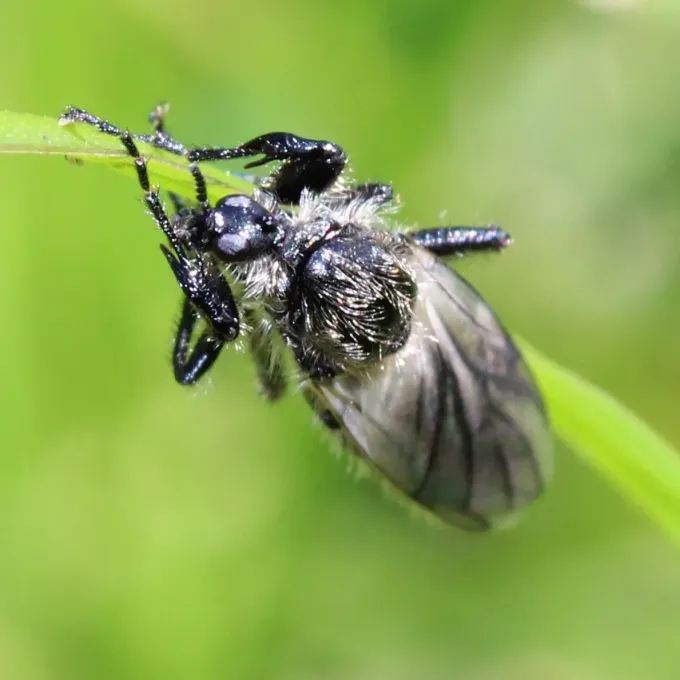
The St. Mark's fly (Bibio albipennis) belongs to the order Diptera and the family Bibionidae. Adults typically measure 7–10 mm in length and possess a robust, bulky body structure characteristic of this family.
The name refers to the distinctive appearance of the wings, which often display a pale or whitish sheen. Males are generally black, while females exhibit a lighter, brownish-red coloration on the thorax and abdomen.
The larvae are approximately 15–20 mm long, featuring a cylindrical, segmented body with a dark, sclerotized head capsule. Their skin is covered with small, wart-like projections and short bristles.
The life cycle involves complete metamorphosis, including egg, larval, pupal, and adult stages. The species usually produces one generation per year, with the larvae spending the winter in the soil.
Adult flies are short-lived and are commonly seen swarming in spring, often congregating near nectar-rich plants or hedgerows before mating and laying eggs in organic-rich soil.
What it damages
While adult flies feed on nectar and pollen and are considered harmless to crops, the larvae are the primary stage responsible for agricultural damage.
These larvae are primarily saprophagous, meaning they feed on decaying organic matter. However, when population density is high, they turn to feeding on the roots and underground stems of living plants.
Vegetable crops such as potatoes, carrots, beets, and young cereal seedlings are particularly susceptible to damage, especially when organic-rich fertilizers are used.
Larval feeding causes lesions on roots, which disrupts water and nutrient uptake, leading to stunted growth, yellowing foliage, and potentially the death of the plant.
In greenhouses or nurseries, large larval populations can devastate delicate seedlings, leading to significant economic losses for growers if left unmanaged.
When it appears
Adults emerge early in the spring, typically around March or April, which aligns with the time of year when many crops are beginning their vegetative growth phase.
The adult activity period is brief, lasting only a few weeks. During this time, the flies focus entirely on reproduction and selecting suitable oviposition sites in moist, organic soil.
The larval stage is the longest part of the life cycle, with larvae developing steadily throughout the summer and autumn months before overwintering.
Increased feeding activity typically occurs in early spring as soil temperatures rise, allowing the larvae to move more freely and forage on the root systems of young crops.
Pupation takes place in the soil in late winter or early spring, following which the new generation of adults emerges to repeat the cycle.
Signs of infestation
A primary indicator of infestation is the unexplained wilting or sudden death of young seedlings despite adequate soil moisture and care.
Upon inspecting the soil around the base of damaged plants, one may find groups of greyish, brown-headed larvae clustering near the roots or within the soil aggregates.
Bare patches in rows of vegetables or grain crops, where growth is uneven or stunted, are frequent visual signs that soil-dwelling larvae are active in the area.
In cases of severe infestation, the roots of the affected plants may appear visibly damaged, with missing root hairs or scarred surfaces where the larvae have been feeding.
Large swarms of adult flies in the spring are a reliable precursor that warrants careful monitoring of the soil for larval presence before planting susceptible crops.
Control measures
Cultural control practices, such as deep autumn ploughing, are highly effective as they expose the larvae to predators and unfavorable weather conditions, leading to significant mortality.
Avoiding the use of fresh, uncomposted manure in the spring is crucial, as this material attracts female flies for egg-laying and provides a food source for emerging larvae.
Crop rotation should be implemented to disrupt the life cycle of the pest, especially in garden plots where high populations have been observed in previous years.
Biological control using entomopathogenic nematodes, such as Steinernema feltiae, is an environmentally friendly method that targets larvae in the soil before they damage crops.
Chemical control with soil-applied insecticides is an option of last resort when economic injury thresholds are exceeded, provided the products used are registered for the specific crop.
Taxonomy
- Latin name
- Bibio albipennis
- Order
- Diptera (flies)
- Family
- Bibionidae
- EPPO code
- BIBIAL
Discussion
No discussions yet — be the first.