
Bibio ferruginatus
Bibio ferruginatus
Description
How to identify
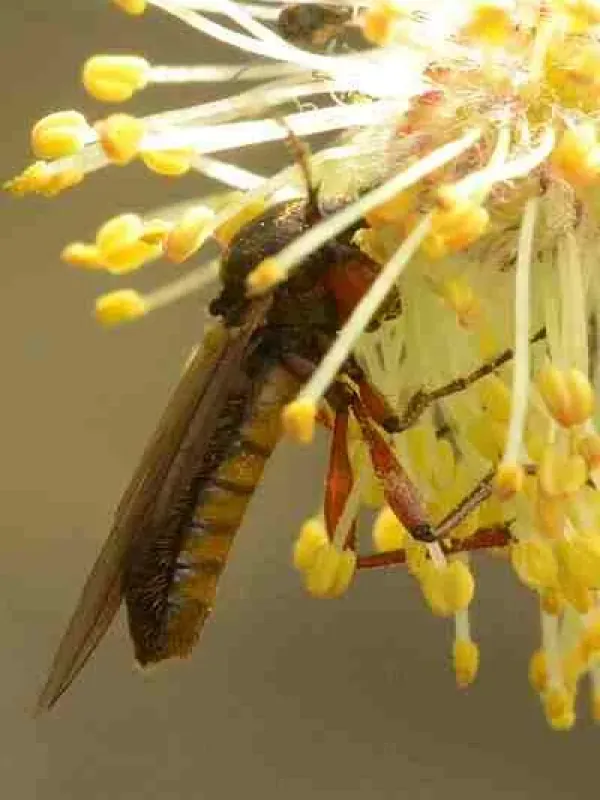
Bibio ferruginatus belongs to the Bibionidae family, commonly known as march flies or St. Mark's flies. Adult flies are characterized by a stout, robust body, typically measuring about 7–10 mm in length.
The coloration of the adult is predominantly rusty-brown or reddish, which gives the species its common name. They have thickened legs, a key morphological trait of the family, and clear wings with dark, distinct veins.
The larvae of this species have a cylindrical, maggot-like shape with a dark brown or black head capsule. Their bodies are covered with small, spine-like projections, which help distinguish them from other soil-dwelling larvae.
The life cycle involves complete metamorphosis, consisting of the egg, larva, pupa, and adult stages. Adults are short-lived and focus primarily on mating and laying eggs in moist, organic-rich soil or leaf litter.
Females deposit eggs in compact clusters within the upper soil horizons. After hatching, the larvae thrive in environments rich in organic matter, where they eventually begin to feed on both decaying material and plant roots.
##damage##The primary damage is caused by the larval stage, which lives underground in the root zone. In conditions with high soil moisture and abundant organic debris, larvae can reach population levels that cause significant agricultural damage.
This pest affects a wide range of crops, including potatoes, carrots, beets, and various bulbous ornamentals. Greenhouse seedlings are particularly susceptible to root damage during the early growing stages.
When natural food sources like decaying organic matter become scarce, larvae shift their feeding habits to the live roots and underground stems of nearby crops. This leads to weakened plants, stunted growth, and potential crop failure.
Potato tubers are specifically targeted by the larvae, which bore deep tunnels into the flesh. These holes not only ruin the appearance of the harvest but also create entry points for soil-borne pathogens and decay-causing bacteria.
Outbreaks are most commonly associated with fields or gardens where fresh manure or compost has been incorporated shortly before planting, creating an ideal nursery for the developing larvae.
##season##Adult emergence typically occurs in the spring, spanning from April to May as soil temperatures rise. This is the period when mating swarms may be observed above the soil surface.
Larval activity peaks during the first half of the growing season, which coincides with the development of young seedlings. During this phase, plants are at their most vulnerable to root zone attacks.
Most populations complete one generation per year, though specific environmental conditions can influence the timing and speed of development. Adults are most active in warm, sunny weather.
Pupation takes place within the soil as the season progresses toward autumn. The larvae or pupae survive the winter in the soil, effectively preparing for the next spring's emergence.
Soil moisture levels are the most critical factor for larval survival. Persistent wet conditions encourage feeding activity, while prolonged dry spells can lead to high mortality rates among the larval population.
##signs##One of the earliest indicators of an infestation is the sudden wilting of plants, which often occurs despite adequate soil moisture. This is especially noticeable during the warmest hours of the day.
Inspecting the root system often reveals characteristic damage, such as gnawed root tips or small, crater-like holes on the subterranean parts of the stem, indicating larval feeding.
Clusters of larvae can often be found in the soil immediately surrounding the damaged roots. They are easily visible as brownish, slow-moving entities when the soil is disturbed or tilled.
In potato crops, visual evidence includes entry holes on the skin and deeper tunnels within the tuber. The surrounding tissue often appears dark or water-soaked due to secondary fungal infections.
Reduced vigor and chlorosis (yellowing) of leaves, even when nutrients are sufficient, serves as a common secondary sign that the root system is under stress from subterranean pests.
##control##The most important preventative measure is the use of fully decomposed organic matter. Fresh manure should be avoided, as its smell and nutrient content strongly attract females for egg-laying.
Deep autumn tillage is highly effective for reducing pest numbers, as it exposes overwintering larvae and pupae to birds, predators, and harsh weather conditions, significantly lowering their survival rate.
For greenhouse operations, it is essential to sterilize potting soil and maintain proper drainage to prevent excessive moisture, which creates the optimal environment for larval development.
When infestation levels exceed economic thresholds, authorized soil insecticides may be used. These treatments must be applied strictly in accordance with local regulations and crop-specific guidelines.
- Regular inter-row cultivation to disrupt larval habitats.
- Strict hygiene measures, including the removal and destruction of crop residues after harvest.
- Deployment of pheromone or light traps to monitor and reduce adult fly populations in the spring.
Taxonomy
- Latin name
- Bibio ferruginatus
- Order
- Diptera (flies)
- Family
- Bibionidae
- EPPO code
- BIBIFE
Discussion
No discussions yet — be the first.