
Coastal cicada
Diceroprocta vitripennis
Description
How to identify
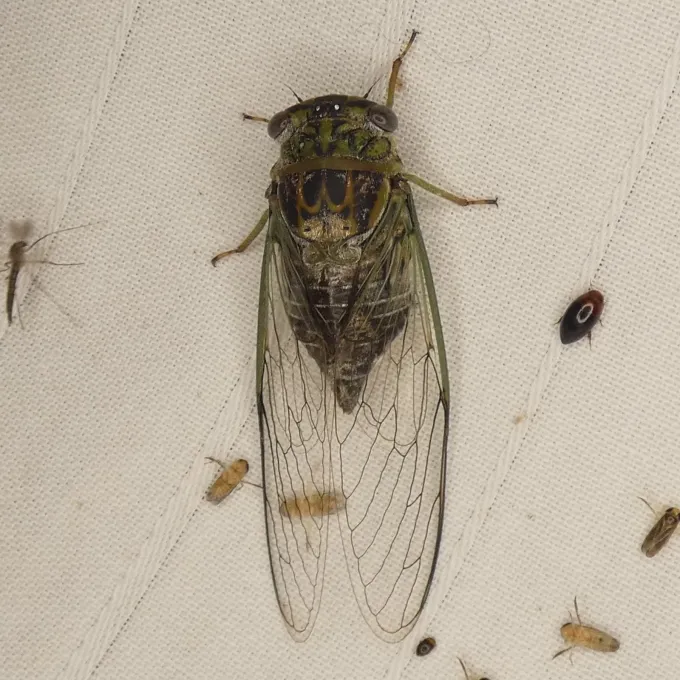
The coastal cicada (Diceroprocta vitripennis) belongs to the order Hemiptera and the family Cicadidae. It is a large insect with characteristic transparent wings with prominent veining.
Adults possess a powerful piercing-sucking mouthpart used for feeding on plant sap. Their bodies typically exhibit camouflage coloration that helps them hide on tree bark.
Larvae lead an underground existence, developing in the soil near tree root systems for several years. They have strong front legs adapted for digging through the soil.
Females possess sharp ovipositors, which they use to make slits in young plant stems to deposit eggs. This biological trait makes them damaging to young nursery stock.
The loud songs of males during the mating season allow for easy identification of the population's presence in an area, simplifying monitoring efforts.
What it damages
The primary damage is caused by adult females, which puncture young shoots of fruit and ornamental crops, creating deep slits in the woody tissue.
Damaged branches often dry out or snap under the weight of fruit or wind, leading to crop loss and deformation of young tree crowns.
Larvae, which feed on root sap, can significantly stunt plant growth if present in high numbers, making trees more susceptible to secondary diseases.
Cicadas are active during warmer months when adults emerge from the soil. Massive attacks can cause premature leaf drop and the loss of fruit buds.
The coastal cicada is non-specific and can attack a wide range of woody species, including fruit trees and native forest trees, complicating control efforts.
When it appears
The life cycle of the coastal cicada is long, lasting several years, with most of this time spent as larvae developing within the soil profile.
Mass emergence of adults typically occurs in late spring or early summer, when soil temperatures rise enough to trigger the completion of metamorphosis.
The mating and egg-laying period usually lasts between four to eight weeks, depending on the climatic conditions and average ambient temperature of the region.
After the reproductive cycle, adults die, and the newly hatched nymphs drop to the ground and burrow into the soil to feed on roots until the next stage.
Monitoring the adult emergence is critical, as this is the only window of time when control measures are effective in preventing damage to tender shoots.
Signs of infestation
The primary sign of infestation is the presence of longitudinal slits or ragged wounds on young shoots and current-year twigs, often arranged in rows.
A characteristic symptom is yellowing and wilting of leaves on individual branches, which later die back. Inspection of these branches reveals oviposition marks.
Loud, persistent singing by males in tree canopies during the day is a clear indicator of the presence of adults ready for reproduction.
The appearance of holes in the soil, approximately 1 cm in diameter, near tree root zones signals that adults have emerged from the ground.
The presence of a large number of empty larval exoskeletons (exuviae) on tree trunks or shrubs confirms that the population has completed its life cycle.
Control measures
Mechanical control involves pruning and burning damaged twigs containing eggs before they have a chance to hatch.
Installing protective netting on young trees during the peak flight season of cicadas helps prevent females from laying eggs in vulnerable shoots.
Systemic insecticides may be used when population densities are high, though efficacy is restricted to the specific residual period of the chosen chemical.
Maintaining tree vigor through proper horticultural practices, such as irrigation and fertilization, increases plant resilience against larval feeding stress.
Biological control, including the encouragement of natural predators like birds and beneficial insects, helps keep cicada populations in check within gardens and orchards.
Taxonomy
- Latin name
- Diceroprocta vitripennis
- Order
- Hemiptera (bugs, aphids, leafhoppers)
- Family
- Cicadidae
- EPPO code
- DICPVI
Discussion
No discussions yet — be the first.