
Apache cicada
Diceroprocta apache
Description
How to identify
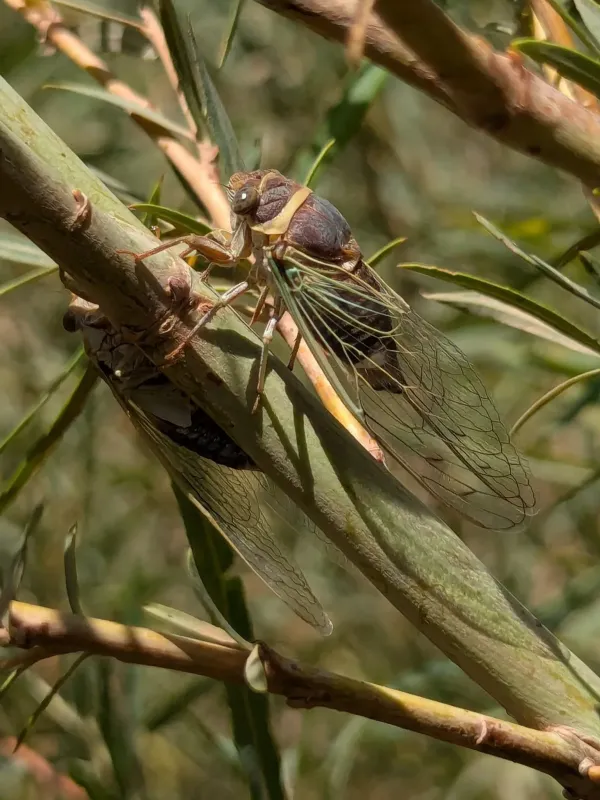
The Apache cicada (Diceroprocta apache) belongs to the order Hemiptera and the family Cicadidae. This insect is relatively large and possesses a coloration pattern that allows it to blend in perfectly with the bark of desert trees.
Adults have well-developed transparent wings with distinct venation. Their body typically features shades of brown, green, or sandy colors, which helps them camouflage within arid habitats.
Males of this species produce loud, specific sounds using specialized organs called tymbals. These acoustic signals serve as a primary method for attracting females during the mating season.
The insect's life cycle includes the egg stage, the nymph stage (which develops in the soil), and the adult (imago). The development period of the nymphs can last for several years, a survival strategy common among cicadas.
Unlike many other pests, adult Apache cicadas live for a relatively short time, focusing primarily on reproduction and dispersal to new territories for egg-laying.
What it damages
The primary damage is caused by females during the egg-laying process. Using a sharp ovipositor, they create deep incisions in young tree branches and shrubs to deposit their eggs.
Crops that may suffer from these insects include various ornamental trees, desert fruit trees, and several types of shrubs common in their natural distribution range.
Damaged branches often lose structural integrity, leading to breakage under the weight of foliage or during high winds. This significantly weakens the plant and makes it susceptible to secondary infections.
Apache cicada nymphs spend their lives underground, feeding on the sap from the roots of various woody and herbaceous plants. This hinders the root system's growth and affects the overall health of the tree.
In years of mass emergence, the population of these cicadas can cause significant aesthetic and economic damage, especially in young plantations or nurseries where plant integrity is crucial.
When it appears
The emergence of adult Apache cicadas usually coincides with the hottest time of the year, when climatic conditions become optimal for their activity and mating.
In their native regions, they show maximum activity during the summer months, starting from mid-summer when air temperatures reach their peak.
The period of mass emergence of adults from the soil is usually spread out over time, allowing the species to maintain a stable population throughout the season.
These pests can be observed on tree trunks and branches, where they spend most of the daylight hours feeding and searching for mates.
By autumn, the number of adult individuals decreases sharply, as the life cycle of the imago concludes after the reproductive function is fulfilled.
Signs of infestation
The first and most obvious sign of cicada presence is the loud, buzzing sound produced by males in the tree canopy during the hot hours of the day.
On plant branches, one can find characteristic scars or longitudinal cracks in the bark left by females during oviposition. Often, these branches begin to yellow and wilt.
When inspecting the soil under trees, one might notice exit holes through which nymphs crawled to the surface for their final molt into adulthood.
Empty exuviae (discarded larval skins) are often left on tree trunks, clinging firmly to the bark after the metamorphosis is complete.
Mass shedding of young shoots that show mechanical damage in the form of grooves also serves as an indicator of this pest's presence in the garden.
Control measures
The primary control method involves maintaining high plant health. Well-cared-for trees with good turgor pressure are better able to withstand mechanical damage.
In nurseries, it is recommended to use protective netting on young trees to prevent females from reaching the tender shoots to lay eggs.
Timely sanitary pruning and removal of damaged branches help reduce the pest population, as eggs are often located within the cut sections.
Chemical insecticides show limited effectiveness against adults, so the focus is primarily on biological methods and cultural practices.
In some cases, light traps or sound deterrents are employed, although these methods remain secondary and do not guarantee the complete eradication of the pest.
Taxonomy
- Latin name
- Diceroprocta apache
- Order
- Hemiptera (bugs, aphids, leafhoppers)
- Family
- Cicadidae
- EPPO code
- DICPAP
Discussion
No discussions yet — be the first.