
Parsnip moth
Depressaria daucella
Description
How to identify
The Parsnip moth (Depressaria daucella) is a member of the Depressariidae family, known for targeting Apiaceae crops. It is a small moth with a wingspan of approximately 20 millimeters.
The adult moth features brownish-grey forewings adorned with dark spots and longitudinal streaks, providing excellent camouflage against plant stems.
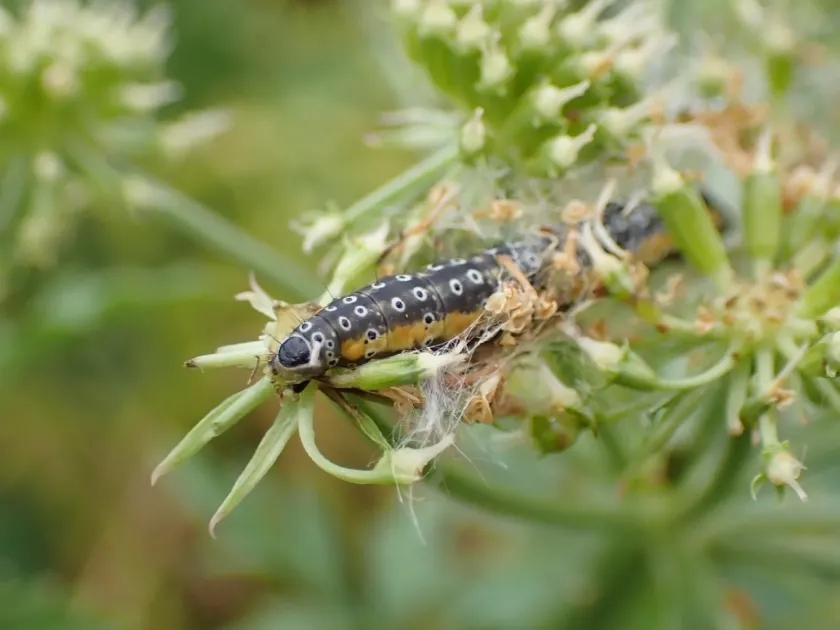
The larvae, or caterpillars, reach lengths up to 15 mm. They typically exhibit a green to yellowish-brown body coloration with dark stripes running along their sides.
A distinctive feature of the larvae is their shiny black or dark-brown head capsule, which helps in identifying the species during field scouting.
Pupation occurs within the damaged flower heads, where the insect constructs a protective shelter using silk webbing and floral debris.
What it damages
The Parsnip moth primarily attacks crops within the Apiaceae family, including carrots, dill, parsley, parsnips, and cumin.
The damage is caused by larvae feeding on the developing flower heads, which is particularly destructive for seed-production crops.
By consuming the buds, flowers, and ovaries, the caterpillars can lead to a complete loss of seed yield if left unchecked.
Larvae also feed on tender foliage, skeletonizing leaves and causing the plant to lose photosynthetic capacity, which weakens overall health.
Severely infested plants display stunted growth and deformed stalks, significantly reducing the marketability and quality of the produce.
When it appears
Adult moths overwinter in sheltered locations, such as under plant debris, in bark crevices, or in abandoned agricultural structures.
Emergence occurs in late spring, generally starting in May when temperatures become favorable for mating and oviposition.
Females deposit eggs directly onto the developing flower buds, ensuring the larvae have immediate access to food once they hatch.
Depending on the climatic zone, the pest may complete one or two generations throughout the growing season, peaking in mid-summer.
High temperatures and dry weather are often associated with increased larval activity and rapid population growth in the field.
Signs of infestation
The most visible sign of infestation is the presence of silk webbing that binds together the flowers and flower stalks of the plants.
Scouting reveals areas of the flower heads that appear brown, withered, or chewed, often accompanied by the accumulation of larval frass.
The plants may exhibit deformed or stunted inflorescences, often referred to as "clumped" or "webbed" flower clusters.
Early stage infestation can be detected by small holes in the buds or by observing larvae active inside the webbed clusters.
In severe cases, the entire flower head may fail to produce seeds, resulting in visible gaps where flowers should have developed.
Control measures
Effective management includes implementing a strict crop rotation and keeping seed-production fields isolated from commercial vegetable plots.
Cultural practices such as deep autumn plowing help destroy overwintering sites, reducing the number of moths emerging the following spring.
Sanitation is key; remove and destroy infested flower heads manually in small gardens to prevent the next generation from emerging.
Chemical control involving selective insecticides should be applied during the peak egg-hatching period to prevent widespread damage.
- Maintain clear field borders to reduce wild Apiaceae weeds.
- Monitor moth flight using pheromone or light traps.
- Utilize biological control agents when appropriate.
- Clean machinery to prevent transferring larvae between fields.
Taxonomy
- Latin name
- Depressaria daucella
- Order
- Lepidoptera (butterflies)
- Family
- Depressariidae
- EPPO code
- DEPRDA
Discussion
No discussions yet — be the first.