
Demodex brevis
Demodex brevis
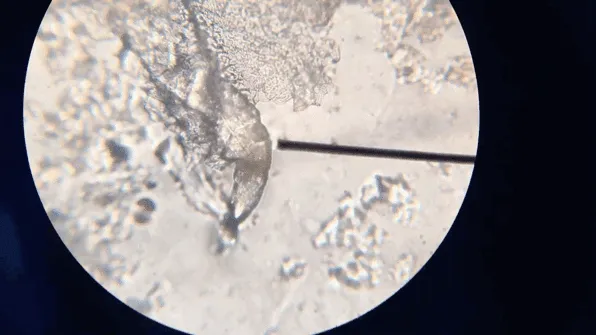
Description
How to identify
Demodex brevis is a microscopic mite belonging to the order Trombidiformes and the family Demodicidae, known primarily for its parasitic nature.
The organism is characterized by a small, elongated, worm-like body, usually measuring between 0.15 and 0.2 mm, making it invisible to the naked eye.
Morphologically, it possesses four pairs of short, stubby legs located on the anterior portion of the body, which facilitate movement within restricted environments.
Identification typically requires specialized equipment, such as a light microscope, to observe the specific structure and movement patterns of the mite.
Although commonly studied in medical contexts, its presence in botanical samples involves examining tissue samples where it might inhabit cavities or spaces.
What it damages
In an agricultural context, Demodex brevis is considered a minor or non-traditional pest that can affect the overall health of certain plant species.
The damage caused is primarily mechanical, as the mites penetrate cellular structures, potentially disrupting the plant's natural protective barriers.
Such injuries create entry points for opportunistic pathogens, including various species of bacteria and fungi, which can lead to secondary infections.
While the mite does not consume plant biomass in the traditional sense, its feeding habits can lead to localized stress and reduced vitality in affected plant organs.
High infestation density may result in tissue discoloration and metabolic disruption, ultimately impacting the plant's growth rate and structural integrity.
When it appears
The development and lifecycle of the mite are highly dependent on environmental conditions, with temperatures between 20°C and 30°C being optimal for growth.
The mite thrives in stable microclimates where humidity and temperature remain consistent, allowing for continuous reproduction throughout the year.
During warmer seasons, the rate of population growth increases significantly, leading to potential outbreaks if conditions remain favorable for the organism.
In colder conditions, the mite may enter a state of dormancy or survive in sheltered locations, such as deep within plant tissue or organic debris.
Short generation times allow the mite population to recover quickly after interventions, necessitating regular monitoring during the active growing season.
Signs of infestation
Symptoms of infestation are often subtle and can easily be mistaken for physiological disorders or nutritional deficiencies in the plant.
Early indicators include the appearance of tiny, localized necrotic spots on leaves, which may slowly expand over time if the infestation is not addressed.
Heavily infested plants often exhibit signs of general decline, including stunted growth, leaf deformation, and a loss of overall vigor.
The presence of fine, dust-like particles on the surface of tissues is often a byproduct of the mite's lifecycle and indicates high population density.
- Chlorotic spots and leaf yellowing.
- Deformed growth in young, succulent shoots.
- Premature aging of infected tissue segments.
Control measures
Effective control of Demodex brevis requires a comprehensive integrated pest management (IPM) strategy focused on minimizing favorable conditions for the mite.
Chemical control through the application of specific acaricides is effective, provided the products are applied at the correct stage of the pest's life cycle.
Sanitation is a critical control measure, involving the removal and destruction of infested plant parts to reduce the inoculum load in the field or greenhouse.
Maintaining optimal environmental conditions, such as improving air circulation and managing humidity levels, can significantly inhibit mite reproduction.
Biological controls, including the use of entomopathogenic fungi or predatory mites, offer sustainable alternatives for reducing pest numbers without heavy reliance on chemicals.
Taxonomy
- Latin name
- Demodex brevis
- Order
- Mites
- Family
- Demodicidae
- EPPO code
- DEMOBR
Discussion
No discussions yet — be the first.