
Short-tailed Blue
Cupido minimus
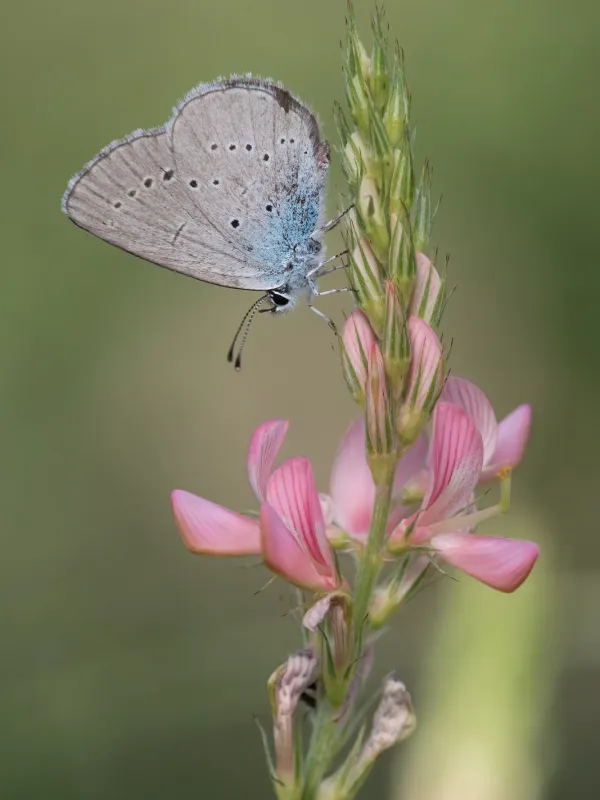
Description
How to identify
The Short-tailed Blue (Cupido minimus) is one of the smallest butterfly species within the Lycaenidae family. Adult specimens have a wingspan of only 18–24 millimeters, making them quite discreet in agricultural environments.
Male butterflies exhibit dark brown wings with a subtle blue dusting, while females possess plain brown wings. This neutral coloration provides excellent camouflage against the surrounding vegetation during their flight period.
The underside of the wings is light grey or smoky in color, characterized by numerous small black spots that lack any darker framing. This specific pattern is the primary diagnostic feature used for field identification.
Taxonomically, this species belongs to the order Lepidoptera and the family Lycaenidae. The larvae (caterpillars) are typically onisciform (woodlouse-shaped), allowing them to hide efficiently within the flower heads of their host plants.
The life cycle involves complete metamorphosis, including egg, larva, pupa, and adult stages. Hibernation usually occurs at the pupal or late larval stage within the soil or ground litter, ensuring survival during winter months.
What it damages
The Short-tailed Blue is primarily a pest of legume crops. It causes significant damage to various species, including clover (Trifolium), horse-shoe vetch (Hippocrepis), and several other forage grasses and wild legumes.
Larval feeding is the primary source of economic damage. The caterpillars specialize in consuming the reproductive organs of the plants, specifically targeting buds, developing flowers, and seeds located within the pods.
In years with high population density, the pest can severely reduce seed yields. For seed-producing farms, an infestation of Short-tailed Blue can lead to significant financial losses due to the destruction of the generative parts of the plants.
Feeding damage often causes the flower heads to wither or dry out prematurely. When larvae penetrate the pods, they consume the developing seeds, leaving behind empty shells and rendering the pod unviable for harvesting.
Furthermore, the physical damage caused by larval feeding creates entry points for various pathogens, including fungi and bacteria, which can lead to secondary infections and rot, further compromising the overall crop quality.
When it appears
Adult flight typically occurs from late spring through the first half of summer. This timing coincides with the active vegetative and flowering phases of host legume crops, which provide essential nourishment for the larvae.
The larval stage coincides with the peak blooming period of the plants. Depending on climatic variables and latitude, the developmental period of the larvae may fluctuate, which directly influences the severity of the damage inflicted.
The emergence of new generations is synchronized with the phenological phases of the host plants. Agronomists should prioritize field monitoring during the budding and early flowering stages to detect potential infestations.
Since the species may have one or two generations per year depending on the region, the period of vulnerability for the crop can be quite extensive. Regular observation is necessary to track the presence of adults, which indicates the onset of egg-laying.
Weather conditions, such as temperature and humidity, play a critical role in determining the speed of larval development and the overall population dynamics throughout the growing season.
Signs of infestation
Field identification involves examining plant reproductive structures for characteristic damage. Empty buds, hollowed-out flowers, and the presence of frass (larval waste) within the clover heads are reliable indicators of an active infestation.
Although the caterpillars are well-camouflaged, careful inspection of individual flower heads in areas with high butterfly activity can reveal their presence. Searching during the early morning hours increases the probability of spotting the larvae.
- Presence of small entry holes in seed pods.
- Premature yellowing or browning of individual flower florets.
- Significant decrease in viable seed yield upon inspection.
- Adult butterflies observed fluttering and resting on legume inflorescences.
Using an entomological sweep net during the flight season is a standard monitoring practice to estimate population density. This data helps in assessing whether the infestation has reached the economic threshold.
Early detection is crucial to implementing management practices before the larvae cause irreparable damage to the seed crop, thereby preserving the commercial value of the harvest.
Control measures
A primary management strategy involves agrotechnical control, such as early mowing of forage grasses. Harvesting the crop before the larvae can pupate effectively breaks the life cycle and reduces the local population.
Proper crop rotation and maintaining spatial isolation between seed production fields and wild legume habitats are essential to prevent the pest from colonizing cultivated areas from nearby reservoirs.
Chemical control should be reserved for cases where the economic threshold is exceeded. Insecticides permitted for use on forage and legume crops should be applied, with careful attention to timing and safety intervals.
Biological control agents, such as formulations containing entomopathogenic bacteria, can be employed to target younger larvae while maintaining the safety of beneficial pollinators and other non-target insects.
Integrating pheromone traps for monitoring allows agronomists to pinpoint the timing of population peaks. This precision ensures that any necessary interventions are applied at the most effective time, reducing overall pesticide usage.
Taxonomy
- Latin name
- Cupido minimus
- Order
- Lepidoptera (butterflies)
- Family
- Lycaenidae
- EPPO code
- CUPIMI
Discussion
No discussions yet — be the first.