
Maple ringed moth
Cosymbia annulata
Description
How to identify
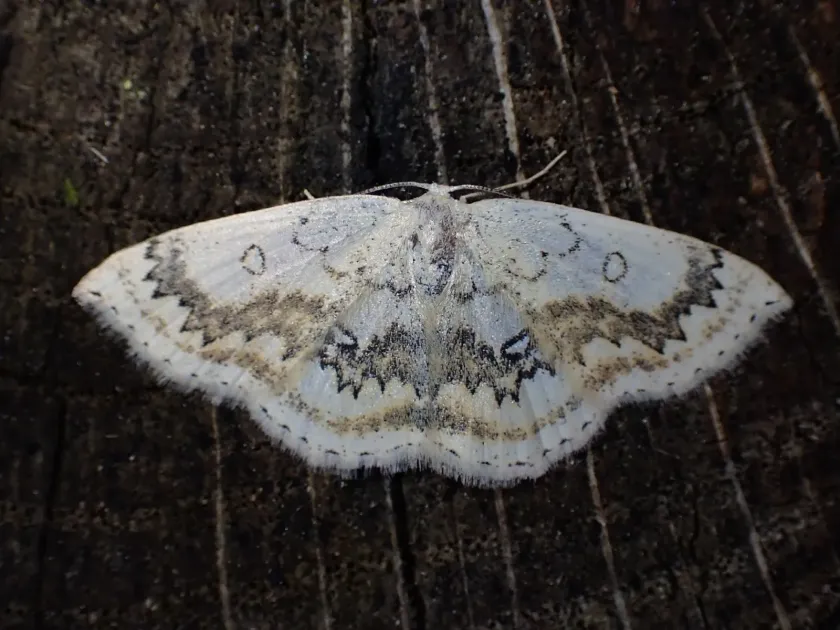
The Maple ringed moth (scientific name: Cyclophora annulata, formerly Cosymbia annulata) is a small moth belonging to the Geometridae family. Adult moths typically have a wingspan ranging from 20 to 25 millimeters. Their wings are colored in light gray or ocher-yellow tones, featuring a distinctive pattern of dark lines and rings that give the species its common name.
The insect possesses a slender, fragile body, typical of geometric moths. Its larvae, known as inchworms or loopers, exhibit the characteristic gait caused by the reduction of abdominal prolegs. The caterpillars are usually greenish, providing excellent camouflage against the foliage of their host plants.
The species undergoes complete metamorphosis: egg, larva, pupa, and adult. Depending on local climate conditions, the insect can produce one or two generations per year. The adult moths are primarily nocturnal, remaining hidden on the underside of leaves or tree bark during the day.
Overwintering usually takes place at the pupal stage within leaf litter or sheltered crevices on tree trunks. With the arrival of spring and rising temperatures, the adult moths emerge to mate and lay eggs on suitable host trees.
Monitoring the presence of this pest can be achieved using light traps, which are highly effective at attracting nocturnal adults. Regular inspection of young shoots and the undersides of leaves during the active feeding season is also recommended for early detection.
What it damages
The primary host plant for this species is the maple (Acer), specifically the field maple and other related species. The pest is frequently found in forest parks, ornamental tree nurseries, and private gardens where maple trees are cultivated.
The main damage is caused by the caterpillars, which feed aggressively on the leaves. Younger larvae skeletonize the foliage, consuming the tissue between the veins, while older larvae may devour the entire leaf blade, significantly reducing the tree's photosynthetic capacity.
During mass outbreaks, the Maple ringed moth can cause severe defoliation of maple trees. Weakened trees become highly susceptible to secondary pests, such as wood-boring insects, and various fungal pathogens that affect the bark and woody tissues.
Damage is particularly critical for young saplings in nurseries, as leaf loss inhibits growth, reduces frost resistance, and may lead to plant mortality during harsh winter conditions. Ornamental trees lose their aesthetic value as branches become bare.
While this species rarely causes widespread forest mortality, local population spikes require the attention of arborists and foresters, especially in areas with high concentrations of maple stands.
Signs of infestation
The presence of the pest is indicated by characteristic feeding patterns on maple leaves. The foliage appears ragged, often showing irregular holes or notched margins where the caterpillars have been actively feeding.
A reliable diagnostic sign of an infestation is the presence of caterpillar frass—tiny dark pellets that accumulate on the lower leaves or on the ground beneath the tree canopy in significant quantities.
During visual inspections, look closely at the undersides of the leaves. Because of their excellent camouflage, caterpillars are often difficult to spot, so the branch-tapping method onto a white sheet is a more effective way to check for their presence.
The presence of thin silk threads on branches is another indicator. Caterpillars use these threads to anchor leaves or to lower themselves from branches when disturbed or when moving between different parts of the canopy.
Premature yellowing or browning of leaves during the summer, unrelated to drought stress, often signifies serious damage to the canopy caused by the larvae consuming nutrients and disrupting the leaf's water balance.
Control measures
Biological control is the preferred management strategy. Encouraging insectivorous birds, such as tits and flycatchers, which actively hunt caterpillars, can help keep populations below economic damage thresholds.
During significant infestations, the use of biological insecticides based on Bacillus thuringiensis (lepidocides) is highly effective. These products specifically target caterpillars while remaining safe for the environment and non-target beneficial insects.
In nursery settings or for high-value ornamental trees, chemical insecticides may be used if the damage reaches critical levels. Such applications should follow strict guidelines to minimize impact on the surrounding ecosystem.
Cultural practices include the thorough raking and removal of leaf litter in the autumn. Since the pupae overwinter in the debris, disposing of this material significantly reduces the next year's population without the need for chemical intervention.
- Utilize light traps for early population monitoring.
- Practice sanitary pruning to improve canopy airflow.
- Apply biological control agents at the early larval stage.
- Maintain biodiversity to support natural predator populations.
Taxonomy
- Latin name
- Cosymbia annulata
- Order
- Lepidoptera (butterflies)
- Family
- Geometridae
- EPPO code
- COSYAN
Discussion
No discussions yet — be the first.