
Elm lace bug
Corythucha ulmi
Description
How to identify
The elm lace bug, known scientifically as Corythucha ulmi, belongs to the Tingidae family of the order Hemiptera. These insects are distinguished by the intricate, net-like appearance of their wings and pronotum.
Adults are small, typically measuring between 3 to 4 millimeters. Their flattened bodies and lace-like wing patterns allow them to blend into the bark and the undersides of leaves.
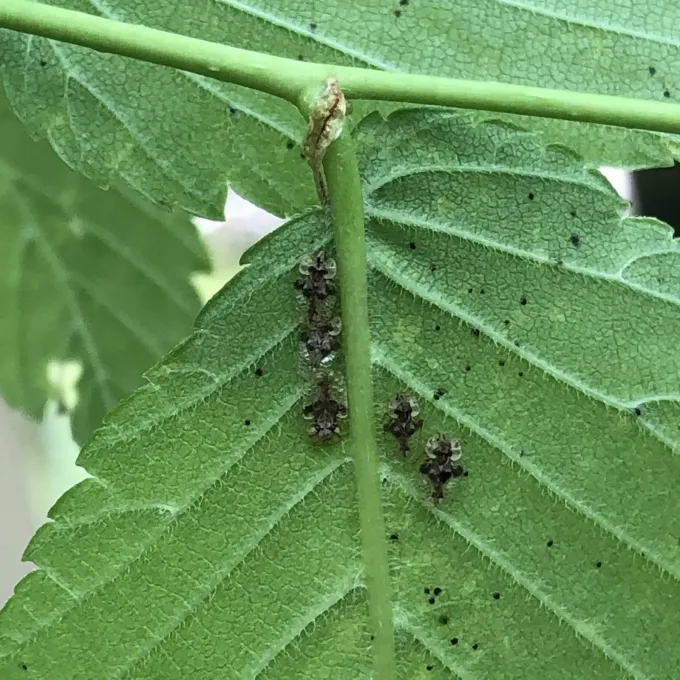
The nymphs go through several developmental stages, often covered in small spines, and are primarily found clustered on the undersides of host leaves, where they feed throughout their lifecycle.
These bugs are sunlight-loving and are frequently found in open areas or on trees bordering roads, where the canopy is exposed to direct light.
Correct identification is vital, as several species of lace bugs share similar morphological features, but the association with host trees of the genus Ulmus is a primary identifier.
What it damages
The primary hosts of the elm lace bug are elm trees, particularly species like the Siberian elm or the smooth-leaved elm, which serve as both food and shelter.
Both adults and nymphs cause damage by feeding on the sap of the leaves using their piercing-sucking mouthparts, which disrupts the tree's vital physiological processes.
Heavy infestations result in chlorotic spotting, where the leaf turns pale or white, eventually leading to reduced photosynthetic capacity of the entire canopy.
Young trees and those under stress are at the highest risk, as severe feeding can lead to stunted growth and premature leaf drop in the middle of the growing season.
Repeated yearly damage significantly weakens the tree, making it more susceptible to opportunistic pathogens and wood-boring insects, potentially leading to long-term decline.
When it appears
These insects overwinter as fertilized females in protected niches, such as bark crevices, leaf litter, or debris gathered at the base of the host tree.
Emergence occurs in early spring as temperatures rise, signaling the beginning of the active feeding and reproduction cycle on the newly developed foliage.
The primary egg-laying period occurs in late spring and early summer, with eggs deposited in clusters on the lower leaf surface, often protected by insect secretions.
Population density typically peaks in mid-to-late summer, coinciding with the second generation, which can cause visible damage to the tree canopy within a short period.
As autumn approaches and temperatures drop, the bugs seek out their overwintering sites to survive the cold, concluding their active cycle for the year.
Signs of infestation
The most common sign of infestation is a stippled appearance on the upper leaf surface, with small pale or white spots indicating areas where sap has been extracted.
Observation of the leaf underside often reveals large amounts of dark, spotty excrement, which is a hallmark of lace bug colony presence.
Heavily infested leaves turn yellow, appear scorched or bronze in color, and eventually drop from the branches long before the natural onset of autumn.
The presence of cast-off nymphal skins (exuviae) clinging to the undersides of the leaves provides clear evidence of ongoing development within the canopy.
In cases of severe infestation, the tree's overall appearance becomes thin, and the canopy may look dull and lackluster due to the loss of chlorophyll.
Control measures
Sanitation is a primary control method; removing and destroying fallen leaves and organic debris around the tree base helps reduce overwintering populations.
Systemic insecticides or contact-based soaps can be highly effective when applied directly to the underside of the leaves during the early nymph stages.
Maintaining tree vigor through proper watering and fertilization is essential, as healthy trees are better equipped to withstand the stress caused by feeding insects.
High-pressure water sprays can be used on smaller trees to dislodge the bugs from the foliage, providing a non-chemical method of reducing population numbers.
- Application of horticultural oils to suppress egg hatch and nymph development.
- Encouraging natural predators such as lady beetles, lacewings, and minute pirate bugs.
- Monitoring foliage in late spring to catch infestations before they escalate.
Taxonomy
- Latin name
- Corythucha ulmi
- Order
- Hemiptera (bugs, aphids, leafhoppers)
- Family
- Tingidae
- EPPO code
- CRTHUL
Discussion
No discussions yet — be the first.