
Alder lace bug
Corythucha pergandei
Description
How to identify
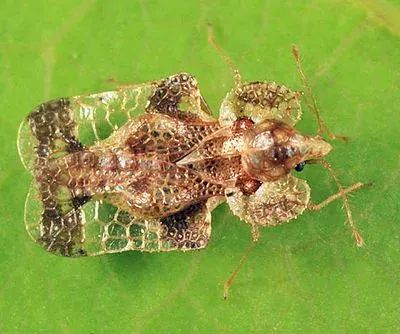
The Alder lace bug (Corythucha pergandei) is a member of the Tingidae family, belonging to the order Hemiptera. It is named for the unique, intricate, lace-like appearance of its pronotum and wing covers.
Adults are tiny insects, typically measuring between 3 to 4 mm in length. Their bodies feature semi-transparent, reticulated outgrowths that act as camouflage on the surfaces of leaves, making them quite difficult to spot.
The coloration of adults ranges from creamy white to brownish, often adorned with dark spots on their wings. Nymphs, or immature stages, appear darker and are often covered in small spines, which provide defense against predators.
The life cycle consists of the egg stage, several nymphal instars, and the adult stage. Females typically deposit their eggs in small clusters on the underside of leaves, using a protective secretion to anchor them.
Adults usually overwinter in protected locations such as bark crevices, leaf litter, or debris near host plants, allowing them to survive cold temperatures until the return of spring weather.
What it damages
The primary hosts for the Alder lace bug include members of the Betulaceae family, specifically alder trees (Alnus). To a lesser extent, birch and hazel trees may also be affected by these insects.
Both adults and nymphs cause damage by feeding on the sap of the host plant. They pierce the leaf tissue and suck out the cellular contents, which disrupts the tree's photosynthesis and overall vitality.
High populations can lead to severe damage across large areas of forest or landscaping. Young or newly planted trees are particularly susceptible, as heavy defoliation can significantly reduce their growth rates.
The feeding process often leads to tissue necrosis, which can act as an entry point for secondary fungal infections. This often results in the premature browning and dropping of leaves during the peak of summer.
Trees in urban environments often suffer the most, as urban heat islands and limited resources make them more prone to population explosions of these pests during the growing season.
When it appears
Activity begins in the spring once temperatures consistently rise above 12–15°C. Overwintered adults emerge from their shelters to begin feeding and laying eggs on the newly flushed foliage.
Throughout the summer, multiple generations can develop depending on the prevailing weather conditions. The peak abundance of nymphs is usually observed mid-summer, when conditions favor rapid insect development.
As autumn approaches, the activity level decreases. The final generations of the season seek out overwintering sites, moving from the foliage to the bark or ground cover to enter diapause.
The speed of the life cycle is highly dependent on ambient temperatures. Hot, dry summers accelerate the metabolic rate of the lace bugs, leading to a rapid increase in the number of generations per year.
Late summer and early autumn are crucial times to monitor for overwintering behavior, as these insects migrate to stems and trunks to find safe havens for the winter months.
Signs of infestation
The first signs of an infestation are small, light-colored stippling or mottling on the upper leaf surface. These spots gradually expand and merge, giving the foliage a pale, sickly appearance.
On the underside of the leaves, you can observe the insects themselves, their molted skins, and tiny black varnish-like droplets, which are the excrement of the feeding nymphs and adults.
As feeding continues, the leaves may curl, turn brown, and fall prematurely. This often results in a thinned canopy, making the tree look stressed and unhealthy even while other plants remain green.
A severely infested tree may lose its leaves well before the natural autumn senescence, which negatively impacts its ability to store nutrients for the following year.
- Light-colored mottling on the top of leaves
- Black, shiny excrement spots on leaf undersides
- Premature yellowing and leaf drop
- Colonies of nymphs clustered on the undersides of leaves
Control measures
Systemic insecticides are the most effective method for controlling lace bug populations. Applications should be timed to coincide with the appearance of nymphs, as they are most vulnerable at that stage.
Good sanitation practices, such as raking and removing fallen leaves in the autumn, can significantly reduce the overwintering population, thereby limiting the initial infestation the following spring.
Maintaining tree vigor through proper watering and fertilization is essential. Strong, healthy trees can better tolerate pest feeding, whereas stressed trees are more likely to succumb to infestation.
In parks and sensitive areas, biological control methods using insect-pathogenic fungi or beneficial predators can help manage population levels without disrupting the local ecosystem.
For smaller ornamental trees, physical removal of heavily infested branches or leaves can be an effective spot-treatment to slow down the spread of the colony.
Taxonomy
- Latin name
- Corythucha pergandei
- Order
- Hemiptera (bugs, aphids, leafhoppers)
- Family
- Tingidae
- EPPO code
- CRTHPE
Discussion
No discussions yet — be the first.