
Birch lace bug
Corythucha pallipes
Description
How to identify
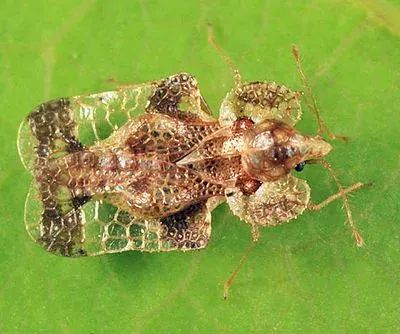
The birch lace bug (Corythucha pallipes) is a member of the Tingidae family, named for the intricate, lacy-like structure of its pronotum and wings, which provides a perfect camouflage.
These insects are small, measuring approximately 3-4 mm in length. Their body is flattened, and they possess a distinctive reticulated pattern that hides them effectively against the leaf veins.
The larvae, which differ significantly from the adults, are elongated and covered with small, prickly spines. They tend to cluster together on the undersides of leaves throughout their developmental stages.
The life cycle involves multiple nymphal stages. Females deposit eggs in clusters on the underside of leaves, usually protected by a secretion that cements them to the leaf surface.
Winter is spent as an adult in sheltered locations, such as under leaf litter, within deep cracks in the bark of trees, or other protected woody debris in the landscape.
What it damages
The primary hosts for this species are birch trees, though they are also known to infest a variety of other deciduous trees depending on the environmental conditions.
Damage is caused by both nymphs and adults using their piercing-sucking mouthparts to remove chlorophyll and sap from the leaf tissue, which interferes with photosynthesis.
As the feeding continues, the leaves develop characteristic yellow or white stippling. Severe infestations cause foliage to brown, wither, and drop prematurely from the tree canopy.
Continuous defoliation over consecutive seasons weakens the tree, making it susceptible to secondary environmental stresses, such as drought, frost, and various wood-boring pests.
Beyond health issues, the aesthetic damage is significant, often rendering ornamental birch trees unsightly for the remainder of the growing season.
Signs of infestation
The first sign of an infestation is the appearance of light-colored, mottled spots on the upper leaf surface, which correspond to the feeding activity on the underside.
Colonies of nymphs, cast-off skins (exuviae), and dark, varnish-like excrement spots on the underside of the leaves confirm the presence of a lace bug infestation.
A general decline in the tree's vigor is observed, characterized by a premature yellowing of the entire crown, creating a dusty or unhealthy appearance in the landscape.
In cases of high pest density, the leaves may become so heavily damaged that they curl and lose their structural integrity before falling off earlier than normal.
Observation of the adult bugs is possible during the peak summer months, especially when branches are gently tapped over a white sheet of paper.
Control measures
Sanitation is a key control measure; collecting and destroying fallen leaves in the autumn removes the overwintering sites for the adult bugs, significantly reducing next year's population.
For chemical control, systemic insecticides are the most effective, as they are absorbed into the leaf tissues and provide long-lasting protection against feeding stages.
Application timing is crucial; treatments should be performed as soon as nymphs are observed, typically in the late spring or early summer, before adulthood.
- Application of systemic insecticides like imidacloprid.
- Keeping trees well-watered to improve resilience against pest stress.
- Regular canopy inspections during the growing season.
If chemical use is undesirable, high-pressure water sprays directed at the underside of the leaves can effectively dislodge and eliminate a significant portion of the nymph population.
Taxonomy
- Latin name
- Corythucha pallipes
- Order
- Hemiptera (bugs, aphids, leafhoppers)
- Family
- Tingidae
- EPPO code
- CRTHPA
Discussion
No discussions yet — be the first.