
Acacia lace bug
Corythucha nocens
Description
How to identify
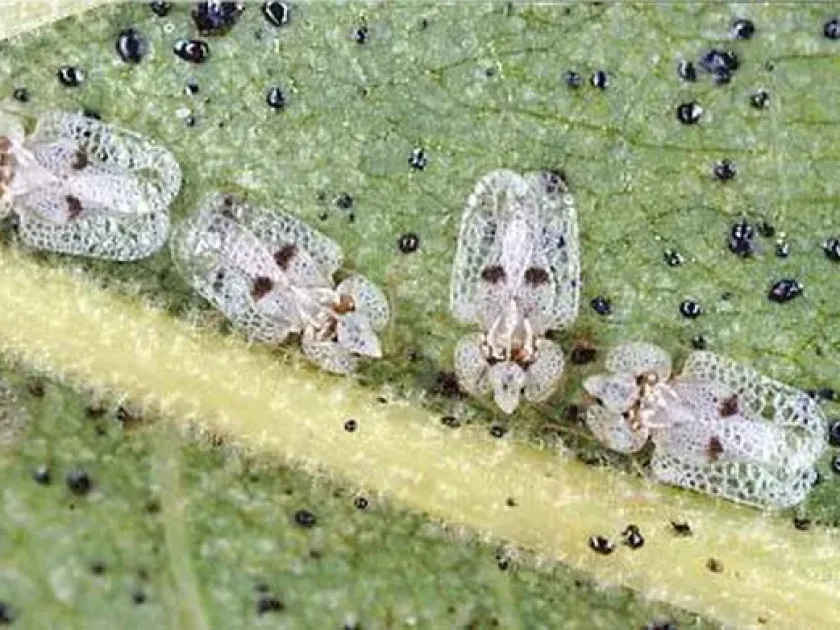
The Acacia lace bug (Corythucha nocens) is a member of the Tingidae family, commonly known as lace bugs. The species is easily recognizable by the intricate, net-like pattern on its wings and thorax, which gives it a lace-like appearance.
Adult bugs are small, typically measuring 3–4 mm in length. They have a flattened, oval body with a whitish or yellowish coloration and brownish markings, which help them blend in perfectly with the leaves of host plants.
The nymphs go through several stages of development, appearing darker and covered in spines, which serves as a defense mechanism against natural predators. They are usually found in clusters on the undersides of the leaves.
The life cycle includes eggs, nymphs, and adults. Females lay their eggs in batches on the underside of leaves, often glued with a secretion. This allows the population to multiply rapidly during the growing season under favorable conditions.
Adults overwinter in protected areas, such as bark crevices, leaf litter, or debris near the base of trees. This strategy allows them to survive cold winters and emerge in the spring as soon as temperatures rise.
What it damages
The primary hosts for Corythucha nocens are members of the Fabaceae family, most notably the black locust (Robinia pseudoacacia) and the honeylocust. In high populations, they can cause severe aesthetic and physiological damage.
These insects are sap-feeders. Using their piercing-sucking mouthparts, they drain the contents of leaf cells, specifically the parenchyma. This feeding activity disrupts the photosynthesis process, causing significant stress to the host tree.
Severe infestations result in a chlorotic appearance of the leaves, followed by necrosis and premature leaf drop. The aesthetic value of ornamental trees is significantly reduced, as the foliage turns yellow and dry mid-summer.
Consistent damage by lace bugs weakens the trees, making them susceptible to other stressors, such as drought, secondary pests, and various fungal diseases that may colonize the damaged leaf tissue.
In nurseries, the presence of the Acacia lace bug can lead to economic losses by stunting the growth of young trees and making them unattractive to customers, often requiring chemical intervention to ensure plant health.
Signs of infestation
The most common sign of an infestation is the appearance of mottled, yellow, or whitish stippling on the upper leaf surface. This is caused by the loss of chlorophyll in the punctured leaf cells.
The underside of the leaves reveals the presence of the bugs themselves, along with their characteristic dark, varnish-like excrement spots. These spots, mixed with cast-off nymphal skins, are a clear indicator of a lace bug infestation.
As the infestation progresses, leaves may curl, turn brown, and fall prematurely. The tree may appear dusty or dirty from a distance, and a thin, sparse crown becomes visible in the late summer months.
Heavily infested trees may experience branch dieback due to long-term lack of energy reserves. Observing the undersides of the foliage early in the season can help detect the presence of nymphs before significant damage occurs.
- Mottled or stippled leaves.
- Dark fecal spots on leaf undersides.
- Early leaf drop and thinning of the canopy.
Control measures
Cultural control includes maintaining tree vigor through proper watering and fertilization. Healthy trees have a much higher tolerance for insect feeding and can better recover from mild infestations.
Biological control involves conserving natural enemies, such as lady beetles, green lacewings, and predatory bugs. Reducing the use of broad-spectrum pesticides can help maintain these predator populations in the garden.
Chemical control should be employed if the infestation reaches high levels. Systemic insecticides are the most effective method, as they are absorbed into the plant, providing a long-lasting defense against the sap-sucking nymphs.
Timing is crucial when applying insecticides. Treatment is most effective when nymphs are present and actively feeding, usually in early summer, rather than waiting until significant damage has already occurred.
Sanitation is a critical step; raking and disposing of fallen leaves in the autumn can significantly reduce the number of overwintering adults in the area, thereby decreasing the potential for an outbreak the following spring.
Taxonomy
- Latin name
- Corythucha nocens
- Order
- Hemiptera (bugs, aphids, leafhoppers)
- Family
- Tingidae
- EPPO code
- CRTHNO
Discussion
No discussions yet — be the first.