
Morrill lace bug
Corythucha morrilli
Description
How to identify
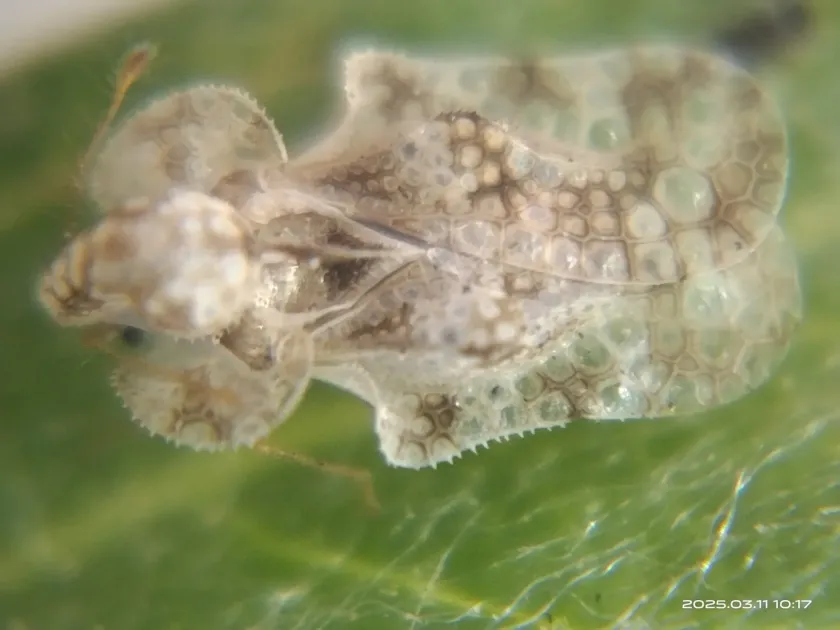
The Morrill lace bug (Corythucha morrilli) is a small insect belonging to the family Tingidae within the order Hemiptera. They are named for the intricate, lace-like pattern on their thorax and wing covers.
Adults typically measure between 3 and 4 millimeters in length. Their bodies are flattened, and their delicate, translucent, reticulated wings provide excellent camouflage against the foliage of their host plants.
The nymphs go through several instars, appearing quite different from the adults; they are usually wingless and covered in various small spines that serve as a defensive mechanism.
These insects use a piercing-sucking mouthpart, known as a rostrum, to extract nutrients directly from the plant's vascular tissue, causing localized damage at the site of the puncture.
Females lay their eggs in clusters, usually on the underside of leaves, where they are protected by the physical structure of the foliage and sometimes by their own secretions.
What it damages
This pest primarily feeds on plants within the Asteraceae family. Sunflowers are among the most economically significant hosts, though various weeds, especially ragweed, are also frequently attacked.
Feeding disrupts the plant's photosynthetic process, causing the leaves to develop a chlorotic, speckled appearance that progresses to necrotic lesions and eventual drying.
Heavy infestations can significantly weaken the plant, reducing its vigor, impeding its growth, and resulting in lower seed quality or yield loss in agricultural settings.
In addition to direct feeding damage, the puncture wounds can serve as entry points for various pathogenic fungi and bacteria, leading to secondary infections that further stress the plant.
The cumulative effect of sustained lace bug feeding is most evident during dry summer periods, as plants lack the water pressure required to recover from the loss of cellular sap.
When it appears
Adults overwinter in protected locations, typically hidden in leaf litter, plant debris, or under the loose bark of trees, waiting for warmer conditions to become active again.
As temperatures rise in the spring, the lace bugs emerge from dormancy, beginning their feeding cycle on the earliest available host plants to initiate the first generation.
During the peak of the growing season, these insects can complete multiple generations, with development time highly dependent on local ambient temperatures and humidity levels.
The highest population density is generally observed in mid-to-late summer, when the abundance of host plants supports rapid reproduction and colony expansion.
When autumn approaches and temperatures start to drop, the adults begin their search for suitable overwintering sites, marking the end of their most active feeding phase.
Signs of infestation
The most prominent sign of infestation is the yellowing or whitening of upper leaf surfaces, often referred to as stippling, which is caused by the extraction of chlorophyll.
Small, dark, tar-like spots found on the underside of leaves are actually the excrement left behind by the feeding nymphs and adults, confirming their presence.
In cases of severe infestation, the foliage may look dusty or marbleized, often leading to confusion with spider mite damage; however, the presence of the bugs themselves confirms the cause.
Leaves may show signs of curling or wilting, which is a symptom of severe cell sap depletion and the inability of the plant to maintain proper turgor pressure.
Discarded nymphal skins (exuviae) found clinging to the leaf underside are another clear indicator that a colony has been actively developing and molting on the plant.
Control measures
Cultural control is a primary defense; this includes the removal of alternate host weeds like ragweed and the thorough cleaning of crop residues after harvest to eliminate overwintering sites.
Biological control can be effectively employed by encouraging or releasing natural predators such as lady beetles, green lacewings, and predatory mites that feed on both nymphs and adults.
Chemical control should be used judiciously, focusing on systemic insecticides if the population levels threaten to significantly damage the commercial crop value.
Regular monitoring of field edges is recommended, as lace bugs often start their colonization from the boundaries before moving into the center of the crop field.
- Crop rotation to break cycles.
- Sanitation of surrounding areas.
- Use of insecticidal soaps for light infestations.
- Integration of predator-friendly practices.
- Proper timing of insecticide application.
Taxonomy
- Latin name
- Corythucha morrilli
- Order
- Hemiptera (bugs, aphids, leafhoppers)
- Family
- Tingidae
- EPPO code
- CRTHMO
Discussion
No discussions yet — be the first.