
Chrysanthemum lace bug
Corythucha marmorata
Description
How to identify
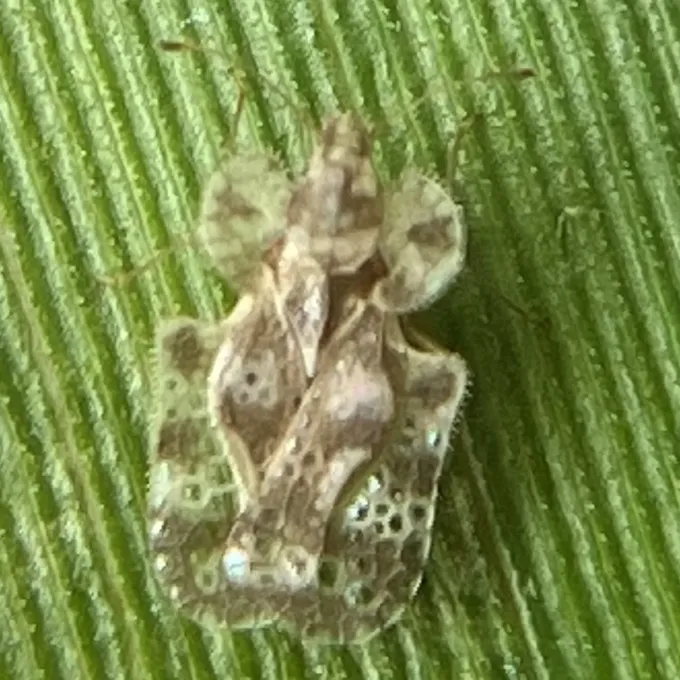
The chrysanthemum lace bug (Corythucha marmorata) is a member of the Tingidae family, order Hemiptera. It is named for its intricately patterned, lace-like wings and pronotum that provide excellent camouflage on foliage.
Adult insects are small, approximately 3 millimeters in length. Their bodies are flattened, featuring transparent, mesh-like wings with dark brown or reddish-brown markings that create a marble-like appearance.
Eggs are minute, oval, and deposited in clusters, usually on the underside of leaves. They are often glued to the leaf surface with a dark secretion that hardens to protect the eggs from environmental stressors.
Nymphs go through several instars. Unlike the adults, nymphs are wingless and possess numerous spine-like projections on their bodies. Their coloration is typically dark brown or black, aiding their concealment.
These bugs are primarily sedentary compared to other flying insects. They tend to stay in localized colonies, making it easier to target them if the infestation is caught in its early stages.
What it damages
The primary hosts of this pest include a wide variety of Asteraceae plants. Chrysanthemums, asters, goldenrod, and sunflowers are among the most frequently attacked species in gardens.
Lace bugs feed by inserting their needle-like mouthparts into the leaf tissue to extract cell sap. This feeding pattern destroys the leaf's mesophyll cells, which are essential for the plant's photosynthetic process.
The damage is cumulative. As the colony grows, the affected foliage loses its natural green color, becoming stippled, yellowed, and eventually necrotic due to the loss of chlorophyll.
Severe infestations result in significant plant stress. The plant redirects energy away from growth and flower production to attempt tissue repair, leading to stunted overall development.
In addition to physical damage, the punctures created by the lace bugs can serve as entry points for various pathogens, including fungi and bacteria, which can cause further tissue decay.
When it appears
Adult lace bugs overwinter in sheltered environments. Common overwintering sites include leaf litter, mulch, tree bark crevices, and sometimes the upper soil layer near the host plants.
Activity begins in the spring when temperatures consistently rise. The bugs emerge from their overwintering sites to seek out fresh, developing foliage on host plants.
Depending on the climatic zone, Corythucha marmorata can complete multiple generations in a single growing season. Reproduction rates increase significantly during hot, dry summer months.
The peak population density usually occurs in mid-to-late summer, coinciding with the flowering phase of many host species, which makes the damage particularly detrimental to the visual appeal.
As daylight hours decrease and temperatures drop in the autumn, the adults seek out hibernation sites to enter diapause, effectively ending their feeding season until the following spring.
Signs of infestation
The most distinctive sign of infestation is stippling, which appears as tiny, white or yellowish spots on the upper side of the leaves, corresponding to the feeding sites on the underside.
Upon closer inspection of the leaf undersurface, you will find clusters of nymphs, adults, and characteristic dark, varnish-like droplets of excrement left by the insects.
- Yellowing and browning of leaves (chlorosis).
- Premature leaf drop and wilting.
- Presence of shed exoskeletons (exuviae) on leaf surfaces.
- Weakened plant growth and diminished blooming.
In advanced stages of damage, the leaves may turn almost completely white or pale, dry out, and crumble. This creates an unsightly look that significantly reduces the value of ornamental plants.
Affected plants often appear dusty or dirty due to the accumulation of frass and the presence of the shed skins, which are common hallmarks of a established lace bug colony.
Control measures
Sanitation is the first line of defense. Thoroughly raking and removing leaf litter and garden debris in the autumn eliminates the primary winter shelters for the adults.
For minor infestations, a strong stream of water directed at the underside of the leaves can physically dislodge and kill nymphs and adults, significantly reducing the colony size.
Systemic insecticides are the most effective chemical control. Products containing imidacloprid or acetamiprid are highly effective as they are absorbed into the plant sap, killing the bugs as they feed.
Proper coverage is essential for chemical treatments. Ensure that the spray reaches the lower canopy and the undersides of the leaves, where the insects spend the majority of their time.
Monitoring is crucial. Regularly check the undersides of leaves early in the season to catch colonies before they spread. Repeat treatments may be necessary to manage subsequent generations.
Taxonomy
- Latin name
- Corythucha marmorata
- Order
- Hemiptera (bugs, aphids, leafhoppers)
- Family
- Tingidae
- EPPO code
- CRTHMA
Discussion
No discussions yet — be the first.