
Walnut lace bug
Corythucha juglandis
Description
How to identify
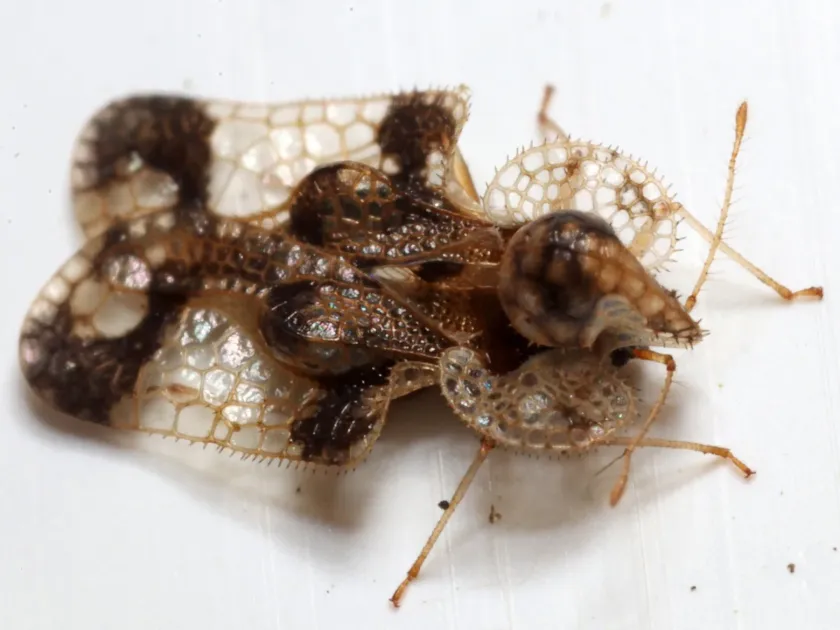
The walnut lace bug (Corythucha juglandis) is an insect species in the family Tingidae, order Hemiptera. It is named for the intricate, lace-like appearance of its wing covers and pronotum.
These insects are very small, typically measuring 3 to 4 millimeters in length. Their bodies are flattened, and they possess semi-transparent wings with dark brown markings, allowing them to blend in with leaf surfaces.
Eggs are dark, cylindrical, and laid in clusters on the undersides of leaves, often near the leaf veins. Nymphs, the immature stage of the insect, have spiny bodies and undergo five molts before reaching adulthood.
Adult females overwinter in protected areas, including bark crevices, leaf litter, or under debris near the base of the host trees, emerging in the spring when temperatures rise.
The life cycle involves multiple generations per year depending on the climate. Warm summers often lead to population explosions, as the insects reproduce rapidly on the foliage of the host tree.
What it damages
The primary hosts for Corythucha juglandis are black walnut (Juglans nigra) and butternut trees. Occasionally, they can also be found on Persian walnut and other deciduous trees like linden or willow.
Damage is caused by both adults and nymphs, who use their piercing-sucking mouthparts to feed on the leaf sap. This feeding process destroys the chlorophyll-containing cells of the foliage.
The loss of sap leads to the stippling or bleaching of the leaves. As feeding continues, these spots coalesce, turning the entire leaf yellow, bronze, or brown, and significantly reducing the tree's photosynthetic capability.
Severe infestations frequently result in early leaf drop, which weakens the tree significantly. A tree losing its foliage in mid-summer is unable to produce sufficient carbohydrates for the upcoming winter.
Persistent stress from lace bug feeding makes the trees more susceptible to secondary infections, such as cankers or other diseases that thrive on weakened plant tissues.
Signs of infestation
The most noticeable symptom is the presence of small, pale, or yellowish spots (stippling) on the upper surface of the leaves, which are caused by the bugs feeding underneath.
The undersides of the leaves become infested with small, shiny black droplets of excrement and discarded nymphal skins, giving the foliage a dirty or scorched appearance.
Heavily infested leaves often wilt, curl, and turn brittle. The overall appearance of the tree becomes thin and sickly, losing its natural healthy luster long before autumn.
- Light, chlorotic spotting on the top of leaves.
- Visible black excrement and molted skins on leaf undersides.
- Premature browning and leaf fall in late summer.
Inspecting the underside of the leaves reveals clusters of small black eggs and moving nymphs, which confirms the presence of the lace bug infestation.
Control measures
Sanitation is a vital first step; raking and removing fallen leaves in the autumn reduces the number of overwintering sites, significantly limiting the population for the next spring.
Chemical control with systemic or contact insecticides is effective if applied early in the season when the first generation of nymphs hatches. Proper timing is critical for success.
When applying sprays, it is essential to ensure thorough coverage of the underside of the leaves, as the insects remain there throughout their feeding cycles.
Encouraging beneficial predators like lacewings, lady beetles, and pirate bugs can help naturally suppress lace bug populations in gardens where chemical usage is minimized.
Regular monitoring starting in late spring allows gardeners to spot initial outbreaks before they develop into widespread infestations, saving the tree from significant vigor loss.
Taxonomy
- Latin name
- Corythucha juglandis
- Order
- Hemiptera (bugs, aphids, leafhoppers)
- Family
- Tingidae
- EPPO code
- CRTHJU
Discussion
No discussions yet — be the first.