
Quince lace bug
Corythucha cydoniae
Description
How to identify
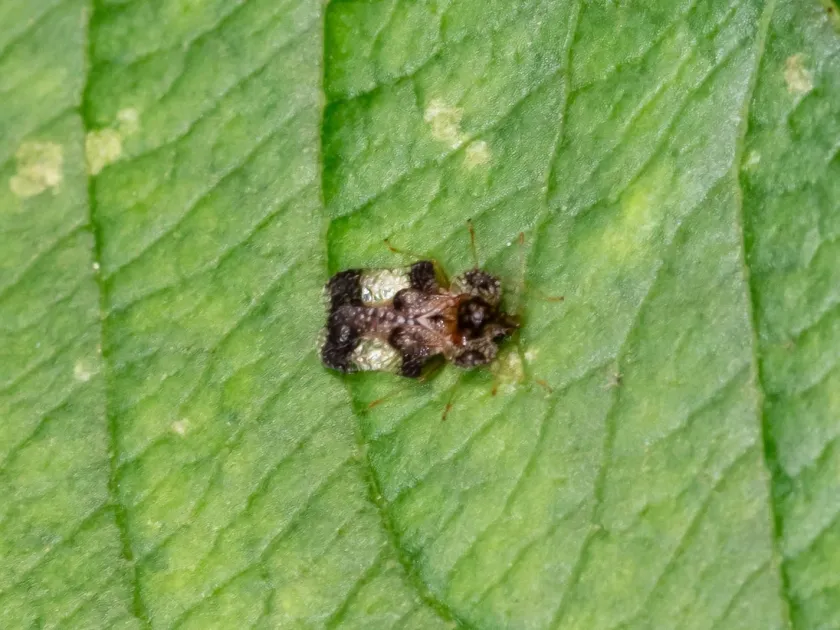
The Quince lace bug (Corythucha cydoniae) belongs to the family Tingidae. It is easily recognized by the intricate, net-like appearance of its wings and pronotum, which resemble delicate lace.
Adults are small, typically measuring 3–4 mm in length. Their body coloration is generally creamy or brownish, often with dark spots on the wings that help them blend into the leaf surface.
Eggs are laid in clusters on the underside of leaves, often embedded in a dark, sticky secretion. This secretion hardens and helps protect the eggs from predators and environmental stress.
Nymphs go through several developmental stages. They look similar to adults but are wingless, smaller, and covered in distinctive spines, which provide a defensive mechanism against some predators.
The taxonomic classification places them in the order Hemiptera. Their specialized mouthparts, designed for piercing and sucking plant sap, are a characteristic feature of this insect group.
What it damages
This pest targets a variety of plants within the Rosaceae family. The most common hosts include quince (Cydonia), hawthorn (Crataegus), cotoneaster, pear, and serviceberry (Amelanchier).
Both adults and nymphs feed on the leaves. They insert their stylets into the mesophyll cells and extract sap, which leads to the destruction of chlorophyll-rich tissues.
Initial feeding causes small yellow spots on the upper leaf surface. Over time, these spots merge, leading to a general loss of green color and reduced photosynthetic efficiency for the plant.
Heavy infestations can result in severe defoliation during mid-summer. This premature leaf drop stresses the tree, making it vulnerable to cold damage during winter and reducing fruit production.
Beyond plant health, the aesthetic damage is significant for ornamental varieties. The leaves lose their natural color, become discolored, and look unhealthy, detracting from the landscape's appearance.
When it appears
The Quince lace bug overwinters as an adult, typically hiding in protected areas such as bark crevices, leaf litter, or under debris near the base of the host tree.
Activity begins in spring as temperatures rise. Adults emerge to feed and begin laying eggs on the newly developed leaves, marking the start of the first generation of the season.
The life cycle is temperature-dependent, allowing for multiple generations per year in warmer climates. Populations tend to peak in mid-summer when conditions are optimal for nymphal development.
Activity continues throughout the summer and into early autumn. As days shorten and temperatures drop, adults begin searching for suitable overwintering sites for the cold season.
Regular scouting is recommended starting in late spring. Monitoring the underside of leaves allows for early detection before the population reaches an uncontrollable level.
Signs of infestation
A classic sign of lace bug activity is the appearance of mottled, bleached, or chlorotic spots on the upper side of the foliage, which is often mistaken for a nutrient deficiency.
The underside of the leaf provides the most evidence. You will see groups of insects, cast-off skins (exuviae), and small, dark, shiny droplets of excrement stuck to the leaf surface.
Leaf curling and brown, dried edges are common symptoms in the later stages of infestation. In severe cases, the entire leaf may take on a papery, silver-bronze appearance.
Reduced vigor and stunted growth of young shoots indicate long-term feeding damage. Trees that suffer from chronic infestations may exhibit poor bloom quality in the following year.
If you tap a branch over a white piece of paper, you can often dislodge the insects, making it easier to confirm the presence of a colony even if they are well-hidden.
Control measures
Sanitation is a critical management tool. Collecting and disposing of fallen leaves in late autumn reduces the number of overwintering adults that will emerge the following spring.
Chemical control should be implemented when scouting indicates a large population. Systemic insecticides are highly effective as they move through the plant tissues to reach the feeding insects.
When applying contact insecticides, full coverage is mandatory. Ensure the spray reaches the underside of the leaves, as the insects congregate and feed primarily in those protected spaces.
Biological control agents, such as lacewings and lady beetles, play an important role in suppressing lace bug numbers. Avoiding broad-spectrum pesticides helps maintain these natural predator populations.
- Maintain tree health through proper irrigation and fertilization.
- Use a strong stream of water to dislodge and kill nymphs during early infestation stages.
- Apply horticultural oils or soaps to reduce pest numbers without harming beneficial insects.
- Rotate insecticides with different modes of action to prevent the development of resistance.
Taxonomy
- Latin name
- Corythucha cydoniae
- Order
- Hemiptera (bugs, aphids, leafhoppers)
- Family
- Tingidae
- EPPO code
- CRTHCY
Discussion
No discussions yet — be the first.